
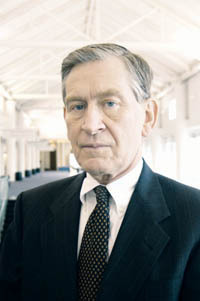
Gary Sasse has been promoting fiscal restraint in Rhode Island for almost three decades.
For more than three decades, Gary S. Sasse and his team at the Rhode Island Public Expenditure Council have tracked state and local government taxes, spending and the forces that shape them.
The business-backed think tank also has advocated for fiscal restraint and for lower taxes. After documenting the high tax burden that wealthy Rhode Islanders bear, Sasse urged state leaders to cut the top marginal income tax rate for the sake of economic competitiveness. This year, he has been at the forefront of an effort to amend the Rhode Island Constitution to limit annual spending increases at the state and local levels.
With the legislative season nearing its end, Sasse spoke with Providence Business News about the progress made this year and what he still hopes to accomplish.
PBN: You’ve just put out a new report showing the tax burden in Rhode Island is the seventh-highest in the country, $120.35 per $1,000 of personal income in 2004, compared with a U.S. average of $110.33 and $105.77 in Massachusetts. Has it been growing each year?
SASSE: If you look at it over the last 10 years, from fiscal 1994 to 2004, our relative tax burden has grown significantly. Ten years ago, [by that measure], Rhode Island was 19th-highest; we were just a little bit above the national average. Ten years later, it’s seventh-highest. So you see a gradual increase.
PBN: And it’s increased in all three major categories: property, income and sales taxes.
SASSE: In property tax collections, we were eighth-highest 10 years ago, and now we’re fifth-highest. And if you look at personal income tax collections, we’ve gone from 25th to 20th.
PBN: How do you stop these trends?
SASSE: I say we don’t have a tax problem – we have a spending problem. And the way you begin to rein this in is to look at the experience in other states in putting in effective limitations on the growth in property taxes.
PBN: We have two different proposals on the table to do that: the one RIPEC, the governor and several business groups have put forward, to pass a constitutional amendment to limit state and local spending growth, and a more limited proposal passed by the state Senate. Could the Senate proposal be enough?
SASSE: We strongly support the state Senate proposal. We think it addresses the right issues. It addresses the issues of closing loopholes in the existing property tax cap; it addresses the issue of benchmarking growth in school spending; it deals with [unfunded] mandates; it deals with clarifying when communities can override the cap. So the Senate bill is a very good taxpayer piece of legislation. The difference with the constitutional amendment is that it would have to be approved by the people, but it would also be more difficult to change [back]. A statute can always be amended. As a practical matter, a constitutional question is not going to be put on the ballot, and progress can be made [this year] by enacting the statute.
PBN: But ultimately, you think we need a constitutional amendment?
SASSE: I think it needs to be considered, yes.
PBN: Can you really limit spending, especially at the local level, without hurting the school kids?
SASSE: The objective of these proposals is not to make government less compassionate or have government invest less in necessary public services. The objective is to recognize that the cost of government should not exceed the ability of people, taxpayers, to pay for it, and also to build into the system some incentives for government to operate more efficiently and get more bang for the buck. … In terms of per-pupil spending, Rhode Island is the seventh-highest in the country, and yet our performance doesn’t equal the investment that we make. We have 39 school districts in a very small geographic area. We just issued a report with the Rhode Island Association of School Committees that suggested, just by sharing of services and cooperative arrangements, we could save $100 million, about 3 to 5 percent of school spending.
PBN: The House leadership had its own tax-cutting plan this year, backed by the Greater Providence Chamber of Providence, and a lot of it made it into the House budget. Is it a good tax reduction package?
SASSE: I think it accomplishes several objectives. One was to make the state tax structure more competitive. In a report that RIPEC published in 2000 called “A System Out of Balance,” we noted that … we had to address the top marginal rate. The House proposal did that, and I think that certainly should be viewed as a positive step to improve the economic competitiveness of the state. But also, at the same time, one has to recognize that for every $1 that Rhode Islanders spend in taxes, 42 cents is for the property tax. Property taxes affect locational decisions of businesses. They affect the affordability of housing. … When you have a system where the property tax generates as much money as the income and sales tax together, that’s a clue that the system is out of balance.
PBN: Have we made real progress this year?
SASSE: It’s been mixed. I think if we’re able to get the property tax limitation bill, [plus] there was an article included in the budget that would put a constitutional amendment on the ballot to reform the rainy day fund along the lines that we had suggested … there’s an opportunity to make substantial tax reform with the Senate bill and the House budget; there were some reforms to the Family Independence Plan … so those are positives. But there’s still a lot to do in terms of entitlement and personnel reform. So there was progress this year, but there’s still a lot we need to improve.
INTERVIEW
Gary S. Sasse
Position: Executive director, Rhode Island Public Expenditure Council
Background: Sasse has led RIPEC since 1977, overseeing a wide range of research and policy analysis projects and advocating for fiscal responsibility. He has led commissions to reform government operations and education and been a fixture at the State House. Prior to RIPEC, he was associate chief administrative officer for the city of Memphis, Tenn., and director of the Tennessee Office of Urban and Federal Affairs. He is also an adjunct lecturer of public policy at the Kennedy School of Government at Harvard University.
Education: B.A. in government, Florida State University, and M.P.A. (master’s in public administration) from the University of Missouri–Columbia.
Residence: East Greenwich
Age: 62