
With seven agencies responsible for maintaining and protecting Rhode Island’s major waterways, lawmakers eventually realized someone needed to coordinate the agencies’ efforts.
The R.I. Bays, Rivers and Watersheds Coordination Team was created by the legislature in the aftermath of the Greenwich Bay fish kill of August 2003, when more than 1 million fish were killed by a sudden plunge in the bay’s oxygen level.
Subsequent investigations led to calls for more collaboration between agencies. In 2004, Rep. Eileen Naughton, a Warwick Democrat, passed a law creating a permanent office to coordinate their efforts. The coordination team released a 140-page report over the summer which sets out the state’s first unified plan for water management, from 2009 through 2013.
The plan lays out the role each state agency plays in implementing pollution control and fisheries restoration strategies, among other efforts. It also identifies topics that agencies should focus on as they plan future research projects.
“Rhode Island’s bays, rivers and their association watersheds are our most precious natural resources,” Naughton said after the report was released. “Critical to their preservation is a coordinated approach to their management.”
The team’s membership demonstrates just how spread out the responsibility for water management is in Rhode Island. It includes the R.I. Coastal Resources Management Council, the R.I. Department of Environmental Management, the R.I. Department of Administration, the R.I. Water Resources Board, the R.I. Rivers Council, the R.I. Economic Development Corporation and the Narragansett Bay Commission.
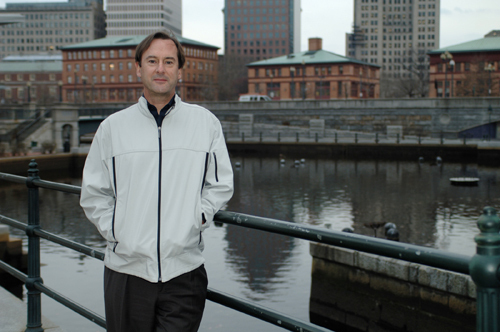
Ames Colt, the coordination team’s chair, said Rhode Island’s effort has a broader mandate than similar groups in other states, which focus solely on environmental concerns. “We’re trying to go a little further than that,” he said, by also looking at recreation, tourism, marine activities, fishing and other coastal real estate.
“It’s an effort by these state agencies to sit down together and work out what their key long-term priorities are, and how they relate to each other,” said Colt, a former researcher at Rhode Island Sea Grant who was appointed to chair the coordination team by Gov. Donald L. Carcieri.
Save The Bay Baykeeper John Torgan, who served on the legislative commission that helped create the coordination team, described it as “a meta-agency – sort of an agency of agencies.”
“There were so many disjointed efforts, and it’s important to coordinate,” he said. The team’s creation also emphasizes the importance of protecting watersheds in order to keep larger bodies of water healthy, he said.
Just as there is no shortage of agencies looking out for the state’s water resources, there is also a variety of different plans for managing those assets, from Special Area Management Plans for specific zones to the 1992 Comprehensive Conservation and Management Plan for Narragansett Bay. Although there is a perception that the agencies’ mandates overlap, Colt said he has not seen much evidence .
The coordination team’s 2009-2013 plan is an effort to take all of these efforts into account and synthesize them, Colt said, calling it “a plan of plans.” It will also help agencies guide their budgeting this fall, particularly as they are forced to prioritize and trim their plans in the face of the state’s budget shortfall, he said.
Richard Ribb, program director of the Narragansett Bay Estuary Program, said the coordination team should help to reduce the balkanization of various agencies, and hopefully will eventually lead to the streamlining of permit reviews and other processes.
“Efficiency is the watchword we’re working under, and we’ve found that collaboration is really the way to get that here,” Ribb said. •


