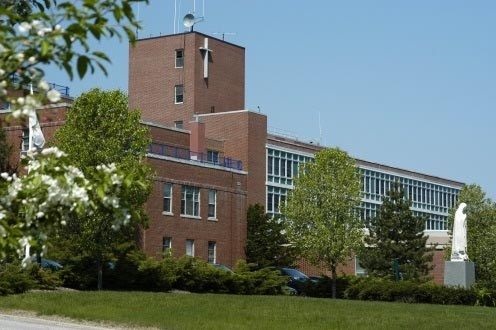
Saving Roger Williams Medical Center and Our Lady of Fatima Hospital will end up costing four times the value of the bonds used to finance the sale to new owners, according to a final pricing report shared with the state’s quasi-public financing agency Wednesday.
A copy of the report by Acacia Financial Group, the corporation’s financial adviser, was obtained by Rhode Island Current.
Selling Luxury Real Estate Requires More Than Exposure
By Emilio DiSpirito IV License Partner | Private Office Advisor Engel & Völkers Oceanside www.DiSpiritoteam.com…
Learn More
The R.I. Health and Educational Building Corporation sold $101 million in taxable and tax-exempt bonds on Feb. 25 on behalf of The Centurion Foundation, which bought the pair of Rhode Island hospitals from bankrupt former owner, Prospect Medical Holdings. The deal closed on March 6, the final day possible under the deadline mandated by the federal bankruptcy judge overseeing Prospect’s Chapter 11 proceedings.
State leaders and hospital executives celebrated the long-awaited completion of the sale as a new beginning for the cash-strapped hospitals, which otherwise were at risk of closure. The two hospitals account for more than 500 hospital beds and 50,000 annual emergency room visits between them, with critical specialties in cancer treatment and in-patient psychiatric care. Together they employ 2,400 workers.
Also on the horizon: three decades of debt service payments totaling $408 million. The first payment is due Oct. 1.
Centurion, through its Rhode Island subsidiary, CharterCARE Health of Rhode Island, is on the hook for the majority of the money, which includes $318 million in principal and interest on the bonds, plus two outstanding federal property loans it took over from Prospect.
But state taxpayers could end up shouldering some of the burden – up to $18 million – under a reserve account authorized by the General Assembly and signed into law in February. The state contribution is a secondary backup for annual debt service payments on the bonds. It would only be tapped if Centurion doesn’t have the operating revenue and if Centurion has already drained a separate, primary $9 million reserve of its own, set up from bond sale proceeds.
The state funding cannot be used to pay off the debt on $2 million of subordinate bonds purchased by CharterCARE to show its stake in the deal. Nor will taxpayers be responsible for repaying the nearly $90 million owed in federal infrastructure loan debt, originally owed by Prospect, which Centurion agreed to pay back as part of the deal to buy the hospitals.
Including the two federal loans through the Property Assessed Clean Energy program, Centurion’s 30-year debt repayment plan exceeds $408 million, paid out through Sept. 30, 2057.
The biggest chunk of the debt service comes from the $93.3 million in tax-exempt bonds, which carry a fixed 8.5% interest rate, although a call provision allows Centurion to refinance at a potentially lower interest rate in 15 years. The $6.75 million in taxable bonds used to finance the hospital sale have a 12.5% interest rate, but can be paid off early with a lump sum based on the net present value.
The high interest rates were not unexpected. Preliminary projections by Acacia in August showed similar debt repayment totals, reflecting an investor market wary of the hospitals’ sullied financial history and Centurion’s lack of experience — the Atlanta nonprofit has never run a hospital before. After an initial, failed public bond sale, several revisions to the terms of the agreements between Centurion and state regulators, and multiple court deadline extensions, four unnamed, private investors were finally secured in January.
The buyers remained unidentified, though Acacia’s report describes them as “qualified,” and later, “sophisticated institutional investors.”
Ben Mingle, CEO for Centurion, also declined to identify the investors when asked during a press event marking the sale closure on March 6. But, Mingle and other CharterCARE executives assured state lawmakers during February hearings on the requested state contribution that the nonprofit had no intention of not making the debt payments.
Returning the hospitals to nonprofit status is expected to save CharterCARE $75 million annually, including money for prescription drugs through the federal 340B program. Subtracting the roughly $45 million annual operating losses, that leaves $30 million for debt service payments and operating expenses, alongside capital projects, according to projections shared by CharterCARE.
A spokesperson for CharterCARE did not immediately respond to inquiries for comment Thursday.
Nancy Lavin is a senior staff writer for the Rhode Island Current.
(Correction: An earlier version of this story contained an inaccurate multiple in the lead sentence.)