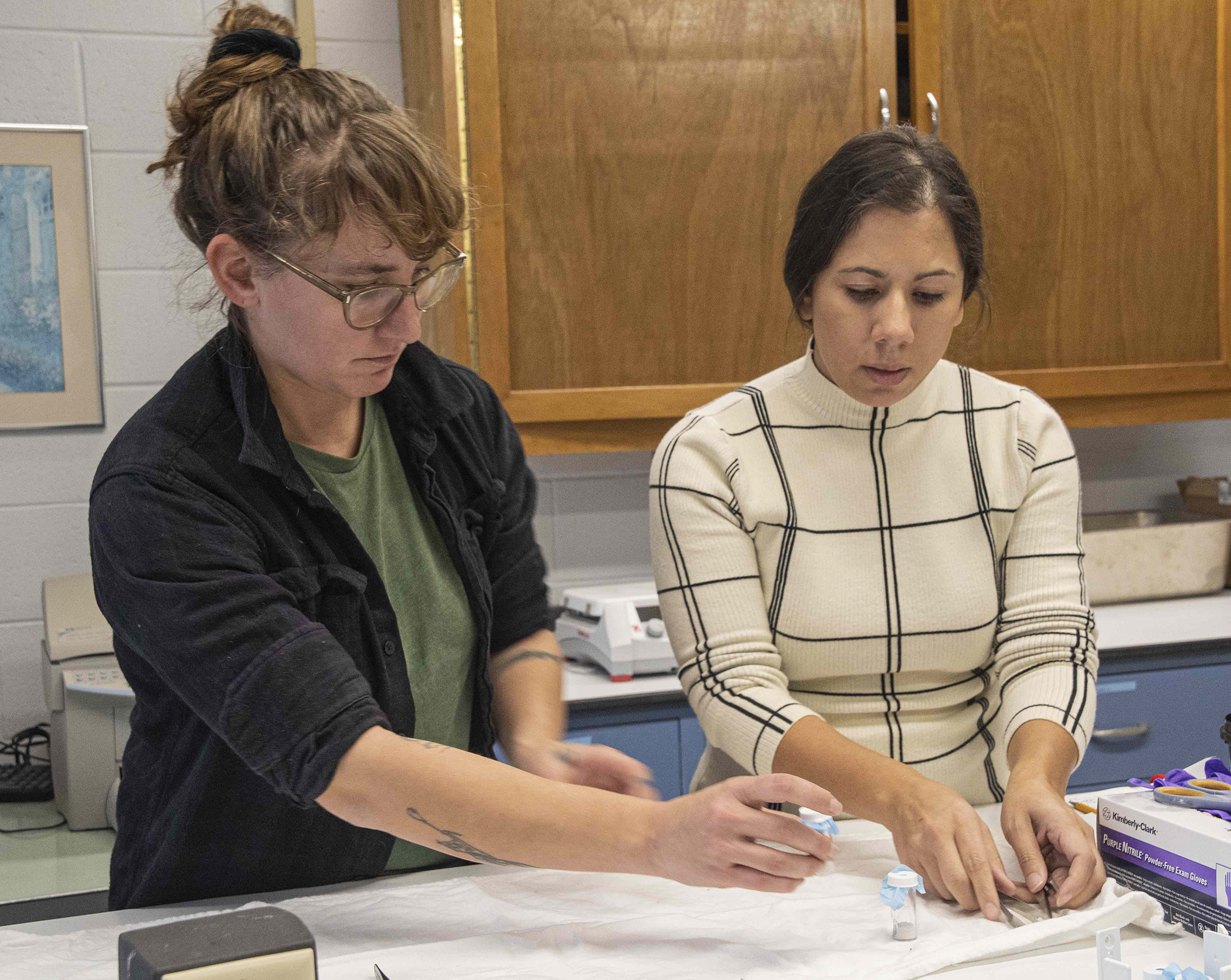
SOUTH KINGSTOWN – A University of Rhode Island entomologist is seeking to better understand the bacteria that causes Lyme disease by taking a view of the deer tick. Now, she will have a seven-figure federal grant to take a deep dive in how the bacteria operates.
The university announced Wednesday that Jannelle Couret, an assistant professor of biological studies at URI, has received a four-year, $2.6 million National Institutes of Health grant to research the ecological factors that drive the evolution of Borrelia burgdorferi, the bacteria within deer ticks which is a pathogen that causes Lyme disease in humans, but does not directly cause the disease. The grant, URI said, is part of the Ecology and Evolution of Infectious Disease, which is run by the NIH, the National Science Foundation and the U.S. Department of Agriculture.
URI says deer ticks acquire bacteria that causes Lyme disease during any of its life stages during a blood meal from white-footed mice, the primary carriers of the Lyme bacterium. Deer ticks are responsible for approximately 95% of the tick-borne diseases in the U.S., including about 30,000 annual reported cases of Lyme.
Between 2008 and 2020, there have been 8,490 cases of Lyme in Rhode Island, according to data from the U.S. Centers for Disease Control and Prevention.
Couret, URI said, will work with professors from Yale Medical School, Michigan State University and the University of Florida, along with student trainees, on this project. URI said the researchers will explore relationships of many influences on the bacteria within deer ticks. They will look into environmental factors, such as temperature and humidity; ecological facets, such as the tick’s microbiome; and the bacteria’s interactions with other organisms in the tick.
When the research is completed, the study, URI said, will greatly expand the understanding of the factors driving the maintenance of Lyme disease in wildlife.
“We’re studying the effects of the bacteria on ticks at different levels, from gene expression to behavior,’’ Couret said in a statement. “We’ll combine that information to look at the evolutionary fitness of ticks, and model the impacts of bacteria on annual tick populations. We also are considering the microbiome. We want a really comprehensive view of the ensemble of ecological interactions that influence ticks, Borrelia burgdorferi, and their partnership.”
James Bessette is the PBN special projects editor, and also covers the nonprofit and education sectors. You may reach him at Bessette@PBN.com. You may also follow him on Twitter at @James_Bessette.