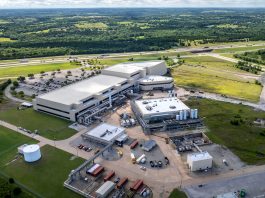
Lonza Biologics Inc. is part of a bustling new life sciences economy. Based in Switzerland, with a local plant in Hopkinton, Mass., the company manufactures biopharmaceuticals on contract for small firms. It’s highly specialized, tightly regulated, ever-changing work.
As new contracts come in, Lonza has to hire scores of new workers. And even if they have experience in this field, they need specialized training for each project.
But Lonza can’t afford to train employees on the job; the lab work is too sensitive. It could build its own training facility, but that would be cumbersome and costly. So for the last six months, it’s been sending new hires to Providence.
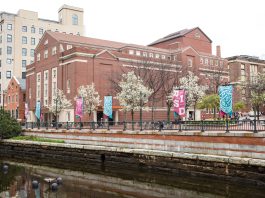
In intensive two-week sessions on the University of Rhode Island’s Feinstein Providence Campus, they learn key biotech manufacturing processes – from chromatography to membrane filtration – and most important, how to work in a tightly controlled “clean” environment.
It’s like a “biotech boot camp,” said Professor Gregory E. Paquette, director of biotechnology and the clinical laboratory science program at URI. Taught mostly by experts from the industry, plus two URI professors, they simulate in the lab what they will do in real life at Lonza.
“We kind of take them from A to Z on what biopharmaceutical manufacturing is,” he said. “They’re working with bioreactors, which is what you grow the genetically engineered cells in … they’re working with very sophisticated protein purification equipment … but we’re doing it on a small scale, and then when they go back to Lonza they’ll go from a one-liter bioreactor to a 5,000-liter bioreactor, but the principles are the same.”
URI has signed a three-year, roughly $1.2 million deal with Lonza, which is the world’s largest contract biopharmaceutical manufacturer, Paquette said. But far more than money is at stake; with Lonza, URI is also moving into a new sphere in work force development.
Biotech work force training is still a relatively new field for URI. When the university first started focusing on biotech, it developed just a master’s program for professionals wishing to expand their credentials. Then, about five years ago, it worked with industry leaders to develop a bachelor of science program to start growing the entry-level work force.
“Once that was in place, industry said, ‘That is great but the next thing we need is training, because the field changes so rapidly,’ ” Paquette recalled. “It’s kind of like the wild, wild West – just when you learn something, you’ve got to start learning the next thing.”
URI responded by creating new workshops, offered about three times a year in the same labs used by undergraduates and taught by biotech professionals plucked out of companies throughout the region. And when Alexion Pharmaceuticals Inc. opened a facility in Smithfield, URI designed a two-week program to train the new workers.
Lonza, however, has taken the industry training program to a new level by creating a steady demand for these workshops, Paquette said, to the point that URI needed extra lab space.
So Lonza’s contract with URI includes a $100,000 donation to the university that, combined with about $150,000 in other funds, has now made it possible to build out a 2,400-square-foot lab in the Shepard Building that is specifically for industry training.
That, in turn, allows URI to further expand its industry offerings, Paquette said. And the demand is there: Despite the region’s wealth of life sciences academic programs and companies, there are actually no industry training facilities like this, he said – the closest are in Baltimore and North Carolina. “So as the word is getting out that we’ve got this URI biotech training center,” he said, “we really expect it to grow.”
In addition, Paquette said, the Tech Collective has been doing a biotech industry skills-gap analysis for the Governor’s Workforce Board, and URI has not only been involved in the project, but also expects to benefit from one of its key findings – that more training is needed.
“The most significant thing missing in the region is a good, solid, ongoing biotech industry training facility, so we expect that to give our programs a big shot in the arm,” he said. URI could also qualify for new funding, he added, as the state seeks to boost work force training.
In a news release about the new lab last week, Jeffrey R. Seemann, dean of URI’s College of Life and Environmental Sciences, said the facility “is critical to the growth of the biotechnology industry in this region,” especially when combined with the city’s, Lifespan’s and Brown University’s efforts to grow the biotech industry.
“By doing this,” he added, “we will have helped to reposition Rhode Island as a key player in generating the kind of work force necessary to build a 21st-century innovation economy. … Undoubtedly, these activities will positively impact our state’s economy – and image – for decades to come.” •