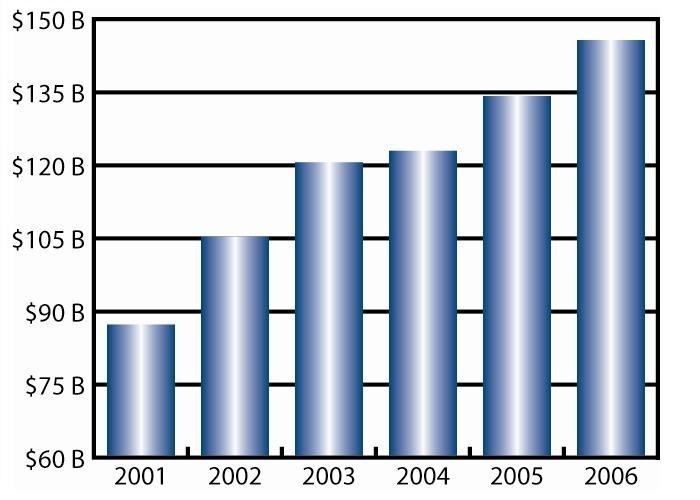
The U.S. banking industry broke earnings records in 2006 for the sixth year in a row, but much of that profit occurred at the largest banks in the nation, while community banks struggled to compete in an increasingly tough industry.
Earnings at federally insured banks and thrifts jumped 8.8 percent last year to a record $145.7 billion, despite a challenging interest-rate environment that increased the cost of deposits and slowed loan growth, the Federal Deposit Insurance Corporation said last month.
Across the nation, big banks boosted their earnings through acquisitions of other banks and through interest and fees on credit cards, wealth management revenue and other activities, the FDIC reported.
But the share of banks whose earnings increased in 2006 dropped, as regional and community banks that depend more on interest income struggled to repeat their 2005 performances.
Rhode Island’s banking market offered a snapshot of the national trend, with Bank of America, the nation’s largest bank and No. 2 in the state, thriving in 2006, while major community banks such as Bank Rhode Island and BankNewport saw profits drop.
Bank of America posted record earnings of $21.13 billion last year – a 28-percent increase from 2005 – reflecting a boost from the 2005 acquisition of credit card issuer MBNA Corp. as well as a 52-percent gain in non-interest income.
Citizens Financial Group, meanwhile, parent of Citizens Bank and part of the Royal Bank of Scotland, last week reported only a 2-percent earnings gain for 2006, to $2.92 billion, despite a 4-percent increase in average deposits and a 10-percent increase in average loans.
Chairman and CEO Lawrence K. Fish said in a statement that he was “particularly pleased with our performance and growth in our lending and deposit businesses despite continued interest rate margin pressure that is impacting the entire banking industry.”
Non-interest income rose by 9 percent, Citizens said, to $2.27 billion, and business and corporate non-interest income “rose strongly,” especially in foreign exchange, interest rate derivatives and cash management. Citizens also added 20 percent more credit card customers.
Both Citizens and Bank of America declined comment for this story.
BankNewport, meanwhile, a Middletown-based mutual savings bank with $1.03 billion in assets as of Dec. 31, saw earnings decline 25 to 30 percent last year, said Thomas W. Kelly, the bank’s president and CEO.
“Generally speaking, the larger you get, the more profitable you are,” Kelly said.
BankNewport’s 2006 earnings were negatively affected by one-time expenses, including the bank’s sponsorship of the U.S. Women’s Open and a major computer conversion that cost several hundred thousand dollars, Kelly said.
Still, those costs did not entirely account for the earnings decline last year, he said. The bank simply doesn’t have the means to break into many of the nontraditional, fee-based businesses that are generating record profits for larger banks, he said.
“We just don’t have the critical mass to do some of the big things,” Kelly said. “The credit card business is a big-bank business – it takes lots of volume. And there’s other things – the investment banking activities that they do, you know, you get into international services and money desk operations and trading currencies. That is making a difference for them.”
Even banks with more robust commercial loan portfolios are losing ground in the challenging interest rate environment. Providence-based BankRI’s profits declined 19 percent in 2006, despite the fact that the bank grew its commercial loan portfolio by 19 percent.
“As a young bank we are very margin driven, interest rate driven,” said Bill De Witt, spokesman for the company. “Once the interest rate environment corrects itself, we should be able to translate that increased balance sheet into better earnings.”
Interest rates have been especially tough on banks in New England, where net interest margin is as much as 80 basis points lower than the national average, said Kelly of BankNewport.
“That’s a lot,” he said. “On a billion-dollar bank our size, that’s $8 million pre-tax we don’t have that a bank our size … outside of New England would be earning. After tax, that’s probably another $5.5 million to our bottom line.”
For the smaller banks, stagnant profits and difficulties competing with the giants can pose a threat to their survival. Some try to bolster their position by merging with one another – as NewportFed and Westerly Savings Bank did.
Others become targets for acquisition, such as BankRI, which is facing pressure from PL Capital LLC, an Illinois investment firm with a history of forcing bank sales and mergers that calls BankRI underperforming and plans to seek two seats on the board this spring.
Banks that manage to diversify their revenue do far better. The Washington Trust Co., Rhode Island’s largest independent bank, with $2.40 billion in assets as of Dec. 31, grew its earnings by 8.7 percent in 2006 to $25 million, mostly through its wealth management business and other sources of non-interest income, such as credit card merchant processing services.
The numbers reflected the first full year of operations since the bank acquired Weston Financial in 2005 – a move that John C. Warren, Washington Trust’s chairman and CEO, called “an outstanding investment for us.”
“Probably the best business area we had was obviously the wealth management business,” Warren said. “Our fee income for the year – which includes wealth management and other things – is now to the point that it’s 41 percent of our revenues, and obviously the markets had a good year.”
Few object to banks’ boosting their profits on those fronts, but when it comes to fees and interest charged to customers, some consumer advocates and government officials in Rhode Island and across the nation are starting to push back.
With some banks charging customers who’ve missed a payment or had their credit scores decline interest rates in the mid-20s and even above 30 percent, two separate bills have been introduced this year in the General Assembly that would cap interest rates.
State Sen. James C. Sheehan, D-Narragansett, is proposing to cap the rates that can be charged to Rhode Island customers at prime plus 10 percent or 24 percent, whichever is lower. “No one is trying to meddle with this industry’s right to make a buck, but we also have a responsibility to protect citizens from unfair actions, and I can’t think of much that’s more unfair than gouging consumers,” Sheehan said in a statement.
Attorney General Patrick C. Lynch also has introduced a bill to cap interest rates at 21 percent – the rate the state defines as “usurious” for all but credit card issuers.
“It’s time to put a stop to the ‘carte blanche’ environment enjoyed by banks and other lending institutions that enables them to charge exorbitant and usurious credit card rates to Rhode Island residents,” Lynch said in a news release.
“The law, as it currently stands, adversely affects all income levels but, most of all, it hits hard-working Rhode Island families and the economically poor,” he added. “Passage of this bill will put an end to this unfair and outrageous practice.”