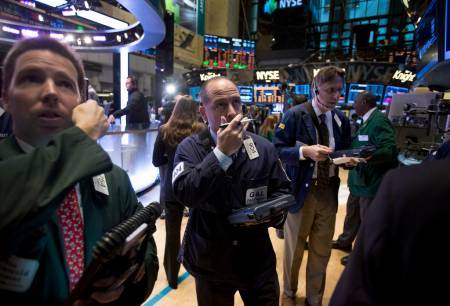
NEW YORK – U.S. stocks were little changed, after last week’s advance in the Standard & Poor’s 500 Index, as Americans prepared to vote in presidential elections and amid growing concern that Greece will struggle to win a bailout.
Time Warner Cable Inc. declined 6.3 percent amid disappointing earnings. Apple Inc. rose 1.3 percent as it sold 3 million units of its iPad mini and fourth-generation iPad during the debut weekend, saying demand for the smaller version of its tablet outstripped supply. KBW Inc. added 7.1 percent as Stifel Financial Corp. agreed to buy the boutique investment bank in a cash-and-stock transaction valued at $575 million.
The S&P 500 lost 0.1 percent to 1,413.46 at 10:44 a.m. New York time. The Dow Jones Industrial Average slid 10.65 points, or 0.1 percent, to 13,082.51. Trading in S&P 500 companies was 18 percent below the 30-day average at this time of day.
“People are more like holding their breath and turning blue,” said Madelynn Matlock, who helps oversee about $14.7 billion at Huntington Asset Advisors in Cincinnati. She spoke in a phone interview. “There’s concern about Europe. The market is looking like there’s some worry in Greece. There’s also the election in the U.S. That keeps investors on the sidelines.”
Equities we little changed as European shares dropped and the euro traded at an almost two-month low. Greek Prime Minister Antonis Samaras will this week battle to win political support for measures needed to obtain aid. U.S. voters decide tomorrow between giving President Barack Obama another four years in office or changing course with Republican challenger Mitt Romney.
Service industries
The Institute for Supply Management’s non-manufacturing index declined to 54.2 last month from 55.1 in September, the Tempe, Arizona-based group said today. Economists projected 54.5, according to the median estimate in a Bloomberg survey. Readings above 50 signal expansion in the gauge of industries that account for almost 90 percent of the economy.
The S&P 500 rose 0.2 percent last week as the market reopened after Hurricane Sandy caused the longest weather- related shutdown since 1888. The benchmark gauge for American equities has surged 12 percent this year as central banks around the world stepped up stimulus to boost the economy. About 70 percent of companies that released quarterly results have beaten analysts’ estimates, according to data compiled by Bloomberg.
“Markets are expected to remain mostly range bound today, with some more downside possible as investors tend to take money off the table, preferring to take a wait-and-see attitude until the picture is clearer,” Markus Huber, head of German sales trading at ETX Capital in London, wrote in an e-mail.
‘Top-heavy’
Time Warner Cable slumped 6.3 percent to $92.01. It lost 140,000 video subscribers, more than the 128,000 that analysts had estimated. Time Warner Cable has become “top-heavy” after shares gained more than 54 percent this year, Todd Mitchell, an analyst at Brean Capital LLC in New York, said in an interview before the results were released. Its operations also aren’t as strong as those of Comcast Corp., the largest U.S. cable company, he said.
Apple rallied 1.3 percent to $584.20, after slumping 4.5 percent last week. The shares capped a sixth weekly decline on Nov. 2 for the longest losing streak since October 2008. The company began selling the 7.9-inch tablet in the U.S. and more than 30 other countries on Nov. 2, ramping up an effort to fend off competition in the market for tablets, which NPD DisplaySearch predicts will more than double to $162 billion by 2017.
IPad mini
“Demand for iPad mini exceeded the initial supply and while many of the pre-orders have been shipped to customers, some are scheduled to be shipped later this month,” Cupertino, California-based Apple said today in a statement.
KBW jumped 7.1 percent to $17.46. Shareholders will receive $17.50 per share, comprised of $10 in cash and $7.50 in Stifel common stock, the companies said today in a statement. The deal values KBW 7.4 percent higher than its closing price on Nov. 2.
Swings in U.S. stocks have shrunk to the lowest level in six years, an indicator that has most often coincided with incumbent parties keeping the presidency in data going back to 1900.
The Dow has gained or lost 0.54 percent a day on average this year, the smallest fluctuations for an election year since George W. Bush defeated John Kerry in 2004, according to data compiled by Bloomberg. Daily changes have trailed the 112-year average of 0.75 percent in 13 of 17 instances when incumbents won, compared with six of 11 times the parties lost.
While volatility doesn’t predict winners, its decline shows less concern that prices will be whipsawed by economic news, a potential benefit for Obama. At the same time, the Dow’s 65 percent rally since he took office never pushed it above the record 14,164.53 reached in October 2007. No Democrat since World War II has held on to the White House with the Dow this far from its peak.
“The incumbent tends to get re-elected when the market is doing well,” James McDonald, chief investment strategist at Northern Trust Corp. in Chicago, said in a telephone interview. His firm manages $750 billion. “If the market has done well, that means the economy is doing well, that means the incumbent has a better chance.”