
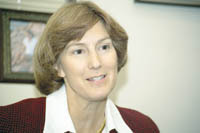
Women & Infants Hospital is abuzz right now: Its research programs are flourishing, bolstered by a federal Centers of Biomedical Research Excellence (COBRE) grant. Its outpatient services and outreach programs are growing. And most important, the 121-year-old hospital is planning its biggest construction project in two decades, a $64-million, five-story addition.
At the helm of it all is President and CEO Constance A. Howes, the first woman ever to lead the hospital where nearly 10,000 Rhode Islanders are born each year.
PBN: How’s your campaign going? How’s your expansion?
HOWES: That is the most exciting project we have going right now. We are currently before the Health Services Council seeking regulatory approval of the certificate of need for an addition to the building that will have a new neonatal intensive-care unit with the capacity for 80 babies. Right now we’ve been running at, on average, 65 babies a day.
PBN: Your project’s been compared to Rhode Island Hospital’s emergency room expansion.
HOWES: It’s different to provide emergency care and neonatal intensive care. It’s clear to me that no one would choose to have a baby in our NICU unless they needed to be there. The irony is, if we are not open to these patients … they will be transported to Boston or New Haven. We can’t just say, ‘Well, you don’t really need to be here.’ But if we build this, some of those people from Massachusetts and Connecticut can come here, and they help pay for the cost of those highly specialized services – it’s spread across a higher volume. So we do a better job the more patients we’re able to accept.
PBN: The concern may be that babies stay in the NICU longer than they need.
HOWES: Some people ask because the utilization of the NICU has grown tremendously – the number of days that babies spend in the hospital has grown. But that’s because the tinier babies are now surviving, where before they might have died.
PBN: Women & Infants is growing in other ways, like buying the building at 300 Richmond St.
HOWES: We unfortunately are in many different locations, over 20 different locations, and we are trying to (consolidate). That was done as a financial investment, because it made more sense to own than to rent. But what is driving most of our needs is that much of the care of individuals is moving from an inpatient setting to an outpatient setting, so we have a lot of ambulatory programs dispersed throughout Providence and the state.
PBN: How are you doing financially?
HOWES: We have had a history of discipline, principally from our board of trustees, that has required us to have a positive margin from operations. If you don’t have that, you can’t have a future. … You need to reinvest in equipment, you need to pay your employees a reasonable amount or you won’t have any employees left – in the environment we’re in. Rhode Island is on the lower end of the reimbursement scale, though, and that’s a real challenge. And the women’s services we offer are not necessarily high-end in terms of compensation. We don’t have the cardiac services, the orthopedic services that other hospitals may use to help with their bottom line, so it’s always a struggle. Plus about a third of our patients are Medicaid-eligible. We need to look to the government at times for help, and the disproportionate share payments help. We also are a teaching hospital, and unlike other teaching hospitals, whose payment for that comes from the Medicare program, we only have about 6 percent of our patients on Medicare. So the amount of money we receive from the federal government to support medical education is under $500,000 a year, and our costs are over $10 million.
PBN: How do you offset that?
HOWES: That’s the constant struggle. You have to either pay it from operations, or from grants, and we have really invested to recruit people who’ll do research that is externally funded. Or you have to look to philanthropy. Right now we’re raising over $16 million – that’s our initial working target – to help us build this building and be vibrant into the future. That’s going to be key for hospitals, to be able to look to the generosity of the community.
PBN: Do you think women’s health issues get the attention and financial support they need?
HOWES: Women’s health has always been almost a footnote. It started out when much of the research conducted on humans was done on males, and then people realized … there are some substantial gender differences: There are diseases that are much more prevalent in women, as well as conditions that can only apply to women. … It’s important to make sure (medical) research does justice to those differences. In general terms, some areas of women’s health care are not well-reimbursed. The classic case is mammography, a proven screening and diagnostic technique that can make a huge difference, and yet the reimbursement is so low, and the risk of malpractice is so high, that you have very few radiologists who are interested in going into that field.
PBN: Is it true that nobody wants to deliver babies anymore?
HOWES: Yes, it’s definitely a concern. When you look at the number of medical students applying for OB residencies, it has dropped from, I think, 7 percent to 3 or 4 percent. The reasons relate to lifestyle choices – it’s very hard being on call, overnight, for your entire career. It’s also a high-risk specialty.