Roger Williams Medical Center has completed a $1.9 million, 7,000-square-foot building addition that allows it to consolidate all its cancer services under a single roof, a priority for the hospital as it develops increasingly specialized surgical oncology services.
The addition, which was slated to be unveiled at a ceremony on Jan. 20 and open to patients the following day, is the second phase of a project that began several years ago with the construction of a new radiation oncology center.
Located on the hospital’s Elmhurst Campus in Providence, the center now includes a 12-bay chemotherapy infusion center, a pheresis room, a minor-procedure room, three physician offices, a pharmacy and support spaces. It will also serve patients preparing for and recovering from bone marrow transplants, and patients seeking a diagnosis and treatment of blood diseases and cancer.
“This is sort of the realization of a dream that we’ve had for some time,” President and CEO Kenneth Belcher said in an interview. “The vision was to bring all cancer services to one location for patient access and patient convenience. … We see this as an opportunity to refine our services and to collaborate with other institutions that serve our patients.”
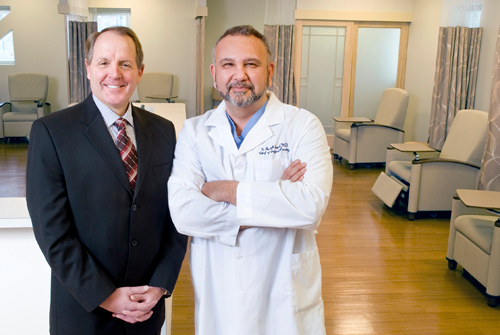
The new, expanded Adele R. Decof Cancer Center is also getting an interim director, Dr. N. Joseph Espat, who is already chief of surgical oncology at Roger Williams and vice chairman of the department of surgery – and a candidate in the search for a permanent director.
Trained at Memorial Sloan Kettering Cancer Center in New York, where he was a fellow in surgical oncology, Espat specializes in liver, pancreatic and other upper digestive system cancers. He was previously chief of hepatobiliary surgery and director of regional hepatic therapies at the University of Illinois at Chicago.
Since arriving at Roger Williams in 2007, Espat has helped put the hospital on the map in his specialty. In September 2007, he and fellow surgeon Dr. Ponnedai Somasundar performed the nation’s first laparoscopic bipolar radiofrequency liver tumor ablation, using a brand-new technology that Espat said is safer than conventional devices because it directs the tumor-killing energy directly at the tumor, and not around it.
Espat has also given Roger Williams an expertise in liver and pancreas cancer surgery that made it one of the top 20 hospitals in the nation for surgical volume in those specialties, he said.
If lesions are found early, before they become malignant, they can be removed safely with state-of-the-art laparoscopic surgery.
Those kinds of surgeries, he said, are now being done about once a week at Roger Williams.
Similarly, the hospital is doing a substantial number of laparoscopic liver resections, he said, and it’s the only facility offering that service “within several hundred miles.”
Having all oncology specialists under one roof, and with other medical specialists next door, is a big advantage, Espat said, because these kinds of cases require a wide range of expertise.
“When you take care of patients with gastrointestinal tumors, it is a team effort,” he said. “You need medical oncology, radiation oncology, bone marrow transplant salvage, interventional oncology … and we are all one very nice working team with tremendous collaboration, not just internally, but also outside the hospital.”
Asked whether Roger Williams could become a high-volume cancer treatment center, Espat said he hopes so.
“Cancer care is very much like a ‘Field of Dreams’: If you build it, they will come. But you have to build a quality program and make it accessible for patients,” he said.
“The technology that we now have available for treating patients who were told to go home and die just 10 years ago … it’s an exciting time in medicine,” he said. •