
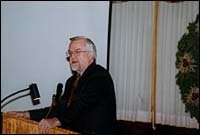
Garfield Manhood
His audience was clear — Rhode Island’s top tobacco control activists, in a conference sponsored last month by the Rhode Island Department of Health.
But the message from Garfield Mahood, premier Canadian anti-smoking activist, was even clearer, regarding success in the fight against premature deaths caused by cigarettes:
Focus on the product, not the behavior.
And target not the smokers, many of whom will never be able to quit, but on the tobacco industry that makes the products that are killing them.
It’s a subtle but powerful difference, one that Canada’s newest cigarette pack warning labels use effectively.
Beginning Dec. 31 new warnings on cigarette packs sold in Canada will occupy 50 percent of both major faces of the pack, and for the first time will use color pictures and graphics, in a world-precedent-setting effort that Mahood said should “revolutionize” international tobacco control efforts.
The new Canadian warnings will also contain explicit warnings inside each pack including quitting information and toxic constituents in cigarettes and new warnings outside, including a couple that graphically and glossily present lung and oral tissue ravaged by smoking.
In total, Mahood said, 32 new warnings will be used inside and outside cigarette packs and will essentially cripple what for tobacco companies is their greatest and most ubiquitous form of advertising.
“The industry is not happy,” he said, but “all we’re doing is forcing the industry to tell the truth.”
Mahood, leader of the Non-Smokers’ Rights Association and Canada’s National Campaign for Action on Tobacco, has been at the forefront of anti-tobacco battles for more than 25 years.
He helped get smoking banned from Canadian airplanes and Toronto bars and restaurants and is today working for stiff tax hikes, as much as 30 to 40 cents for each pack of Canadian cigarettes, which now sell for about $3.
Mahood also helped achieve a ban on tobacco advertising in Canada, and a ban on vending machine sales, tobacco sales in pharmacies and was able to have tobacco prohibited in all federal workplaces and Ontario government buildings. In three years there will be no more tobacco company sponsorship in Canada.
And in one of his most valiant efforts, Mahood is working with the Canadian government to sue tobacco companies for damages that could reach $3 billion U.S. dollars, potentially nearly bankrupting the industry.
As his Rhode Island audience gasped to hear some of these hardball exploits, Mahood assured that even though their group is not large – an annual budget less than $ 1 million U.S. dollars – the Canadian health community has succeeded in its efforts basically because it refused to take no for an answer. “No is just a stage of yes,” Mahood said, adding that Canada actually grows more tobacco per capita than the United States and has its own “powerful tobacco lobby.”
Too little, too late?
While health department director Dr. Patricia Nolan says that Rhode Island has done well in decreasing tobacco use among adults – the state’s current smoking population is now at 22 percent, one of the leading low-smoking rates in the country – “teens and young adults smoke at substantially higher rates.”
Last month the health department released its annual “Smoking Report Cards,” which gave the state a ‘D’ for tobacco-control efforts aimed at young adults, whose smoking rate of 29 percent exceeds both the state and national average.
“Tobacco companies go to great lengths to buy legitimacy,” Dr. Nolan said, through gifts and sponsorships, so efforts like Canada’s must be modeled in the United States to show them as “the rogue industry” that they are.
“We’ve sought barriers,” Dr. Nolan said, succeeding, with help from the state’s attorney general, in preventing Philip Morris from being a sponsors of a Rhode Island domestic violence conference last year. Still, she said, smoking “continues to be a very significant problem.”
World cigarette production has gone up in the last 30 years, doubling to more than 5.5 trillion cigarettes annually, or more than 1,000 cigarettes per capita, Mahood said, placing the blame for those dismal numbers on activists like himself. “The international health community has allowed that to happen, including me,” he said.
The World Health Organization projects that 500 million people alive today will die thanks to the tobacco industry, equal to eight times the deaths that occurred during World War II, Mahood said. “And this industry believes that it has a legal right to create carnage of this magnitude,” he said, but as the WHO has noted, in fighting this monstrosity, health activists have been “too little, too timid and too late.”
Besides not focusing on the true agents of smoking disease, the tobacco industry, Mahood said health professionals have failed to “denormalize the industry” and really confront the argument that cigarettes are a legal product. He said activists have also failed to convince the government that the “lives of children are more important than campaign donations or party allegiance.”
Last month, an alliance of eight antismoking groups including the American Cancer Society proposed a 50-cent hike in Rhode Island’s tax on a pack of cigarettes. Advocates say the hike would not only discourage smoking but raise $38 million a year for antismoking and health programs.
Also, Lt. Gov. Charles J. Fogarty has said he wants to raise the money Rhode Island contributes to antismoking campaigns by $5 million a year, increasing the annual total to $8 million by 2002.
Tobacco causes 30 percent of all cancer deaths, 30 percent of all heart disease deaths, 90 percent of all lung cancers and kills one out of two long-term users, Mahood said.
There are about 6 million smokers in Canada and about 60 million in the United States, and “we know the vast majority of these people are not going to be able to quit.”