Biowater Technology LLC, a division of Norwegian firm Biowater Technology AS, has developed a technology for water and wastewater treatment that relies on bacteria, rather than chemicals to remove contaminants.
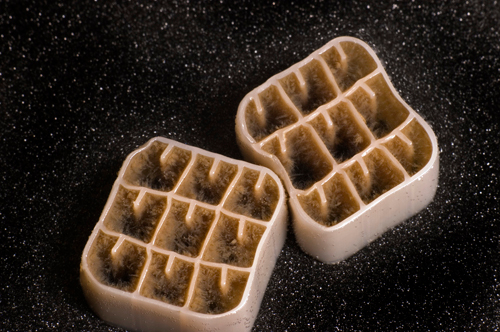
The company opened a Rhode Island office in Cumberland on Aug. 1. Biowater Technology manager Jill Bibby Hairabet explained the firm uses plastic carriers as a home for biological agents – bacteria – that, in turn, feed on wastewater. To promote the growth of the bacteria, oxygen is pumped through aeration pipes at the bottom of the wastewater treatment tanks.
“It is a natural and a very stable process,” she said.
In terms of potential markets, Hairabet pointed out that the U.S. Environmental Protection Agency has already cited 36 states as facing water shortages. “Water reuse will become mandatory in the future,” she said. Globally, she continued, “close to 1 billion people in the world do not have proper access to healthful water.” Her company’s technology, she said, offers a potential solution.
A technology similar to what is being marketed by Biowater Technology is now being employed at the Narragansett Bay Commission’s Field’s Point sewage facility in Providence – what it calls “integrated fixed film activated sludge” plastic media – to break down and reduce the level of nitrogen in the discharged effluent.
“Nitrogen-eating bacteria needs a table to sit down at, with a greater surface area to adhere to,” said Jamie Samon, the commission’s public affairs manager, of the fixed film process.
According to Hairabet, the Biowater Technology process is green because it uses no chemicals and has a much smaller footprint than other conventional wastewater-treatment processes. Use of the process can reduce energy consumption at treatment facilities by as much as 20 to 30 percent, according to the company. Other benefits cited include ease of operation, low capital costs, low operational costs, flexible design and ability to easily retrofit.
“Six hundred municipalities use this process in North America, as well as probably 350 industries,” she said.
The Norwegian parent company was founded in 2007, but many of the people involved with new U.S. division of Biowater Technology, including Hairabet, had previously worked with another technology company based in Fall River, in the 1990s known as Link Water, which was subsequently bought out by another firm.
“Biowater, despite being a startup company, is actually the continuation of a proven business idea that started in the late 1980s,” Hairabet said, explaining the new company’s local connections.
The previous business [with which Hairabet and others had been associated] had conducted a pilot test at Field’s Point using the integrated, fixed film activated sludge technology when the Narragansett Bay Commission was weighing what technology to go with for nitrogen removal, according to Samon. “We chose [at the time] to go with the technology, but not the company,” she said.
Hairabet said her firm has three people working in Rhode Island and hopes to expand. “There are good opportunities for growth, especially with new regulations for reuse of wastewater,” she said. •