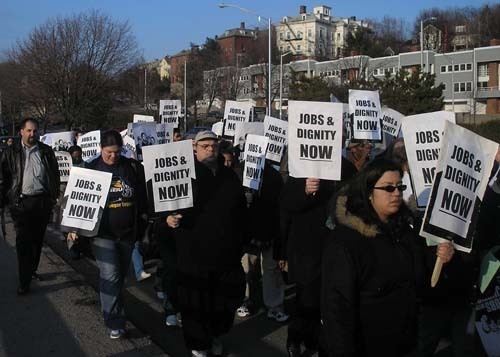
Earlier this month, the day after the Employee Free Choice Act of 2009 (EFCA) was introduced in Congress, eight members of the Human Resource Management Association of Rhode Island met in Washington, D.C., with members of the Ocean State’s congressional delegation to discuss the legislation.
The polarizing bill has been supported largely by unions, with many business leaders in opposition. All four members of Rhode Island’s congressional delegation support the bill. It would allow for card-signing to take the place of National Labor Board elections in most employee unionizations.
After the meetings with Sens. Sheldon Whitehouse and Jack Reed and Rep. Jim Langevin – HRMA-RI also met with staffers at Rep. Patrick Kennedy’s office – neither the group’s leaders, who oppose the measure, nor lawmakers had changed their opposing views.
HRMA-RI legislative affairs representative Cindy Butler said current federal laws – labor organizing is governed by the National Labor Relations Act of 1935 – allow for employees to make decisions on their own. “I think it gives everybody the opportunity to make an informed decision without influence from labor or management,” she said.
The bill is also coming along at a time when unions and businesses in Rhode Island should be focusing their attention on creating and maintaining jobs, she added. Passing EFCA could help to worsen the Ocean State’s recession, she said.
“We’re concerned about … the Rhode Island economy. Our HR folks are on the front lines, handling issues in terms of job displacement, reduced hours [and] work shares,” she said.
EFCA would limit collective bargaining to a 90-day period before a mediator is brought in. It would also allow for card-check agreements to take the place of private voting that’s guided by the National Labor Relations Board.
“So in essence, if 50 percent of the employees plus one signed cards for a union, there would be no election and the union would be recognized by the employer,” said Butler, who works as a human resources consultant to nonprofits and small businesses in Rhode Island.
While business groups opposed to the legislation say it will allow unions to unfairly influence employees, unions and labor organizers in Rhode Island say the current system allows for businesses to do a significant amount of browbeating. Service Employees International Union District 1199 Vice President Stan Israel said businesses have found ways to subvert the system.
“The managements in a lot of places are [running] vehemently anti-union run campaigns that are just devastating to the workers,” said Israel, whose 3,500 Rhode Island members include employees at Women & Infants and Butler hospitals. They threaten people. They stall the process. They get it to the point where they create such a terrible atmosphere that it makes it very difficult for workers to organize.”
Rhode Island AFL-CIO Secretary-Treasurer George H. Nee said he’s seen a “drastic” increase in anti-union meetings and firings of employees who try to form a union. “We would not tolerate that type of behavior in a political election – where you would be threatened with losing your job – if you didn’t vote for the proper politician,” he said.
Rhode Island Builders Association Executive Director Roger Warren said his advocacy group opposes the legislation because a mandated secret ballot election is the “basis of any free election in our society,” he said. “And I think, from what I understand, there’s concern that employers can somehow influence these elections,” he said. “But I think it would go the other way if you’ve eliminated the secret ballot and just use sign-up cards.”
Construction and General Laborers’ Local 271 Business Manager Michael F. Sabitoni added that the new legislation wouldn’t get rid of secret ballot elections, because those elections would still be optional if 30 percent of employees wanted one. His union represents about 2,500 construction workers. He said that the legislation is not anti-business and that it could help companies grow in Rhode Island.
Nee said that although the bill didn’t pass in Congress when it was introduced in 2007, there’s a better chance of its passage now. In 2007, the U.S. House passed it, but it failed in the Senate. And even if it had passed, then-President Bush would likely have vetoed it, Nee said.
“President Obama has recently reaffirmed his support for the Employee Free Choice Act,” Nee said. “In terms of its likelihood for passage, it’s going to be a very tough fight.” •