A House bill that would bring back historic-preservation tax credits for some residential developments will likely be just the first such attempt to resurrect – fully or in part – the program, Scott Wolf, executive director of the preservation advocacy group Grow Smart Rhode Island, said last week.
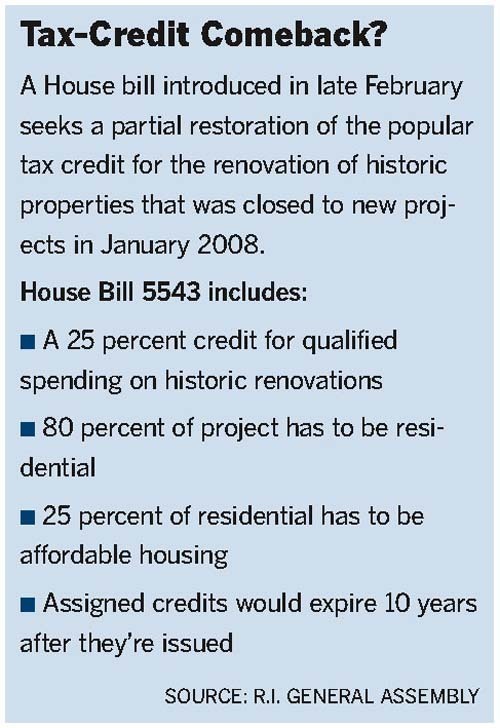
Introduced in late February, the bill was heard March 24 in the House Finance Committee, which took no action on it. The bill, H-5543, submitted by Rep. David Segal, D-Providence, would limit the R.I. Historic Preservation Investment Tax Credit program to projects that were at least 80 percent residential, with at least 25 percent of that as affordable housing.
The credit also would be increased to 25 percent. It’s now 22 percent.
Wolf said he’s been meeting with other lawmakers, including House Majority Leader Gordon D. Fox, who are drafting a separate bill.
“We have been working to develop a proposal that would not be limited as much to residential,” Wolf said, adding that it wouldn’t curb Segal’s effort, “if some of the concepts could be combined with what we’ve been formulating. We don’t think the tax-credit program should be limited to residential development.”
He added that commercial development is capable of creating more permanent jobs than residential construction.
R.I. Historical Preservation & Heritage Commission Executive Director Edward F. Sanderson – who favors bringing the entire program back and confirmed that other proposed legislation is being drafted – last week testified in favor of Segal’s bill.
The proposal would limit the reach of the tax credits, Sanderson said. Only about 8 percent of the total cost of projects that have been completed – since the 2001 start of the program – would have qualified if the program was set up the way Segal proposes, he said.
“In the great scheme of things, it’s a relatively small piece of the whole picture,” Sanderson said of Segal’s bill. “But it is a very important piece. Certainly from a preservation point of view, these projects do a lot for neighborhood revitalization.”
Sanderson added that the legislation as introduced would allow for other aspects of the program – including renovations for commercial use – to be brought back as well. But he wonders whether the Rhode Island laws that had permitted the program – amended with new rules last April – would also need to be revised for Segal’s bill to work effectively.
“The existing law says that you have to have filed an existing application by Dec. 31, 2007, you had to have filed with [R.I. Division of] Taxation and paid a fee by May 15, 2008,” he said. “So, I don’t understand how anybody could do anything, unless all that other stuff gets changed.”
Last April, in the face of looming state budget deficits, the R.I. General Assembly closed the tax-credit program to any project that hadn’t been approved before the beginning of 2008. The state also trimmed the amount of the credit, dropping it from 27.75 percent, and required that most of the state’s fee be collected up front.
After those changes were made to the program, Sanderson’s office relinquished some control to the R.I. Division of Taxation. That office now is in charge of approving project costs and the amount of credit for each project, but completed projects still have to file – and have certified – a final project report with RIHPHC.
But Sanderson said last week that he hasn’t seen filings for most of the 38 projects that were due to wrap up in 2008.
“There are 37 projects that told Taxation that they would be completed in 2008 and they have estimated project costs of $148 million,” he said. “And I haven’t seen them – I’ve only seen one.”
That might be an indication that some of the 82 projects now enrolled in the program have either slowed or stalled.
“In past years, I’ve just been as busy as can be from January 1 until the beginning of April with all the projects coming in,” Sanderson said. “But we’re sort of here and ready to go. … The obvious conclusion is that this terrible real estate market is affecting a lot of projects.” •