NEW YORK – U.S. utilities from Virginia to Maine are adding angry customers to their inventory of storm damage as more than 1.72 million homes and businesses remain without power four days after Hurricane Irene moved into Canada.
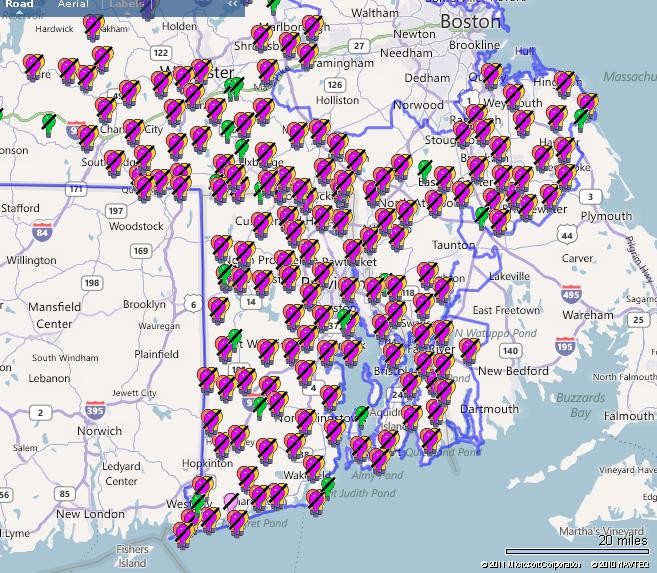
In Rhode Island, 63,718 of National Grid’s 480,281 customers were still without power at 8:23 a.m. Thursday. The utility said it plans to have all of the state back up by Sept. 5 at the latest.
Electric utilities are working through flooded neighborhoods and hacking their way through felled trees to repair power lines and other equipment. Most customers should have power back by the end of the day tomorrow, according to utilities in the stricken region.
Some individuals in more remote locations, or with more severe damage, may have to wait at least another week to get their lights back on, said Matthew Cordaro, former chief operating officer of the defunct Long Island Lighting Co. and now a Shoreham, New York-based industry consultant.
“Usually, people are very cooperative for the first three days after a natural disaster,” Cordaro said. “After three days, they do not give a damn what caused it. They want their lights back on.”
Irene made landfall Aug. 27 as a Category 1 hurricane in North Carolina before striking New York the next day as a tropical storm. The weather system caused record flooding from New Jersey to Vermont and knocked out power to as many as 6.69 million people, according to U.S. Energy Department estimates.
Last in Line
Utilities have made quick work in whittling down power losses by repairing high-voltage systems that serve tens of thousands of accounts, Cordaro said. Now, progress will slow as repair crews tackle more isolated problems, with each affecting fewer customers, he said. Last in line will be streets with only a few homes, or individual residences.
“I am frustrated,” said Adrienne Hutt, 65, who’s been without power at her hilltop home in Old Saybrook, Conn., since a fallen tree knocked a utility pole and transformer across her driveway Aug. 28. “I think what’s causing the frustration is, it’s really pretty scary.”
An online map set up by Maryland’s emergency management agency indicates repairs have been slow in Baltimore County compared with the rest of the state, Maryland Governor Martin O’Malley, a Democrat, said.
Getting Prickly
“A lot of people have 48 hours of patience,” he told reporters Wednesday in Annapolis. “That 48 hours is up. People are getting understandably prickly.”
Power system damage in the Baltimore area was the worst since Hurricane Isabel in 2003, with more than 80 percent of customers blacked out at one point, utility Baltimore Gas & Electric, a unit of Constellation Energy Group Inc., said yesterday in a statement. Only about 20 percent of those affected customers lacked power by this morning, the utility said.
“People are frustrated. We’re frustrated,” said Don Weyant, regulatory officer of Public Service Enterprise Group Inc.’s utility. The company still had 42,289 customers without power after restoring service to 707,711 as of 5 a.m. local time yesterday. Most of those lacking power were in central New Jersey.
“There’s a multitude of problems out there, even getting around with the flooding and the debris,” Weyant said.
Pepco Holdings Inc., owner of utilities in the District of Columbia, its Maryland suburbs and the eastern shore of the Chesapeake Bay, was “really quick” at restoring power, Maryland’s O’Malley said. He and other public officials had criticized Pepco for moving too slowly and not keeping customers informed about when they’d have power back after Hurricane Isabel.
Inaccurate Maps
“It’s too early make a definitive judgment of how they are doing,” Sandra Mattavous-Frye, consumer advocate for the District of Columbia, said in an interview. “Several of our consumers are calling, telling us that the outage maps Pepco has are inaccurate.”
All but 1 percent of Washington-area customers who lost power from Irene had it back on by yesterday morning, Pepco said in a statement.
Public Service, New York’s Consolidated Edison Inc. and FirstEnergy Corp.’s Jersey Central Power & Light have executed repairs quickly and methodically, Cordaro said. State-owned Long Island Power Authority and National Grid Plc, which manages its power lines, haven’t, said Cordaro, who sits on a committee with oversight of the utility.
Idled Crews
“They were slow to survey the damage and develop a plan of attack,” Cordaro said. “They brought in crews before the storm hit, and that’s a grandstand play.” The result was idle crews while the utility surveyed damage, he said.
Long Island Power’s response has been “systematic,” Chief Operating Officer Michael Hervey said Wednesday in a press conference at the authority headquarters in Hicksville, N.Y.
In Fairfield, Conn., Ken O’Toole, 48, watched as a tree blew over in the storm, tearing out the electric line and meter on his home. His neighbors have their power back now, while O’Toole, who stocked up on water, batteries and candles before Irene hit, is still waiting.