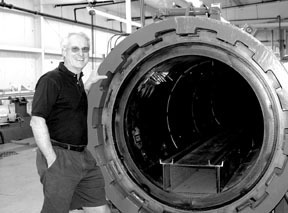
his company's autoclave.
Name: Eric Hall
Position: President, Hall Spars & Rigging
Background: Founded Hall Spars in 1980. Worked in the spar division
of Schaefer Marine in New Bedford from 1975 to 1980. Worked on the design team
for F-14 fighter jet at Grumman Aerospace on Long Island in the late 1960s.
Education: Degree in naval architecture and aerospace engineering from
the University of Michigan
Age: 59
Residence: Bristol
Hall Spars & Rigging, of Bristol, makes carbon-fiber masts for high-performance
sailboats. The company has manufacturing and production facilities in Bristol
and the Netherlands.
Hall Spars for the first time built the mast for the winning America’s
Cup team, the Swiss Alinghi team, this year. Talk about how that process worked.
It started basically in 2000 when we were the spar supplier to the (New York
Yacht Club) Young America syndicate – probably, when it hit the water, the top-rated
U.S. boat and certainly I think the one that the New Zealanders were most worried
about. They were very interested in the mast we made for that one, which had
a lot of innovation on it. So we had caught their eye. It was one of the most
interesting masts in Auckland at the time. In the end, the boat broke and the
project cratered, but the memory of the mast seemed to have lasted. After Russell
Coutts (skipper of the victorious Alinghi team) went to go work for the Swiss,
we were contacted by him, by Murray Jones, his side lieutenant, and by Dirk
Kramers, who worked here for the first 15 years of the company as chief engineer.
(Kramers) knew what the advantages of coming to us were, and we signed them
exclusively.
How complicated was the whole process, building to the America’s Cup specifications?
It was substantially more complicated than usual. We did not do the design
work, but, when you build a mast like that, you want to make it to minimum dimensions
and maximum stiffness. Very tight tolerance work that normally, in composites,
it’s not a medium that lends itself to very, very accurate work, like maybe
machining in a Bridgeport milling machine would. But they were looking for plus
or minus a millimeter or two, and that took an awful lot of care and undistracted,
focused work. And I think we gave them that, whereas I think the other competitors,
most notably the New Zealanders themselves did not get that, because I think
the other manufacturer bit off more than they could chew, making a lot of masts.
We have chosen each year to do work for just one syndicate so we can put our
undivided attention into it.
Why are carbon-fiber composite masts superior to aluminum?
Carbon fiber in laminate is at equal stiffness to aluminum, and stiffness
is mostly the design characteristic of masts. It’s half the weight in a tube
of the same shape and same stiffness. So if it’s just as stiff and half the
weight, obviously you choose that material. It’s also stronger and tougher.
In our experience, the carbon masts have shown to handle accidents and mishandling
much better than aluminum, which tends to kink and bend. Our laminates have
been very tough.
So are more and more companies making carbon fiber?
Yes, a substantial number have entered. More or less every mast maker in the
business has probably now got a carbon program, and some new players have entered
as well. We do make aluminum masts, but we do them for our production order,
original equipment manufacturers like TPI (builder of J-Boats) and Sabre (Yachts),
and one or two others. But I think we’ve built our recent reputation on carbon
fiber.
Can you describe how you make these masts?
We make masts the same way they make golf shafts. You take a metal mandrel
and we wrap the material around that tube form. Then once all the laminate and
laminate reinforcements are on it, we put it in an autoclave and the autoclave
heats it to 250 degrees and compresses it under six atmospheres of pressure,
or six times the atmosphere. And that pressure squeezes all the air bubbles
out of it and makes it a pretty pure laminate with no voids. When you take it
out of the autoclave and it cools down, we then extract the metal form out of
it, leaving just a homogenous, round carbon tube. We’re unique in the industry
in that all of our masts are made this way. Most people make masts in two halves
and glue them together and use screws and fillers to tie them together. We don’t
do that so we have a stronger section that is structurally less complex but
also lighter for the same stiffness.
How many employees do you have?
Right now in round number 65, maybe one or two more, and in Breskens, Holland,
we have just over 35. So both companies combined, about 100.
What kind of jobs are these? I’d imagine a lot of engineers and R&D
as well as manufacturing and assembly?
The engineering of carbon-fiber masts is extremely complex and time-consuming,
and always seems to be more time-consuming than we’d like it to be. So we haven’t
been able to spend great amounts of time on R&D. The R&D happens though
with masts that are produced and built for people, but the boats are so out-there
that building the masts is practically an R&D exercise in and of itself.
We are working quietly on more and more R&D. We now have an engineer who
in training has become devoted to R&D and testing, so we’re starting to
do some long-term fatigue testing on some of our products that we really hadn’t
been able to do before. And testing is something that I’ve been very impatient
about. We really need to not only continue to make new products but test them
and qualify them and find out a lot of still unanswered questions about this.
The Holland business was a result of a 2001 acquisition. Why did you expand
into Europe?
For years there wasn’t a good carbon-mast manufacturer. Nobody in Europe had
good carbon, and I was just itching to get us on the ground there. We looked
at Germany, but it would have been starting from square one. We wanted to hook
up with people who were there and known and did a good job. On a chance meeting,
I asked a guy that we competed against in the metal-mast business, and they
made a nice mast but at a better price. They made money and had been in business
longer than we had. So I asked him if he was interested in joining forces and
maybe being acquired. They were very interested and things moved very quickly.
Now we’ve moved into a brand new building in Breskens. The guys that own the
company hold a significant but minority share, and they are the day-to-day operators
of the business and they’ve become extremely good friends.
You have plans to build a new facility?
Right. We’re meeting with the Economic Development Corporation (last week)
and we’re going full steam ahead on a new building that will be built down the
street (in Bristol). It will be about 65,000 square feet, which is a little
bigger than the combined space in our two (existing) buildings. It will be a
real different kind of building. Even though it will cost us more, it will save
us a lot of money. We’ll be financing part of the building through an industrial
revenue bond.
Do you plan to add new employees with that facility?
The two aren’t linked, but we hope that over time more employees will be added.
The company has grown slowly over the years. Maybe we’ll come to a dead stop,
but that isn’t the trend, and it never has been the trend. We’ve been through
some thick and thin with this company as far as the outside economy goes. It’s
been going up and down and the stock market has been going up and down, but
we just seem to have been on a controlled climb.
It seems like the sailboat business would be hit pretty hard by an economic
downturn. Have you seen the effects?
We have in that the mix has changed substantially. Basically, a significant percentage of our business has been the OEM business, the J-Boats business or Sabre business or Carroll Marine here. (Sept. 11) soured the selling year of 2001-2002. And then all the war jitters soured the selling year from 2002 to 2003, and you can see a lot of this in the stock market, especially leading up to the war. So a substantial amount of business that we had drawings for and engineering for we just didn’t get. But somehow in place of that, the America’s Cup was a big chunk, and this year we had some very, very big projects. Last year we also had a mast for the biggest boat we’ve ever built for, which was 147 feet. So it appears that there’s business out there, and as we move into new sectors and do well in the bigger boats, then we start to get on people’s big-boat list.
For the complete current issue, visit our subscription Web site, or call (401) 273-2201, ext. 227 or 234.