
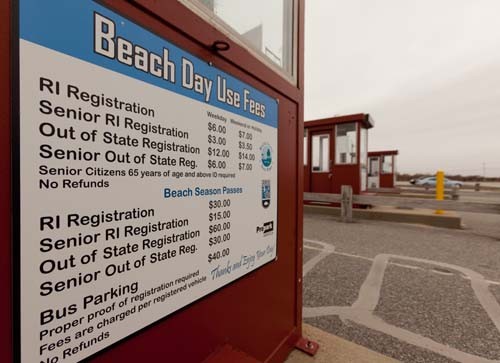
In 36 years working at Aunt Carrie’s Seafood Restaurant, Elsie Foy, now the owner, never wrote to her elected officials in the General Assembly. That all changed recently when the R.I. Department of Environmental Management proposed doubling most parking fees at state beaches, including at the one just down the road from the eatery. Foy fired off a letter to her senator, telling him the raise threatened her Narragansett business.
Foy said higher rates would leave less money in beachgoers’ pockets. That leaves them less likely to buy clam cakes, clam chowder and more at Aunt Carrie’s takeout window or in its dining room, Foy argued.
“I understand the state needs more money. I just don’t think that’s the way,” Foy said. “We’re a tourist state. That’s what we’re known for.”
But the Ocean State’s coffers are hurting, sending officials scrambling for new revenue anywhere they can find it. The R.I. Budget Office says raising rates would generate about $1.9 million a year, of which $367,000 would go to the contractor that operates the lots under a revenue-sharing agreement. Host communities would also take a cut, of approximately $200,000. After all the revenue sharing, the state would collect about $1.3 million in additional parking fees.
Michael Trainor, a spokesman for Gov. Lincoln D. Chafee, said his boss views the increase “as a necessary revenue adjustment.”
In his budget, Chafee also proposed lowering the share of fees the state sends to host communities to 16 percent from 27 percent. But the budget predicts that the higher fees will generate roughly the same amount of money for the municipalities even with the change in share.
Under the plan, slated for a hearing on May 13, daily beach parking fees for residents would increase to $10 from $6 on weekdays and to $14 from $7 on weekends and holidays. Daily fees for nonresidents would climb to $20 from $12 on weekdays and to $28 from $14 on weekends and holidays. Season passes for residents would double to $60 and for nonresidents, they would double to $120. Accessing the beaches themselves would continue to be free.
Bob Paquette, the DEM’s chief of Parks and Recreation, said the higher proposed fees come during a time of limited options. His division has already seen its staff shrink to 43 full-time positions from 62 in 2008. And two years ago, a proposal by his office to modestly raise rates went nowhere.
As such, rates have remained constant since 2002, when rates increased between 20 percent and 50 percent. But since then the state’s budget situation has sputtered and faced gaping holes.
Paquette said he recognized that the higher rates, if approved, could plug a budget hole but also scare off beachgoers, which numbered about 2.5 million last year, according to DEM estimates.
For those that continue to head to the beach, Paquette said it was “tough to determine” the extent of impact, if any, on nearby businesses.
Business owners, however, were quick to offer their predictions.
“These people are getting beat up bad now with gas and everything else. We don’t have to go after them more,” said Norman Dufresne, owner of Sam’s in Westerly, a snack shop and private beach area next to Misquamicut State Beach.
Like Foy, Dufresne worried about beachgoers skipping a snack after spending more money in the parking lot. He also worried that the increase in rates would lead operators of private parking lots to jack up rates in tandem.
(Paquette said that the last time the DEM proposed rate increases the idea received strong support from parking lot operators complaining that the state was undercutting them by offering relatively inexpensive rates.)
Dufresne owns a parking lot and said despite misgivings over higher fees, he would feel pressured to match state rates. But largely, Dufresne and Foy worry that beachgoers will simply stay at home.
Foy said she is especially concerned about Rhode Island residents. For out-of-state tourists a few more dollars may not amount to much in their vacation budgets. But Foy said those few more dollars for Ocean State residents may prove enough to curtail their visits.
“I think we’re going to end up hurting ourselves,” she said.
Deborah Kelso, executive director of the Narragansett Chamber of Commerce, predicts higher fees will depress attendance. That has already sent jitters through the business community.
“Obviously, people aren’t happy,” she said.
State officials, however, note that state beaches, even with the new rates, would remain less expensive than many municipal beaches. And in a summary of the changes, State Budget Officer Thomas Mullaney said the increase in fees would not decrease attendance at state beaches.
“There is no anticipated adverse impact upon small businesses such as gas stations or restaurants that benefit from patrons who visit state beaches,” Mullaney wrote.
The proposal does hold implications for Propark America. The state contracts with the Hartford-based company to operate the beach parking lots.
The contract guarantees the state $1.8 million annually, regardless of actual parking fees collected. Propark then keeps the next $500,000 itself. Any revenue beyond that the company keeps 20 percent and the state the rest.
If the new rates are approved and attendance predictions hold true, the state budget office says Propark would see a $367,000 boost in its share. None of the company’s duties would change.
In an interview, Mullaney said the additional payment to Propark is not included in the documents prepared for the hearing or reflected in the governor’s budget. He said the state would update the documents in time for the hearing. •

The fee increases are needed and are not that bad. If you are complaining about for 4$ or $7 increase on something that hasn’t had a fee rise in nearly 10 years, then you need to re-evaluate your life choices and career path. Perhaps Aunt Carrie’s wouldn’t be so worried if their food was any good. Sorry, but when I’m at my beachhouse in Narragansett (right down the street from Aunt Carrie’s by the way) we go to Galilee. Heck, Iggy’s is better than Aunt Carrie’s for goodness sake!