
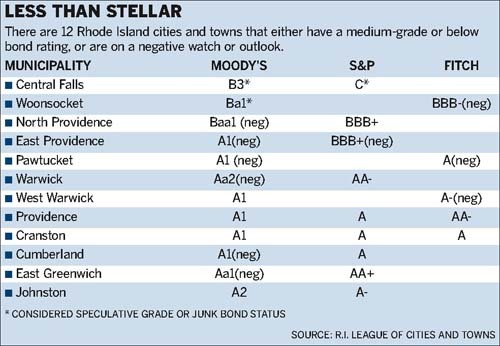
 Click here to view a larger version.) / " title="There are 12 Rhode Island cities and towns that either have a medium-grade or below bond rating or are on a negative watch or outlook. (Click here to view a larger version.) /"/>
Local leaders and public finance advisers are worried Central Falls’ declaration of insolvency and its attempt to enter receivership will have far-ranging effects that might prove costly to communities across Rhode Island.
The fears range from higher borrowing costs for cities and towns – even those with strong bond ratings – to a diminished ability to attract new businesses.
And some worry that other communities will follow Central Falls’ lead.
Woonsocket’s bond rating with Moody’s Investor Service has sunk to junk status, and North Providence’s ratings are only a few notches above that. But with the help of state officials, both municipalities are attempting to resolve their fiscal problems a different way. Woonsocket is preparing to float a $12 million deficit bond and North Providence a $10.5 million bond to close projected shortfalls.
Still, other municipalities are under heavy pressures, too. In January, a special state task force concluded four other cities and towns – Warwick, West Warwick, East Providence and Pawtucket – are in serious financial trouble based on the size of their reserves, pension liabilities, tax rates and public-employee health care benefits.
Pawtucket, for one, already has instituted employee furloughs, layoffs and pay freezes, but the city budget for the coming fiscal year will still require a large tax increase, according to city Finance Director Ronald L. Wunschel.
Wunschel doubted that receivership would be helpful for Pawtucket, if it were to get to that point. A receiver might have the authority to dissolve contracts and alter labor agreements. “But how much more can you do to [Pawtucket city employees]?” Wunschel said. “It’s a tough dilemma.”
Those involved with the municipal bond markets are still trying to get a handle on the effects of Central Falls’ actions.
Experts say it could make investors, already skittish following debt problems in Greece, wary of bidding on municipal bonds coming out of Rhode Island. That would mean higher interest rates to make them more palatable. Rating agencies may enact downgrades, too.
“Up to this point, this is something that wouldn’t have normally been in the mind of the investors or the rating agencies,” said Robert Donovan, executive director of the R.I. Health and Educational Building Corporation, a quasi-public agency providing municipalities and some nonprofits access to the municipal-debt market. “Now it would at least raise questions.”
Donovan said Central Falls’ receivership filing caught RIHEBC by surprise. The agency had been working with the city on a $2.5 million school construction bond. Now that bond sale has been put on hold.
“The marketplace doesn’t like unresolved issues,” he said.
RIHEBC will get a reading on the bond markets this week, when it pushes forward with a $15 million school construction bond issue for Warwick, Westerly and the Chariho school districts on June 2.
Beyond the financial markets, East Providence City Manager Richard Brown worried those “unresolved issues” might hinder efforts to attract new companies into East Providence, as well as the rest of Rhode Island.
“In terms of doing economic development, it’s a highly competitive market,” he said. “We’re always trying to create a positive image. This doesn’t help.”
Central Falls’ entrance into receivership is still not a sure thing.
R.I. Superior Court Justice Michael A. Silverstein has appointed Jonathan N. Savage, a partner at Shechtman Halperin Savage LLP in Pawtucket, as temporary receiver. A court hearing has been scheduled for June 9 to determine whether the receivership proceedings should move forward.
Central Falls’ annual operating budget stands at about $18 million, but the city is projecting a $3 million deficit for the current fiscal year – about 17 percent of revenue – and another $5 million next year.
The city asked for receivership because Rhode Island is one of 26 states that do not allow their municipalities to file Chapter 9 federal bankruptcy protection.
Following the receivership filing, bond-rating agencies Standard & Poor’s and Moody’s Investors Service cut Central Falls’ ratings to junk status.
“The city is at risk of payment default on a $4 million general obligation tax anticipation note, payable June 30, due to insufficient cash flow,” Moody’s warned investors in its downgrade message last week.
Under receivership, Savage has the authority to make financial decisions for the city, prioritizing everything from purchases to personnel. He could void or alter contracts with vendors and labor unions and levy taxes, among other things. Savage did not return calls seeking comment last week.
Gov. Donald L. Carcieri “does not believe receivership is the best course of action,” spokeswoman Amy Kempe told Providence Business News. But as of last week, the administration hadn’t decided whether it would oppose it in court.
“This is uncharted territory,” Kempe said.
State statute allows for the creation of a budget-review commission to intervene in municipal affairs when that community’s bond rating sinks to junk status, among other triggers.
However, none of those triggers were hit before the Central Falls City Council requested receivership, although Kempe said state officials had offered assistance to the city on numerous occasions.
Carcieri’s administration and the R.I. Auditor General’s office are in the early stages of forming a commission to address Central Falls’ problems, despite the receivership filing.
“We’re proceeding on parallel tracks right now while we’re analyzing what receivership may mean to the budget-review commission statute,” Kempe said.
Those unanswered legal questions could cause problems statewide, according to Sandra Mack, law partner in Hinckley, Allen & Snyder LLP’s Providence office.
Investors and rating agencies may have had an understanding that there was a procedure in place to prevent defaults. “But now you have a community take a left turn and file [for receivership] when there are many other communities in the exact same situation,” said Mack, who serves as bond counsel for several Rhode Island municipalities, including North Providence. “There very well may be pressure on others to follow suit.”
Furthermore, the prospect of receivership can have a chilling effect on a municipality’s vendors and service providers, since a receiver has the authority to wipe away contracts. “It makes everybody a little nervous,” she said.
Brown, the East Providence city manager, foresees greater borrowing cost or limited access to the debt market as a possibility in the future. Additionally, he raised questions about how receivership would affect entities such as the Rhode Island Interlocal Risk Management Trust, a risk-sharing insurance pool of public sector groups.
“If Central Falls decides it’s a bill that it doesn’t have to pay, that puts the cost on the other jurisdictions,” Brown said. “The impact of one of us in such a small area having financial problems is going to have an impact on the rest of us.” •