The Public Safety Department at the Rhode Island School of Design purchased hybrid vehicles in an effort to reduce fuel costs and its environmental footprint. Officers soon determined that the fleet guzzled more gas than traditional vehicles. Providence’s steep hills forced the gasoline engines to run most of the time and eliminated any savings. So the department this summer turned to a much older mode of transportation: the bicycle.
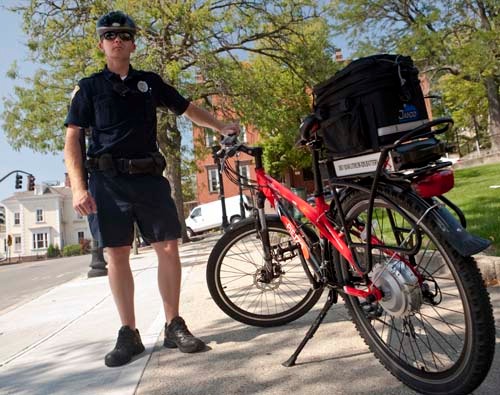
But this is no kid’s bike. A lithium-ion battery above the rear wheel powers a small electric engine that propels the bike up to 15 mph without pedaling. Charged via a standard electrical outlet, the bike by Bedford, Mass.-based Pietzo holds enough energy to last an entire eight-hour shift. The bicycle releases no emissions and fits with efforts by RISD to increase environmental sustainability practices.
“I think it’s the most effective tool to come along for patrol work in a long time,” RISD Sgt. William LaPierre said.
Electric bicycles are, of course, not the only way to dart around campus without firing up a traditional automobile. Brown University Police maintain a fleet of seven mountain bicycles and use a three-wheeled electric scooter resembling a Segway to patrol its Providence campus.
“When fuel costs got extraordinarily high a few years ago, it forced us to step back and look at ways to reduce fuel consumption,” Brown Police Chief Mark Porter said.
Porter said the university looked at electric bikes in the past but opted for the scooter known as a T-3 because it carries more equipment and comes with a larger battery.
Last May, the University of Rhode Island tested the scooter during commencement. URI Police Maj. Stephen Baker said the patrolman assigned to the atypical vehicle applauded its ability to weave in and out of the throngs of people converging on campus for graduation.
“They’re able to get around … when otherwise you’re stuck in vehicular traffic,” Baker said.
The department did not have the roughly $4,500 in the budget to purchase the scooter. So instead Baker continues to put officers on traditional bicycles and encourage foot patrols. The university also purchased a hybrid Ford Escape for its director of public safety.
Such purchases are becoming more common as colleges look to shave fuel costs. Roger Williams University is phasing out the traditional Ford Crown Victoria model patrol cars. Roger Williams expects two hybrid vehicles – a Ford Escape and a Ford Fusion – to arrive on campus this fall. They are expected to get more than 30 miles per gallon, cut costs and be more environmentally friendly. The new Fords will join the university’s existing hybrid Toyota Prius, Director of Public Safety John Blessing said.
“The campus is small, parking is tight,” Blessing said. “A smaller vehicle like the Escape or the Prius really works well and satisfies our needs. We’re not patrolling highways like other public-safety departments.”
Instead, officers spend extended periods of time in one location. When they stop in the Prius, the engine shuts down and cuts back on the fuel burned. Officers can also hop into a golf cart- like electric vehicle when they need to transport students around the 140-acre campus. Blessing said the university estimates it costs less than $1 to charge the vehicle with enough power to last an entire day, if not more.
And in a further action to cut costs, the department, which oversees student transportation, moved this summer to a fuel blended with 5 percent biodiesel for its shuttles. The fuel is the same cost as traditional diesel but releases fewer emissions and may produce slightly better gas mileage, Blessing said.
“It’s a step in the right direction,” added Blessing, whose department’s fleet already includes a shuttle with an engine that burns spent cooking oil from the campus dining hall.
South Kingstown Police Chief Vincent Vespia Jr. said his officers use traditional, nonelectric bicycles to patrol specific areas of town such as the South County Bike Path. However, motor vehicles still dominate patrols in the 57-square-mile town.
But as a police officer with more than 20 years experience, Vespia said there’s no doubt bicycles save fuel costs and improve policing.
“It’s the personal approach,” he said. “You pull up and stop next to somebody and chat with them. It’s much more comfortable.”
RISD’s LaPierre shows off the school’s new bike with the enthusiasm of a 16-year-old receiving his first car. An avid mountain biker, LaPierre loves the ability of the bike to weave around campus and traffic. And he can do so without exerting huge amounts of physical effort typically required to pedal up the campus’ hills. That means he’s not exhausted by the time he reaches the trouble spot. And parking is never an issue.
Then there’s the fuel savings. LaPierre estimates RISD saves close to $20 a day in fuel by putting an officer on a bike rather than in a car with a gasoline engine. At that rate, it would take the $1,600-bicycle just 80 days to pay for itself.
Pietzo says its bicycles outfitted for security uses typically cost between $1,299 and $1,899.
The company founded about a year ago now counts Brandeis University, Harvard University and Wellesley College among its clients. CEO Steve Mongeau said universities and private security companies now comprise about half the company’s sales, with the rest from individual bike enthusiasts.
“I think it’s a market that will grow,” Mongeau said. “How fast I can’t predict. As far as I’m concerned, the faster the better.” •