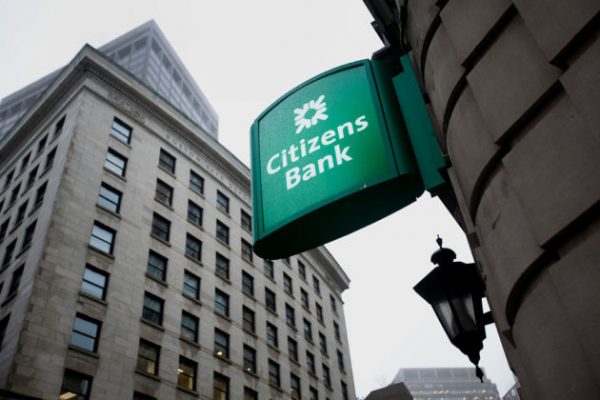
PROVIDENCE – A deep, prolonged recession would cost Providence-based Citizens Bank billions of dollars, but the bank would be able to withstand it, according to Citizens’ latest required stress test.
Citizens Financial Group, the bank’s holding company, is “well-positioned to withstand stress due to the strength of its balance sheet, risk profile and capital base,” the bank concluded in recently disclosed results of its mid-cycle, company-run 2018 stress test.
The test was performed in accordance with the Dodd-Frank Wall Street Reform and Consumer Protection Act of 2010, a key piece of federal legislation approved in the aftermath of the 2008-09 financial crisis.
For the test, Citizens said it recreated a “severely adverse scenario” spanning a 27-month period, from July 2018 through September 2020.
The scenario was a hypothetical recession with a severe drop in equity prices and a sharp increase in market volatility. Using that to estimate the impact on the bank, Citizens found that its capital ratios – common equity tier-1, tier-1 risk-based capital ratio, total risk-based capital ratio, and tier-1 leverage ratio – would come out well-above the required regulatory minimums.
Still, the test found, the deep recession would take its toll, resulting in Citizens taking an estimated net loss before taxes of $9.4 billion.
Those losses would be “primarily driven by an impairment to goodwill and higher provision expense resulting from a weakened credit environment,” the bank wrote.
In addition, the test projected that Citizens would suffer $5.4 billion in loan losses.
“As the macroeconomic environment deteriorates and losses begin to increase,” the bank wrote, “a combination of lower consumer demand and tightened underwriting results in lower loan originations throughout the back end of the [27-month period].”
Scott Blake is a PBN staff writer. Email him at Blake@PBN.com.