PROVIDENCE – The Providence City Council on Thursday approved an expansion of a local historic district in College Hill and Fox Point, helping to protect almost 90 structures from demolition and significant exterior changes.
The local historic district, which connects a portion of the end points of two existing districts, had been sought by historic preservationists and the Providence Preservation Society for almost a decade.
The properties include notable single-family homes, multi-family homes, some commercial properties and a notable building owned by Brown University, the Sprague-Ladd House, built in 1850, at 1 Young Orchard Ave., as well as its original stable, now an accessory building used by the university for offices, at 105 Benevolent St.
A local historic district has the power to prevent tear-downs, which preservationists have decried in many neighborhoods. A structure can be named to the National Register of Historic Places, but unless it is included in a local historic district, it can be razed.
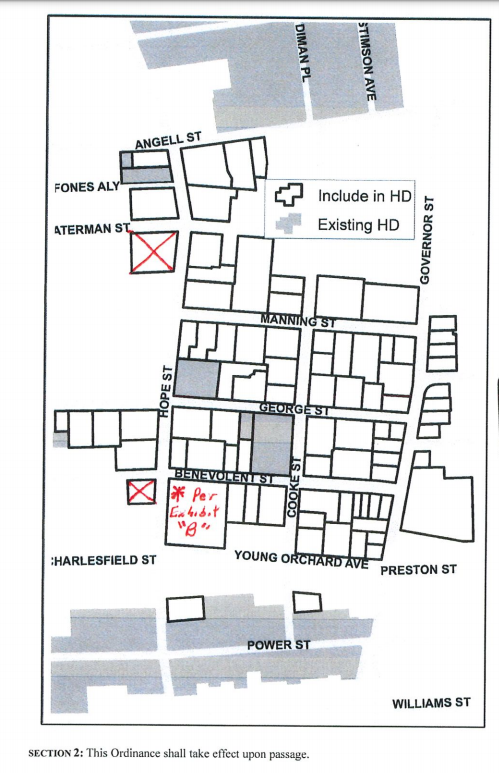
The new district, an expansion of the College Hill Historic District, includes 87 properties bounded by Angell Street, the east side of Governor Street, Young Orchard Avenue and Hope Street. It includes many homes on George, Manning, Benevolent and Cooke streets.
Multiple changes have been made to the district boundaries over the past several years, the most recent of which pulled several Brown University properties from the protected zone. The university had consistently objected to the inclusion of its properties in the district, arguing that its requirement to come to the city as part of its coverage by an Institutional District afforded enough city oversight.
But preservationists have argued that Brown, as it has expanded its geographic footprint, has town down numerous buildings on the East Side.
On Thursday, the City Council approved the zoning overlay with no discussion. An earlier attempt in February had been sent back to a council committee, after Brown objected to the inclusion of four of its properties in the zone. Other property owners had also objected, according to letters sent to the Providence Preservation Society. But more than 50% of the owners agreed.
The new district now exempts three Brown-owned properties that preservationists initially sought to include, including the King House at the corner of Hope and Benevolent streets and 190 Hope St., at the corner of Waterman and Hope streets.
In a statement, the ordinance lead sponsor, Councilman John Goncalves, of Fox Point, said the expanded historic district will protect architecturally significant properties, including the Brown property known as the Orwig Music Building.
“We heard from so many residents who love this neighborhood and want to maintain its beauty and honor the iconic style and architecture that makes College Hill feel like home,” he said.
Councilwoman Helen Anthony, who represents parts of College Hill and Wayland Square, also was a co-sponsor. “We heard residents loud and clear as dozens of property owners shared their support for the creation of a historic overlay district,” she said.
Mary MacDonald is a staff writer for the PBN. Contact her at macdonald@pbn.com.