
Lawmakers in Washington, D.C., are considering a bill that would broaden the definition of what it means to be a disabled worker, eligible for special protections under the law.
The Americans with Disability Act of 1990 made it unlawful to discriminate in employment against a qualified person with a disability, and describes the “reasonable accommodations” that employers need to make for workers who meet the definition of disability.
A person with a disability is defined under the ADA as somebody who has, has a record of, or is regarded as having a physical or mental impairment that substantially limits a major life activity – such as walking, talking, brushing your teeth or washing your dishes after a meal.
All private employers with 15 or more employees have to meet the requirements of the law, and a comparable state law applies to all private employers with four or more workers.
The Americans with Disabilities Restoration legislation, which has been floated by some lawmakers in Congress for several years, would redefine the definition of disability under the law as simply having a physical or mental impairment – whether or not the impairment limits a worker’s major life activities or can be corrected or controlled with the help of a corrective device or medical treatment.
The legislation is a response by supporters of the bill to a handful of U.S. Supreme Court decisions in the past decade that have narrowed the reach of the Americans with Disabilities Act of 1990, said Kathy Gips, director of training at the New England ADA Center in Boston.
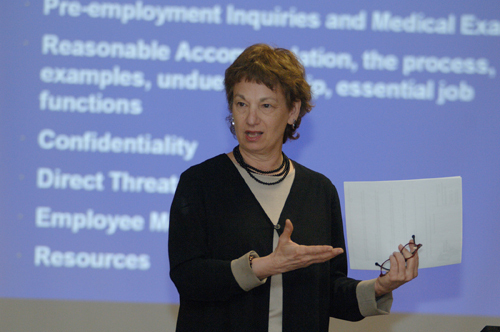
“A lot of the legal cases have simply been on whether or not a person meets the definition of disability,” said Gips, speaking in Warwick on May 15 at a one-day seminar for human resource managers.
The ADA Restoration Act “does away with that whole analysis of substantial limitation on a major life activity,” she said. “And a lot of employers are saying, ‘Whoa! That’s a lot of people who have physical or mental impairments. It’s really going to open the door.’”
The employer seminar was sponsored by Gov. Donald L. Carcieri’s Commission on Disabilities and the Rhode Island Business Leadership Network, a group of Rhode Island employers who champion best practices to promote employment and retention of employees with disabilities.
Gips discussed two U.S. Supreme Court decisions in particular that narrowed the definition of disability. In 1999, the Supreme Court ruled in the case of Sutton v. United Airlines that two pilots for the airline – twin sisters with very bad eyesight – were not covered under the ADA because their vision was corrected when wearing eye glasses.
In its ruling, the Supreme Court said that “mitigating measures” such as medication, hearing aids and walking canes should be taken into account when determining whether an employee is substantially limited as they function, Gips said.
“Well, it’s had a lot of repercussions, because that means if I have bipolar illness and I’m taking medication and I’m doing fine, maybe I’m not a person with a disability,” she said.
In 2002, the Supreme Court further limited the scope of the ADA with its ruling on Williams v. Toyota. In that case, a Toyota employee working in a manufacturing plant for the carmaker was unable to perform some manual tasks required for the job – including cleaning and waxing the tops of the cars – because she suffered from carpal tunnel syndrome and tendonitis.
The Supreme Court ruled the employee was not covered by the ADA, because her physical conditions did not disable her in her daily-life activities.
“What she said was, ‘Look, I’m perfectly capable of doing the job. I can do all the other tasks, but I can’t do this task, OK?’” Gips said. “And the Supreme Court … said, ‘In order to be considered a person with a disability, it’s not just that you can’t do some of the manual tasks in your job. But you must be able to show that you’re limited in manual tasks that are central to your life, like brushing your teeth, dressing or performing household chores.’”
Not every Supreme Court decision has narrowed the reach of the ADA; in 1998, in its first ruling regarding the law, the court narrowly decided that an employee who was HIV positive but had no symptoms was still covered by the ADA.
Sidney Abbott’s lawyers successfully argued that Abbott’s HIV infection was a disability even though she was not sick, because the disease substantially limited her ability to give birth to children.
“Some of the Supreme Court judges said, ‘Reproduction isn’t a major life activity. The major life activities we’re talking about are things you do every day – you know, walking, talking – things that really affect your functioning.’ Other Supreme Court judges said, ‘Not only is reproduction a major life activity, reproduction is the major life activity,’” Gips said. •