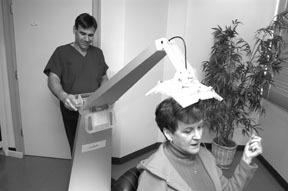
Cranston, operates the Luce LDS 100.
Hair-restoration surgeon Dr. Robert Leonard has a new tool in his belt for the battle against hair loss.
Leonard, chief surgeon at Leonard Hair Transplant Associates in Cranston, last month became one of the first doctors in the country to offer a new laser technology that is said to help curb male and female pattern hair loss – and, in some cases, sprout new hair.
The Luce LDS 100, developed by a company in Milan, Italy, uses low-level infrared light to heat and massage the scalp, which expands the pores and boosts blood circulation and oxygen supply to the hair follicles.
Each of the roughly 150,000 hair follicles on the human head has its own blood supply, Leonard said, and decreased blood flow to the scalp’s capillaries is one of the main causes of baldness.
By boosting the blood flow to the scalp, the Luce machine helped decrease hair loss in 85 percent of cases, and helped spawn thicker, fuller hair growth more than half the time, in clinical testing in Europe, Leonard said.
The technology is not a panacea, Leonard says. Rather, it’s a new, non-invasive treatment to be used in conjunction with other therapies.
“This offers a non-surgical option for men and women alike who are losing their hair,” said Leonard, who has been doing hair-restoration surgery for 17 years. “But if a guy comes in who is as bald as could be, Luce is not going to help him. You have to have some hair to make a cosmetic change.”
Because its main objective is to stop hair from falling out, the treatments are best suited for men and women whose hair has just begun thinning and who aren’t ready for more-invasive steps like surgery.
The technology, however, will be used on hair-transplant patients too. Transplants involve surgically transplanting healthy follicles from the back and sides of the head to the top of the scalp. While the procedure produces good results, patients’ natural hair continues to shed, so the laser technology can be used to keep the old hair from falling out.
Leonard said he would recommend the painless laser treatments to virtually all his patients, either coupled with medications like Rogaine or Propecia, or used as a follow-up to transplant surgery.
The protocol calls for between 25 and 37 treatments, 30 minutes each, spread out over one year. Patients start out with two treatments a week, eventually going down to weekly and then monthly treatments for the last six months. Results should begin to show within eight weeks, Leonard said.
The treatments generally are considered cosmetic and are not covered by insurance. The cost is between $1,750 and $3,500 for the year, depending on the severity of the patient’s hair loss.
Leonard says the Luce machine is especially good news for women who suffer from hair loss, since one of the biggest advances in the hair-restoration field in recent years – Merck’s baldness drug Propecia – is only prescribed to men. Without Propecia, women have been limited to either minoxidil (Rogaine) or transplant surgery. Statistics show that one in 20 women suffer hair loss.
Julia Willecke, a retired psychologist who lives in Wellfleet on Cape Cod, sat relaxed under the warm red glow of the Luce machine during an appointment last month. The machine resembles a salon-style hair dryer, except at its head are small pads that beam 225 tiny red laser lights down onto the crown of the head.
Willecke, 56, said she began to notice her hair thinning a few years ago. She had tried minoxidil and a battery of vitamin supplements – calcium, magnesium and zinc – before resorting to a hair transplant performed by Leonard last month.
“I knew there was a problem because the tile floor in my bathroom was covered in hair,” she said. “I don’t let the dogs in there, so I knew it was mine.”
Willecke found Leonard in the phone book and was intrigued by the laser option. She said she hopes the treatments will keep her natural hair from shedding.
European researchers first discovered the technology while using lasers to
treat diabetic ulcers on the skin of patients’ legs, Leonard said. The scatter
light, or “cold light” from the laser actually generated hair growth in the
skin around the sores.
For the complete current issue, visit our subscription Web site, or call (401) 273-2201, ext. 227 or 234.