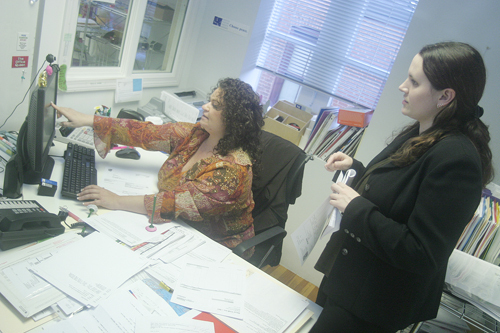
At Décor Craft Inc., a Providence-based wholesaler of knickknacks, designed gifts and holiday goods, founder and Managing Director Roni Kabessa has been trying to hire three new employees for weeks.
“We were looking to hire a few people, but we didn’t get … such high quality resumes and we were really, really surprised,” Kabessa said last week. “We kept getting very unqualified applicants.”
The jobs are in inventory control, logistics and collections for the accounting department. All are above entry-level positions and come with salaries of more than $35,000 a year and have benefits and a performance bonus, he said.
Décor Craft had posted the jobs on craigslist.org and Monster.com, but received few responses from each. In the first two weeks of it being on Monster.com, only 12 jobseekers contacted Décor Craft.
What makes the lack of interest in Kabessa’s jobs surprising is that U.S. Department of Labor’s Bureau of Labor Statistics reported that 9.3 percent of Rhode Islanders were unemployed as of October. That put the Ocean State at the highest rate in the country. The national jobless rate rose 0.4 percent to 6.5 percent from September to October and was up 1.7 percent from last October.
Rhode Island’s joblessness is at its highest rate since February 1983.
Kabessa guessed that at least some of the 52,900 jobless Rhode Islanders might be enjoying the holiday season before getting back to their job searches.
“One of the people in the office has a theory that because it’s the [holiday season] and with the extension on the unemployment, people might be saying, “We’re getting unemployment, we’ll just wait until January” to find a job, Kabessa said. “Which is possible – I don’t know what the story is.”
Another employer in a niche market, West Warwick’s Archway Bus, also hasn’t seen any increase in the number of applications, according to President and owner Stephen P. Archambault, who employs a dozen drivers, half of which are part-time employees.
“It may be because [employee layoffs] haven’t hit our industry, yet,” he said. “The transportation industry has yet to see the full impact of our economy right now. Really, since the economy has been bad and fuel prices have gone up, it really has helped our business. People are more price conscious. They’re more likely to go in a group and charter a bus.”
In the 12-month period ending in October, about 600 transportation and utilities jobs were lost in Rhode Island. That’s relatively small compared the 2,100 lost in retail and the 2,200 lost in professional and business services, according to R.I. Department of Labor & Training.
Archambault said the lack of funding for R.I. Public Transit Authority could increase the number of applications that he’s seeing. “About 80 percent of their employees are driver-based and if it comes down to a major layoff, then I’m sure I would see an increase at that point,” he said. “Until it hits a specific company in my industry, I won’t see a direct impact.”
He added that the transportation industry might see the kind of sharp declines in the coming months that have affected other industries, including construction.
David Henault, who owns Ocean State Tackle and does construction subcontracting as Updike Properties during the winter, says he’s seeing more and more people who work in construction being laid off and coming to him, looking for work.
“Right now, all the people who help me with that stuff are in the building trades and are laid off,” he said. “They’re electricians, pipe fitters, welders, general contractors and they’re out of work. And I’ve got people on hold [to work with me.] These are guys who build power plants and they’re willing to come work with me doing this work.”
He added that much of his construction work has “dried up.”
While Décor Craft’s jobs have been difficult to fill, other employers, including Lifespan, have seen a dramatic rise in applications this year.
From January through October of this year, Lifespan applications – all applications are submitted through an online system – rose to more than 76,000, a 26.7-percent jump from the same period last year, Director of Media Relations Linda Shelton said recently. While some of those applications were from out of state, the increase shows an increased competition for health care jobs in Rhode Island at a time when many hospitals are struggling financially.
“And these are applications that may not be for a specific job,” Shelton said. Many of those applicants might be applying for unadvertised jobs that would fit their credentials.
The number of Rhode Island employees at Lifespan has risen in the last year, too. While the company reported 11,022 employees last year, it now has 11,848 employees, Shelton said.
The human-resources department at Lifespan has 131 people, but that also includes employees focused on benefits and employee health. In the department, there are 20 “recruiters” who deal with the online applications, Shelton said. That number has barely changed year-to-year, even with the larger amount of applications. In the last year, it’s grown by one employee, she said.
Department of Labor & Training Communications Manager Laura Hart last week supplied data that showed a disparity between certain industries as a percentage of Rhode Island’s work force and as a percentage of the long-term unemployed.
For example, manufacturing employees make up 10.6 percent of the work force but 21 percent of the unemployed; and construction workers make up 4.6 percent of the state’s work force, but 11.5 percent of the unemployed.
White collar jobs, for the most part, account for less of the state’s long-term unemployed. While finance and insurance workers make up 5.5 percent of the work force, they make up 8.7 percent of the unemployed; professional- and technology-services workers make up 4.5 percent of the work force and 4.7 percent of the unemployed.
DLT Director Sandra M. Powell explained that as the economy dips, a worker’s skills become more important in finding a job – some industries, such as manufacturing, have long employed workers who might not have the skills needed for another job. She pointed to her department’s 160-career Workforce Investment Act program as a way for unemployed workers to enhance their skills.
“What we have recommended consistently, and even more so during this downturn, is that people take the opportunity to invest in themselves and increase their skills,” she said, adding, “Sometimes people really don’t understand, if they’ve been working for a long period of time, how important it is to upgrade their skills.”
At Décor Craft, Kabessa said he even has had bad luck with prospective employees that he’s considered hiring. He’s scheduled interviews and prospective employees have not kept the appointment or have arrived up 45 minutes late.
“But I don’t want to sound negative,” he said. “I think the most important thing here is that I’m somebody looking to hire and not getting as many applications as I expected.” •