Before Rhode Island voters get to consider allowing full-scale casinos at Twin River and Newport Grand, the legislation that would put the question on the November ballot is facing questions of its own.
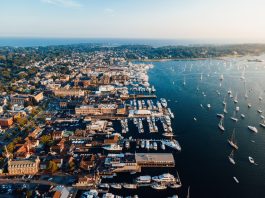
Just weeks after state lawmakers approved letting voters decide whether to allow card and table games at the state’s only two slot parlors, Gov. Donald L. Carcieri has vetoed the measure and one of Newport’s top officials says the city is prepared to fight the legislation in court, if need be.
In his veto message last week, Carcieri said the casino referendum legislation left too many questions unanswered, such as the state’s “split” from the card and table games that would be allowed if voters approved casinos in the referendum.
The governor also expressed concern that the measure usurped local control from the Newport City Council, which has opposed expanded gaming at Newport Grand. The legislation would mandate that the city put the question to its voters, overriding a requirement that local elected officials approve referendum questions before they appear on the local ballot.
“I cannot support such initiatives when critical financial information is unknown and the normal referenda process is altered without good reason,” Carcieri said.
As of last week, the General Assembly leadership had not decided whether to reconvene to override the governor’s veto.
Nevertheless, Newport officials have objected to the casino-referendum bill in part because of their loss of authority over an expansion at Newport Grand by requiring the city to put the question to local voters.
The Newport City Council last week unanimously passed a resolution voicing its opposition to the referendum bill.
“It doesn’t seem right that [the General Assembly] could totally disregard the feelings of the community,” Newport Mayor Jeanne-Marie Napolitano told Providence Business News recently. “It’s not the way Newporters want to build our economy.”
Can the state expect a legal fight from Newport? “Absolutely,” she said, before Carcieri vetoed the bill last week. “We are in consultation with our attorneys right now.”
It’s not the first time a casino referendum has created legal uncertainties.
State leaders turned to the R.I. Supreme Court in 2004 and 2005 for advisory opinions on the constitutionally of proposed legislation that, if approved by statewide voters, would have given the Narragansett Indian Tribe and Harrah’s Entertainment Inc. the right to operate a casino in West Warwick.
In both cases, the Supreme Court ruled that the measures appeared to violate the state constitution’s ban on gambling other than “lotteries operated by the state.”
By 2006, the General Assembly came up with a legal solution: It passed legislation asking voters to approve a constitutional amendment that would clear the way for the Narragansetts and “its chosen partner” to operate a privately owned resort casino in West Warwick, contingent on the approval of the town’s voters too.
Statewide voters shot down the measure by nearly a two-to-one margin.
This time around, the referendum legislation attempts to sidestep the need for a constitutional amendment – and address the Supreme Court’s previous rulings – by clarifying that the additional casino games would be operated by the state.
Jared Goldstein, a Roger Williams University law professor, believes the measure is legally sound.
“It looks to me, on the face of it, that this statute is consistent with the constitution,” Goldstein said recently. “It’s written in extremely broad language so that it says that the state has complete control in every possible way.”
The procedure for moving toward full-blown casino gambling was set in 1994, when Rhode Island voters passed an amendment to the state constitution requiring voter approval for any gaming expansion, both at the state and local levels.
That same year, voters statewide refused to allow gambling in Providence, Pawtucket, Coventry and West Greenwich and expanded gaming in Lincoln.
Things have changed since then.
State leaders have grappled in recent years with severe budget deficits, and the video slots at Twin River and Newport Grand have grown into one of the state’s biggest sources of revenue.
Twin River’s 4,752 video lottery terminals (VLTs) generated revenue of $376.76 million in the first 11 months of fiscal 2010, which started in July 2009. Newport Grand’s revenue from its 1,200 VLTs in the same period was $53.78 million.
The slot parlors don’t own the VLTs. The state leases them from several companies and collects the revenue, taking its share – 61 percent from Twin River and 63.49 percent from Newport Grand – before divvying the rest out. (Next fiscal year, the state’s take at Newport Grand will drop to 61 percent.)
Now a move by Massachusetts leaders to clear the way for two or three casinos – including one in southeastern Massachusetts – has spurred Rhode Island officials in an attempt to protect some of the revenue, considering that nearly half of Twin River’s patrons come from Massachusetts.
The casino referendum has received the backing of the Lincoln Town Council, which passed a resolution in support of putting the casino question on the November ballot.
But it also has its detractors.
Before the casino bill was approved by the General Assembly, Senate President M. Teresa Paiva Weed, D-Newport, made a last-minute plea for her fellow lawmakers to shoot it down. It was still approved, 21-14.
Paiva Weed did not immediately return messages seeking comment.
Napolitano said city leaders have traditionally opposed expanding gambling.
The fear is that a casino in Newport might endanger the city’s lucrative tourism trade.
“What happens to all the other [tourism] venues in Newport?” she said. “We just don’t know what the prospects are of allowing this.” •