
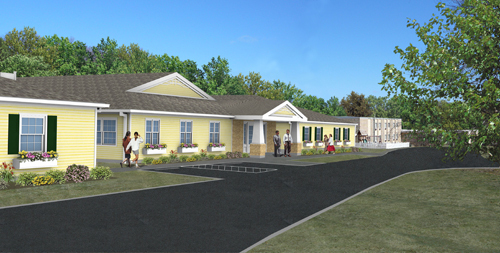
When Briarcliffe Manor owner Akshay K. Talwar decided to build a new Alzheimer’s-care facility on his 20-acre Johnston assisted living campus, he decided to first visit about 30 other facilities, ranging from New Hampshire to Florida, to get a sense of current building and design trends.
“From those visits, I tried to select the best design elements from each that I could and tried to put them into this building,” said Talwar, who last month broke ground on a new facility in Johnston, near two older assisted living buildings. “And integrated in there was a keen sense of the demographics of my area, which is a middle-class community, and an understanding” about what they could afford.
Briarcliffe’s new 20,000-square-foot Briarcliffe Gardens will be just one story. And while it might seem obvious that a facility for memory-loss patients would be a single-floor, that’s not always the case, Talwar said. Many dementia-care facilities are built with other primary uses in mind, he said.
“What happens in most buildings is you will have a combination of independent living, assisted living and then, as an afterthought, a small dementia unit,” he said. “So most senior housing is developed by people from the real estate industry, who look at it as an extension of what they’ve done in the past – apartments, commercial properties. … I’m coming to it from the other direction.”
And with a growing baby boomer population, now is the time to build, Talwar said.
And Talwar isn’t the only Rhode Islander who sees the future need for Alzheimer’s and dementia assisted living. Another developer, Herbert L. George, next month is set to open the 65-bed Albion Court of Lincoln facility. George said that with 30,000 Rhode Islanders and more than 100,000 Massachusetts residents with Alzheimer’s, he’s expecting a growing need for “dedicated, specialized” Alzheimer’s care.
With rooms renting for an average of $5,900 per month, George expects to fill his new building and, at Briarcliffe, Talwar has already seen interest, although there’s still about eight months until he expects to open his 43-bed facility.
Along with a single-story design similar to Talwar’s, George’s 35,000-square-foot Albion Court of Lincoln will have four branches. George, who calls them “neighborhoods,” said the branch system is one of the most important design elements. He said that’s part of an overall attempt to create a more “residential” feel.
“We do that because there will be an average of about 15 residents to each neighborhood,” he said, allowing for smaller dinner gatherings and the like.
But the size and shape of the building aren’t the only important parts of a design. Less obvious choices are also important, George said. For example, the lighting patterns in his new building have been designed to cut down shadows – to avoid falls – and to ease the transition between day and night.
“Alzheimer’s residents get very agitated when the sun goes down. They call it ‘sundowning,’” he said. “To compensate for that, we have special lights on top of our windows. When the sun goes down and it gets darker in their room, this light goes on.”
And George also intends to continue building. He’s now in the permitting process for a second Rhode Island location, tentatively called Albion Court of Exeter.
“We intend to do a chain – some in Massachusetts and some in Connecticut,” he said, adding that each will cost about $10 million.
An Alzheimer’s facility is challenging, Talwar added, because creating a building for tenants requires a balance between functional design and what future residents will be able to afford.
“As you’re designing, people say, ‘It would be nice to have a swimming pool. It would be nice to have this or that,’” he said. “But when you do all those things, you find that you’ve cut a large segment of the market out.” •