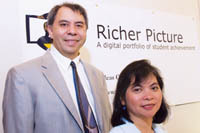
David Niguidula and his wife, Reina Quintero, founded Ideas Consulting Inc. to bring the concept of digital student portfolios to schools across the nation.
COMPANY PROFILE
Ideas Consulting Inc.
Owners: David Niguidula and
Reina Quintero
Type of Business: Software and consulting for K-12 schools
Location: 134 Thurbers Ave., Providence
Employees: 10
Year Founded: 1999
Annual Sales: WND
Providence firm helps schools build portfolios showing kids’ best work
Olivia’s digital portfolio gives a snapshot of her entire high school career, from her best essays, science projects and math problems to audio recordings of her flute performance and video recordings of how she expresses herself in an end-of-the-year review with her teachers.
This is how Ponaganset High School evaluates its students. More than grades, the school’s leaders believe, a portfolio can show students’ progress from grade to grade and measure their work against academic performance standards.
The notion of using digital portfolios as assessment tools began in the 1990s. David Niguidula led original research on the matter with a team from the Annenberg Institute for School Reform and the Coalition of Essential Schools at Brown University in 1993.
In 1999, he and his wife, Reina Quintero, incorporated Ideas Consulting Inc. to bring the concept to a broader audience. They developed Web-based software called Richer Picture, a system that allows students and teachers to create and review portfolios on a secure server.
Since then, they’ve helped schools implement digital profiles for more than 20,000 students in Rhode Island, New Hampshire, Maine, Massachusetts, New York and California.
The process starts with an initial consulting session. Niguidula and Quintero sit down with school staff to discuss their goals and expectations.
“The essential questions schools need to address are: What’s the purpose? Who is the audience?” Niguidula said.
Ideas Consulting customizes the digital portfolio system to meet the school’s needs. And the software is packaged with professional-development workshops designed to help school facilitators learn how to use the technology.
At the high school level, it’s the students’ responsibility to upload the assignments they think best reflect their progress, he said. They can include Microsoft Word documents, Microsoft Excel documents, and some even attach microphones to iPods to record themselves speaking for foreign language assignments.
At the elementary school level, schools depend on volunteers and teachers to help students scan work, such as a writing assignment, into the digital portfolio system, he said. Many use webcams to record videos of students reading assigned text.
“It’s amazing the progress they make,” Quintero said. “You can see their reading skills improving.” Teachers have used the videos in parent-teacher meetings to show parents their child’s progress, she said – and, in some instances, to persuade parents to get a tutor.
Niguidula said he and Quintero have helped schools apply for grants to secure funding for implementing the digital portfolio systems.
The couple’s business has gotten a boost from the fact that across the nation, the so-called “standards movement” in education has put an emphasis on having students demonstrate their skills through their work, rather than just through their test scores and course grades.
Rhode Island in particular adopted a “graduation by proficiency” requirement in 2003 that mandates such an approach – though not necessarily digital portfolios.
Along with meeting the state requirements, Quintero said, digital portfolios can help graduating seniors as they apply for college or pursue a scholarship. A student applying to Rhode Island School of Design, for example, might create a “tour” of his portfolio that highlights digital photographs of his artwork, she said.
“I think it’s a very important tool for students,” Quintero said. “They become a more defined person.”
Developing digital portfolios can be a defining tool for teachers as well, she said, because it can help them develop lesson plans that reflect their school’s and the state’s standards.
Niguidula said it’s rewarding to see how the digital portfolios make the parents, students and teachers interact in ways they might not have before by creating a common ground to comment on.
“It’s about a kid being able to say, ‘This is who I am as a student,’ ” he said. “They’re not just a number in a classroom.”
Ideas Consulting can be reached at (401) 785-0401 or www.richerpicture.com.