About 80 percent of Bay State physicians have prescribed unnecessary tests or given patients referrals that weren’t needed, for fear that they’d be sued if they didn’t do so, according to a study released in mid-November by the Massachusetts Medical Society (MMS).
The practice, called “defensive medicine” is excessive and widespread in the medical community, where patient litigation is a growing threat, said Dr. Alan Woodward, a semi-retired emergency physician, former MMS president and current vice chair of the MMS Committee on Professional Liability.
A similar study in Pennsylvania in 2005 also demonstrated that the practice is widespread. There, the American Medical Association reported that 93 percent of physicians surveyed said they practiced defensive medicine either by using “imaging technology in clinically unnecessary circumstances” or referring patients for consultation when it wasn’t necessary.
The MMS study aimed to further break down the ways in which physicians defend themselves against possible lawsuits. Woodward said the study looked at the impact on access and patient safety, as well as cost, for seven different tests: X-rays, CT scans, Magnetic Resonance Imaging, ultrasounds, laboratory tests, specialty referrals and hospital admissions.
Between November 2007 and April 2008, surveys were sent to 3,650 physicians, with about 880 responding. MMS released its findings Nov. 14.
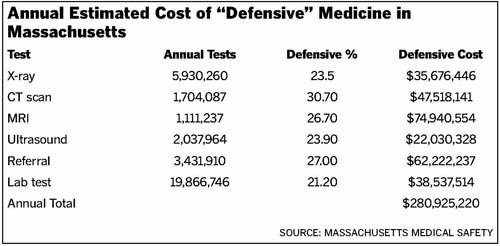
“In essence, 83 percent of physicians in eight specialties told us that 18 percent of lab tests and 20 percent to 30 percent of those other diagnostic studies and referrals were done for defensive medicine reasons,” Woodward said.
With the survey results in hand, MMS calculated an estimated cost, using Medicare figures for average cost for each of the specialties. All tolled that equaled an annual cost of about $281 million, according to the study.
And the cost of “unnecessary hospitalizations” was a staggering $1.4 billion annually, bringing the annual total for defensive medicine to about $1.4 billion, Woodward said. Nationally, that total could be about $100 billion annually, the study says.
That overall cost was a “huge” 8 percent to 15 percent of health care costs, he said. Health care is “unaffordable” and cuts need to be made, he added. Two years ago, the state passed Chapter 15, a move toward universal health care coverage. Now only about 3 percent of the state’s population is uninsured.
“So if we’re going to be serious about dealing with the cost of health care, we feel this is an area we need to address, without question,” Woodward said. “This is one of the major, major components of unnecessary health care costs.”
And it’s important to break the defensive medicine costs out of the total health care dollars, because it isn’t spending that helps patients. And even though the tests could identify a disease or problem, that’s “a very small percentage,” Woodward said.
“With that logic, you’d say that every year you should have every test that’s available,” he said, “and that’s just not an affordable methodology. Physicians should be practicing evidence-based medicine.”
Litigation stemming from patients is a “huge” industry concern, Woodward said. The study points to medical malpractice premiums that have quadrupled since 1975 and cites average patient awards of $4.7 million. About 52 percent of all awards are more than $1 million.
In the study, some physicians – 38 percent – said that they have stopped doing high-risk procedures and 28 percent said they’re avoiding high-risk patients. So patient access to medical care is being affected, Woodward said.
Other practices are changing, too. Some physicians are retiring early because of fears of litigation. Others are carefully choosing their focus and practice areas.
“And we know that some are choosing specialties – even in training, now – to avoid high-risk specialties, because they’re being advised that the premiums are unaffordable and the litigation is so onerous,” Woodward said.
At least part of the “fear” of litigation stems from the lengthy process associated with being sued for malpractice in Massachusetts. The process takes an average of about five years, he said.
“The impact is tremendous on the physician and their practice – their divorce rate goes up, their depression rate goes up, their suicide rate goes up, their heart attack rate goes up,” Woodward said.
But the real issue is that it has an impact on their practice, including a greater propensity to practice defensive medicine after they’ve been sued once, he said.
Woodward said he hopes the results of the survey will help lead a conversation about how to alter the “adversarial process that creates this fear and anxiety.” Instead of litigation, MMS would like the state to move toward a process that’s more open, “honest and fairer to patients, but also doesn’t take a toll on the work force.”
Such a model would also allow for a re-evaluation of practices, a process that Woodward said is still lacking in the current patient-physician legal relationship. “There’s the wall of silence, the culture of secrecy,” he said. “There’s the blame-and-deny game and so often you don’t go back and do the root-cause analysis and figure out how you could have affected this injury and how you can prevent subsequent injuries.”
Another approach to solving the problem would be adjusting the malpractice litigation system to focus on the “enterprise” where the physician practices, not the physician personally. That would “help to eliminate physician fear of medical liability and in turn the practice of defensive medicine,” the study says. •