
Local oil dealers and most of their customers are breathing sighs of relief now that the price of oil has plunged from the record heights it reached this past summer.
With a global economic slowdown curbing demand, the price of a barrel of crude oil has dropped by more than half over the past four months. After spiking to nearly $150 in July, oil has been trading at between $60 and $70 per barrel on global commodities markets in recent weeks.
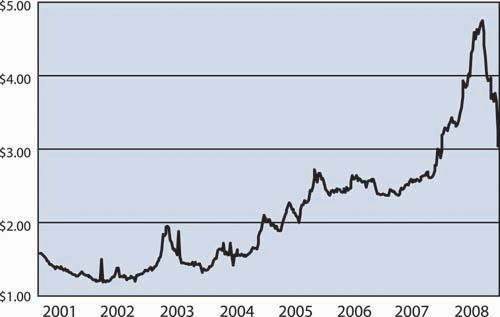
The drop has led to a corresponding fall in the price of various petroleum goods, including heating oil. The average price of heating oil in Rhode Island has dropped by about 40 percent since last summer, falling from $4.75 on July 14 to $2.79 on Nov. 3, according to the R.I. Office of Energy Resources.
Of course, it was not long ago that $2.79 would have been cause for alarm rather than celebration. Two years ago this week, the price of heating oil was $2.37 per gallon; four years ago, it was $2.02. In 2001, the price was just $1.26.
Nevertheless, oil dealers say the recent price drop has lessened some of the pressures on them. “I think we’re all thrilled that prices dropped,” said Mike Genario, whose family has owned Sunshine Oil in Bristol, which has 3,500 heating oil customers, since 1938.
Residential and business customers are also relieved. More than 40 percent of the state’s homeowners heat their homes with oil.
“This winter was like a price hurricane sitting out there, particularly for residential” customers, said John Farley, executive director of The Energy Council of Rhode Island, which represents large commercial and industrial energy customers in the state. “When the price comes down, it just helps.”
Many businesses, on the other hand, have dual-fuel heating systems and already switched from oil to natural gas, Farley said. Although it is likely that gas will still be cheaper this winter, he said businesses are comparing prices again.
Contrary to what some may think, the run-up in oil prices was not beneficial to dealers, said Julie Gill, executive director of the Oil Heat Institute of Rhode Island, a trade group that represents 32 dealers who deliver roughly 75 to 80 percent of the oil delivered in the state. Independent oil retailers are as much at the mercy of global markets as their customers.
“The oil dealers are getting it from every side,” she said.
Most dealers rely on lines of credit from their banks to pay for oil from wholesalers while they await customers’ payments. But as the price of oil rose, many dealers found they were reaching their account limits – and that was before the credit crisis, which has led some banks to scale bank their credit lines. A lower price has reduced that concern.
In addition, many oil dealers had already squeezed their own profit margins to help reduce their customers’ costs last winter. “The problem with a lot of this business is it’s personal,” said Genario. “We do know our customers, so it’s harder to say no to extending credit.”
Dealers also faced escalating fuel costs of their own as they found themselves paying more to run their fleet of diesel trucks.
“The run-up in prices was uniformly a loss for the oil dealers,” Gill said.
In the retail oil industry, much of the anger is directed at speculators, who are blamed for artificially inflating prices beyond their fair market value. “We are absolutely certain that it was greedy speculators in the markets,” said Gill, who thinks there is still a lack of transparency in the commodities market.
Dealers are also concerned that customers who signed fixed-price contracts during the summer will try to wiggle out of the agreements, which often locked in prices of around $4 per gallon. Since dealers have already contracted to purchase the customers’ oil at that price, they will still be on the hook at the higher price even if a customer reneged, Gill said. The Oil Heat Institute met with the state attorney general’s office on Oct. 30 to discuss the issue.
“It’s a two-way street,” said Genario. “Last year customers that locked in fixed-price contracts hit a home run, because they were paying $2.50 or $2.80, and prices jumped to well over $3. Now this year it’s just the opposite.”
Still, he doesn’t blame customers. “You have to look at the psychology of the sale,” he said. “When you go back to July, you had everybody under the sun predicting oil was going to go to $200 a barrel and heating oil was going to be $5 or $6 a gallon. People were looking at a price of around $4 or higher, and they said, I’m just going to lock it in – all hell’s breaking loose.”
Gill said one dealer, whom she did not identify, signed 600 fixed-price contracts this summer, but also included the option for customers to pay a small cancellation fee to get out of the contract – and many are now using it. “He stands to lose tens of thousands of dollars,” she said. “It could literally put him out of business.” If too many of the state’s 110 dealers find themselves in similar circumstances, Gill fears the state won’t have enough dealers to meet demand.
People’s Power & Light, the nonprofit energy consumer alliance, is also taking advantage of the price volatility to attract new customers for its 26-year-old Discount Heating Oil Service, which has over 12,000 members in Rhode Island and Massachusetts. Oil dealers who participate in the program agree to sell fuel at a smaller markup from the wholesale price than they offer their retail customers, usually lowering the price by 15 to 30 cents per gallon.
The group recently announced that it has now expanded the service to make it available in every community in Rhode Island, except on Block Island.
Phil Landsay, oil program director of the Mass. Energy Consumers Alliance, which is a partner group of People’s Power & Light, recently predicted that the groups’ oil price will stay under $3 for the next few months, barring a severe natural or political disaster.
But the group still recommends that consumers focus on conservation for economic and environmental reasons – and considering the volatility of the past year, nobody wants to go out on a limb predicting prices.
“I’d walk away from anybody with a crystal ball who said, ‘This is what’s going happen,’” said Gill. •


