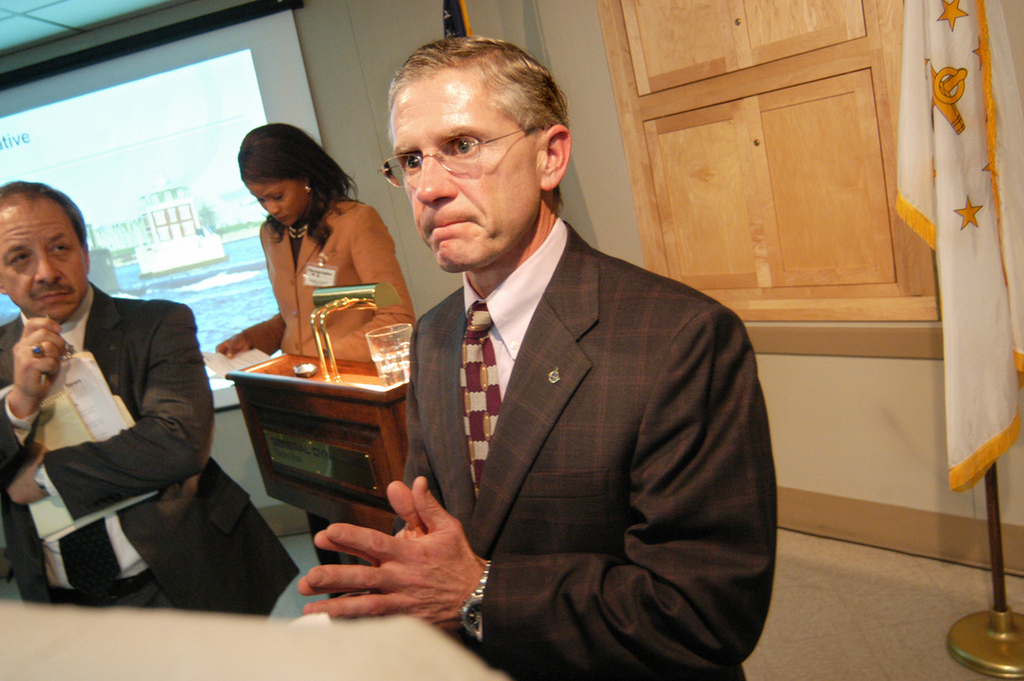
With Electric Boat’s likely inking in 2008 of one of its “most significant” contracts, President John Casey this month predicted a strong, steady need for 2,000 employees at its Quonset Point facility in North Kingston over the next 10 years.
“We see very, very stable employment here at the 2,000-employee level for the foreseeable future,” Casey said, adding that there will be modest growth. The company projects Quonset employment topping 2,500 by 2015.
Nationally, the division of General Dynamics employs about 10,500 and predicts stable jobs for 8,000 during the next decade. Most employees who leave the company during the next few years will do so voluntarily, Casey said Dec. 6, at the company’s annual legislative meeting.
Those employee projections are based on production estimates, which Casey reported as strong. For Electric Boat, the increase in the Navy’s 2008 defense spending is going to bump up the production schedule on the 353-foot Virginia Class attack submarines.
“The original Navy plan called for production of one ship in 2009, one in 2010, one in 2011, two in 2012 and two in 2013,” he said. But those expectations were increased by 2008’s $588 million increase in the Navy’s defense-spending budget to more than $3 billion. “It’s a very significant increase that will allow us to accelerate to production of two Virginia Class ships per year as early as fiscal year 2010,” Casey said.
Casey expects an RFP for one of the company’s most significant projects to date – an eight- or nine-ship contract by early 2008 – with negotiations being finalized by next October. “But I caution people about that very precise-looking October date, because, as you’re all well aware, that at that time next year we’ll be wrapping up a presidential election,” he said. “The administration in Washington will be changing in one way or another.”
The production of those ships also will be a test of new practices for Electric Boat. The company has been working to further streamline production through new technology and designs that were developed through a $600 million, Navy design-affordability program.
“When people are thinking about efficiency, oftentimes they’re thinking about the shop floor and the things people do during the course of the day. In reality much more of the cost is controlled by what you include in its design,” Casey said.
And material costs are rising, too. They now represent about two-thirds of production cost, Casey said. With new procedures, though, the company should be able to cut total spending. “Ultimately these changes we’ve been working on – including design changes – will allow us to reduce the schedule on these vessels to about 60 months,” Casey said.
Casey credited U.S. Sens. Jack Reed and Sheldon Whitehouse, along with U.S. Reps. Jim Langevin and Patrick Kennedy, for supporting Electric Boat in Rhode Island.
“Their efforts led to the $588 million we’re talking about,” he said.
Since 2005, Electric Boat has worked on renovations of four SSGN vessels – the Ohio, Florida, Michigan and Georgia – three of which are finished. Electric Boat’s portion of the $4 billion national contract – $1.5 billion – was done for $100 million less than the contract called for, Casey said.
Many of Electric Boat’s future repairs for Navy vessels will be completed at its Groton, Conn., facility. About 1,500 Rhode Islanders cross the border every day to work there, Casey said, and an increase in that aspect of Electric Boat’s business could affect them.
During the past year, there has been an “unexpected” boom in repairs. And about halfway through 2008, the company expects another increase.
“At least halfway through this coming year, we expect a full plate of this workload,” Casey said.