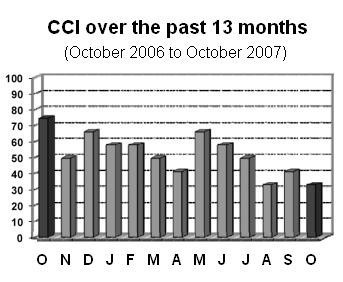
 his most recent CCI report. / " title="HIS INDEX of current conditions in Rhode Island has been trending downward, Lardaro noted in his most recent CCI report. /"/>
The state’s projected $450 million budget deficit will probably drag Rhode Island into a recession in 2008 and keep it there while the rest of the country sees economic improvements later this year, a University of Rhode Island economist predicts.
Leonard Lardaro last week said the deficit situation projected for the fiscal year that begins July 1 will “broadside” the state as the housing and manufacturing sectors start to make a recovery nationwide in the second half of the year.
“The beneficial effect on the economy will occur precisely at the same time that we have to take actions that will slow our economy down – actions to balance a very large budget deficit,” he said in an interview with Providence Business News.
In fact, Lardaro said Rhode Island already may have entered a recession – generally considered to be two or more successive months of economic decline – judging by the leading indicators in his Current Conditions Index. For instance, new home-building permits declined 46 percent in the third quarter of 2007, and employment service jobs – including temporary positions – fell by 10.5 percent in the same time period.
“I can’t really nail it down for a few months, but we’re probably in the early stages of a recession,” he said.
Lardaro outlined his economic forecast for 2008 during a meeting of the Smaller Business Association of New England (SBANE) in Providence on Jan. 9, and he provided other gloomy predictions:
• Only 1,000 jobs would be added to the work force in Rhode Island during 2008 – a 0.2-percent increase. He scoffed at one projection he had seen that had Rhode Island jobs growing by 4,000.
• Personal income growth will slow to less than 1 percent in 2008. According to Lardaro, Rhode Island already has lagged behind most other states in personal income growth over recent months.
“These are going to be very difficult times with no easy answers,” Lardaro said.
SBANE members were hardly surprised by Lardaro’s findings that a recession is either coming in Rhode Island or is already here.
“There is still new business out there,” said CPA Richard Kaplan, a principal at Yarlas, Kaplan, Santilli & Moran in Providence. “But overall, the business activity has dropped, and the optimism has dropped.”
“We already have high taxes in this state,” he added. “How are they going to balance the budget?”
State leaders have been grappling for months with how to close a budget deficit that is projected to be as high as $450 million. As part of a response, Gov. Donald Carcieri has launched an effort to cut 1,000 state jobs, which he had said would save $100 million.
The budget crisis is taking a toll in other ways. Fitch Ratings, a New York-based credit rating agency, already has notified the state that its bond rating might be downgraded, thus increasing borrowing costs and adding to the state’s money woes. Lardaro predicted Moody’s Investors Service wouldn’t far behind with a warning of its own.
“And with the debt we have, [downgrading] one notch will not be pretty,” he said.
Right now, Lardaro said, the national economy is slowing and Rhode Island is slowing with it. But he foresees improvements nationally in the second half of the year as the manufacturing and housing industries make a slow recovery, federal interest-rate cuts start to take effect and exports pick up.
Lardaro believes those factors will be enough to save the national economy from a recession. “I could be wrong on that, but I don’t think I’m going to be,” he said.
Rhode Island is a different story, however, largely because of the structural budget deficit. Lardaro said a recent Rhode Island Public Expenditure Council report projected that reoccurring state deficits will be as high as $200 million for the next several years.
“We’re really up against it,” Lardaro said.
His advice: The state should use the opportunity to “reinvent” the government.
Lardaro criticized the state’s tax policy as “piecemeal.” And he said leaders have failed to smoothly transition the state economy from a manufacturing economy of old. “We’ve got to systematically look at where we want to be, and what we need to do to get there.”
During the SBANE meeting, Lardaro also launched barbs at the General Assembly for ignoring the state’s poor “tax-and-cost structure, which is not competitive” with the rest of the nation.
“They’re just not in the same reality as us,” Lardaro told the audience, referring to the elected officials.
State Rep. Douglas Gablinske (D-Bristol), a small-business owner in his first legislative term, agreed with Lardaro’s economic forecast, but he added that business leaders hold some responsibility to spur changes in the way the state does business.
“Each and every one of you should talk to their representatives to make sure he or she is doing what you want to reduce taxes in this state,” Gablinske told the SBANE members. “It’s up to all of you to look in the mirror.”
Still, Lardaro is not convinced large-scale changes will be made.
“[The budget problems are] distracting our leaders from doing long-term planning – and that’s part of the cost of this deficit,” Lardaro told PBN. “How we balance the budget is critically important. We want to do it in such a way that will preserve economic growth as much as possible in the future.”
“There are no quick fixes because the quick fixes were done in past fiscal years,” Lardaro said. “All the easy fixes·are gone.” •