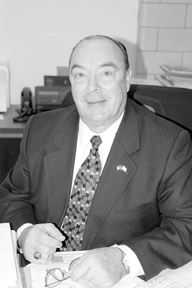
state's fire marshall for nine years.
State marshal says acceptance of new codes is key among businesses
Irving J. Owens
Position: State fire marshal
Background: Owens started as a Warwick volunteer firefighter in Oakland
Beach in 1962 after serving in the Army. In 1966 he joined the Warwick Fire
Department. Two years later he began work within the department’s fire prevention
bureau where he spent most of his career rising through the ranks to city fire
marshal. He has been the state fire marshal since 1995.
Education: A graduate of Roger Williams University and the Southern
New England School of Law
Age: 63
Residence: Warwick
Q. The state’s new fire code regulations were signed last July. What is your reaction to them?
A. First of all, being in the field and especially seeing what’s transpired lately (the new codes) are a very good thing. I think that once we deal with (the codes) directly with the businesspeople, I’m sure they won’t think it is as bad as they thought originally. What we’ve been doing is training our people in the proper methods of inspection. Not that we haven’t done that before, but now we need to relate how to apply them, such as making sure that they deal with people appropriately, doing the standard work of filling out forms and helping people make the changes. I’ve explained (to businesses that) we need to look at a facility first before anyone can say, off the top of their head, how to do this or that. There are some places that are not going to have to change and others will have a lot of changes to make. Not every building is going to fit within the confines of the code, so we need to apply the code appropriately and have the people aware of what is taking place and work with them for compliance. We have a Fire Safety Code Board of Appeal and Review. Structures not capable of change can go before the board and ask for a variance. Our concern is people respect the law and work within its parameters and that it is done appropriately.
Q. What is the budget of your department?
A. At the present time it is about $1.4 million. We were officially given 21 full-time employees as of June. As of the passage of the legislation we were given six additional employees. So we will have 27 people. With the new positions, the $1.4 million figure will be enlarged. I don’t have the figures on this year’s budget because we are still working on things that we need such as clothing and vehicles.
Q. Can you explain the relationship between the state and local fire marshals?
A. State law designates the state fire marshal as the enforcing agency. Within that confine, we are allowed so many people to do the job. Our office is broken down with a fire marshal, a chief deputy and an inspection, technical service and investigation division. The inspection division is required to inspect all state and federal facilities. We used to get more money from the feds to do nursing homes but that is dwindling down, by the feds’ choice. We do day-care centers and anything that is licensed by the state. We are asked by cities and towns to go into municipalities from time to time. The technical service division has an explosive disposal technician and a person that does a juvenile fire-setter program as well as some electrical and fire alarm work. I’m responsible for every suspicious fire investigation in the state by law. The law also says, besides our division, I may select as many assistant deputies as needed to do fieldwork. I ask the fire chiefs to send me a letter indicating who they would want in their division to be an assistant deputy. With that, we train them, give them a certificate and they go back and do the inspections in their city or town. If there is a state facility in their town, we do it. If there is a group home, our office does it and we make sure the locals are aware of it.
Q. What are your feelings regarding the trend of historic structures being rehabilitated for commercial use?
A. I think it is a good idea. I think that historic buildings should be saved. I’m not a city planner so I really don’t know all the aspects of what they know or want. But I’ve seen extremely delicate places that can be protected. One of the first and foremost things that I would require and request is a sprinkler system, because sprinklers can save your building. They are there 24 hours, seven days a week. I also recommend a fire alarm system. Immediate notification is extremely important. Beyond that, there are so many things today that people can do to protect a building. A couple of years ago we had a commission put together for the rehabilitation of buildings and at first I wasn’t too keen on it. But we sat down and came up with a standard with sprinklers, corridors, exits and fire alarm systems. I think all in all it will work. I think it is a good thing for the state because some of these structures now we would never be able to afford to build.
Q. The idea of bringing regular barges, rather than trucks, into the (liquefied natural gas) facility in the Port of Providence … is it a good idea or a bad one?
A. We need to look at it with a sense of protection for the people. I attended a hearing a very short time ago. I am on the LNG committee. At the initial meeting, a lot of things were explained and I think we are going in the right direction.
Q. What jurisdiction does your office have regarding LNG?
A. There are certain aspects in the code that give us jurisdiction. It is broad. I can’t say specifically which area other than the facility itself and the docking. When they were describing the area, they seemed to know about protection.
Q. Is there a particular red flag?
A. Within the National Fire Protection Association standards there is a section on LNG. This is what’s so good about our program, we don’t come up with these things just because I think it is a good idea. It’s a consensus code. There are many experts in this field in the LNG business on the committee, plus fire and building people.
Q. You have been in the fire business since the 1960s. What is the biggest change you’ve seen in the fire marshal profession?
A. The biggest change is with the codes. It’s been historical in the fire field that when (a situation) of this magnitude occurs, (The Station nightclub fire) things change. Before this, you may ask for this or that and it depends on people accepting it … it is not so much being forceful or hitting them with it enough times. It’s how they accept it. We have a very good track record of changing, especially in the fire alarm section. We have a fire alarm group in Rhode Island with members from our office and businesses. They have been so instrumental in modernizing the fire alarm systems. We have to be cognizant at times because we have no control over pricing, but when we are dealing with the human factor we have to make sure we do it in a proper method. We’re not trying to put people out of business. But there are certain things in the law that we have to maintain. The governor said it perfectly when he said the laws will be strict and they will be respected and enforced.
Q. What is your ideal for seeing the new regulations unfold as the first round of deadlines approaches?
A. I’d like to see everything done right away. I’ve spoken with various people in the business community and a prime question was what if we come to a stalemate? Sprinklers and fire alarm (questions) are a big thing. What if I can’t get a sprinkler company to come at this particular time? The answer I give is as long as we see progression and that you’ve tried and there’s a legitimate reason – that’s when you go to the board of appeal. Realistically, the board will say OK, come up with a plan.
Q. It sounds like you are looking for a good-faith effort.
A. Absolutely. And there are things in the code that say they should have a fire person in the building during an event until the sprinklers are in.
Q. Looking to the future, would you like to see more regulations?
A. Looking at the legislation, there is an impact study that has to go on. Now is the time that if we set more goals or parameters, they have to be real and we need to work with the business community. We can do it. We have to set an atmosphere of fire safety. There is a segment in the fire commission report, and I think it is very well written, that says we have to create an atmosphere of fire safety, protection and prevention.
Q. How does your position work – is it appointed?
A. It is a five-year term appointed by the governor with the advice and consent of the Senate.
Q. So you are coming up on completing your second term. Any plans on what happens when that comes up?
A. Yes, I would like to stay until I finish some of the things that
need to be finished. I don’t want to leave in the middle of this atmosphere.
We have a good system and good people in the office. I think it is necessary
that we continue to show the entire state that we do a good job.
Joy Fox is a contributing writer to PBN.