In 1997, the weathervane that sits high atop the 185-foot steeple at the First Baptist Church in America, on North Main Street in Providence, was struck by lighting.
“It didn’t do any real harm to the church, but it did peel off some of the gilding on the weathervane,” said Stanley Lemons, the church historian who is also a member of the restoration committee and commissioner of grants for the church.
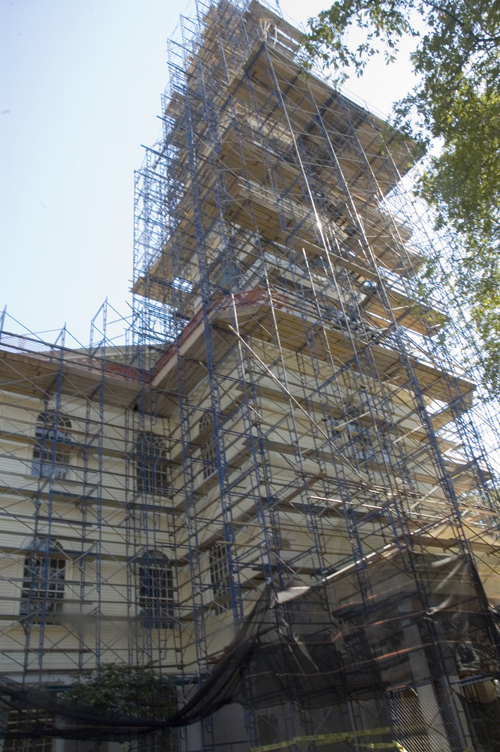
So now that scaffolding has been put up to paint the exterior and reconstruct some of the siding of the building, there’s an opportunity to take down the weathervane and re-gild it with gold leaf. “And it did weather a little bit,” Lemons added last week. “It’s not so much corroded as peeling and I think the lightning strike did a little bit of peeling, too.”
And those aren’t the only changes being made at the 233-year-old church, which is on the National Register of Historic Places. While the scaffolding is up, the restoration committee is also taking down chimneys, fixing the clocks in the steeple and upgrading the lightning-suppression system, Lemons said.
“Everything they can find to fix, they’re fixing,” Lemons said of the $800,000 project. “It’s just a series of small details – masonry, carpentry, the lights. Whatever needs to be done.”
The project is being overseen by Haynes/de Boer Associates, Architects of Providence.
The last time the church was painted was in 1992, Lemons said. In a Sept. 15 church circular, the restoration committee announced that it had voted unanimously on what color to re-paint the church. “Navaho White” was the choice, it noted, saying that “most people will see that the color is almost identical to what was already on the building.”
Three “derelict” chimneys have been removed, but they were not original to the structure, Lemons explained. They were on the corners of the building and had been installed during the 19th century.
The exterior renovation comes a few months after the rebuilding of a retaining wall this spring along the Benefit Street edge of the property. There, a consortium led by Rhode Island School of Design’s then-President Roger Mandle, asked the city to rebuild the wall. It had been knocked down after cars drove over it in January and March of 2004.
The city funded that $150,000 project, Lemons said, because it was their wall. “The city had paid the church to put the wall up in the first place, back in 1794,” he said. “It had lasted until now … and this will last a lot longer.”
For some reason, driving onto the church’s one-acre campus is a bigger problem than some would realize, Lemons said. The wall has been hit enough that there’s a proposal to put a metal fence around the property.
And the restoration committee is also planning extensive changes to the interior systems – including the fire alarm and the sprinkler system. It will be a major renovation of the control center in the basement and will likely include changes to the interior walls. The fire codes have been updated twice since The Station nightclub fire in February 2003.
“After that [fire], they treated all the churches like they’re nightclubs,” Lemons said. “But they’ve backed off on that a little bit and they’ve revised the code again.”
The building has to be up to most codes by December 2009, except for the fire alarm system, which has to be completed by 2010. “But we’re trying to get the whole outside of the building fixed up,” Lemons said, “because once that’s all secure and sealed up – get all the leaks out of the place – the building can go for a long time.”
That doesn’t mean the inside has been neglected. During the last two years, the church has completed a series of projects, including installing new boilers – a $300,000 project financed by R.I. Historic Preservation & Heritage Commission, the Fidelity Foundation and Champlain Foundations – rebuilding the organ for $400,000 and stabilizing the steeple for about $30,000.
The current project is also being funded by the church, Lemons said. “We have the money to spend,” he added. And while the weathervane and clock renovations will restore the aesthetics of the church, Lemons is aware that they’re “obsolete.”
“I don’t think anyone walks by the First Baptist Church and says, ‘I wonder which way the wind is blowing,’ and looks up,” he said. •