Connie McGreavy was “green” before it was chic.
Over the course of her three-decade-long career, McGreavy has experienced the ups and downs of the alternative-energy industry and the broader environmental movement. She describes as “uncanny” the parallels between the late 1970s, when she graduated in the wake of an oil shock that heightened awareness of the need for energy efficiency, and today.
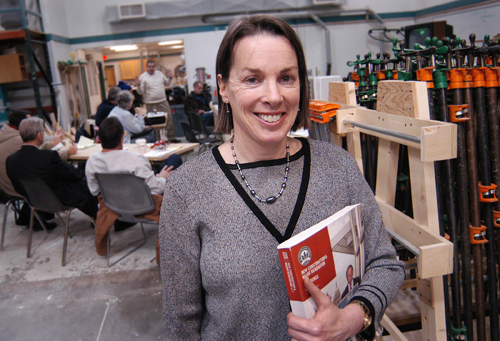
Today, McGreavy, 51, owns Conserve By Design, a green consulting firm that she runs out of the Warren home she shares with her husband. But she is just as busy with a second job for which she does not get paid, as the founder and chair of the nascent Rhode Island chapter of the U.S. Green Building Council.
“I’m a workaholic – it’s a disease,” McGreavy deadpanned during a recent interview. “It has its good points and bad points. I’m just a driven person, and I’m very focused and committed. So when I take something on I’ve thought about it, and then I go in full bore.”
McGreavy, who grew up in Westerly, was always interested in the environment. Her parents, an insurance salesman and a nurse, raised four children, all of whom became scientists and engineers. “It must be genetic,” she said.
McGreavy graduated in 1979 from the University of New Hampshire, where she studied environmental conservation. (She later earned a master’s in public administration from the University of Rhode Island.)
“When I graduated in 1979, it was not unlike today – energy was a huge focus,” McGreavy recalled. She got a job at a regional planning association, and within a year received a certification to install solar hot-water panels.
Soon, though, she also got a lesson in the ways national leadership can change the climate. After Ronald Reagan became president in 1981, Congress allowed the solar tax credits pushed by President Carter to lapse, and much of the industry “disappeared,” she said. “It sort of collapsed, the momentum.”
McGreavy returned to Rhode Island, and took a job at an environmental engineering firm. One day, a client asked her to take measurements of his restaurant, and she became fascinated by design. “That’s when I sort of discovered another love that I had,” she said.
McGreavy, headed to a Home Show builders’ convention, where she managed to get offered a job as a laborer by Dan Paquette, an environmentally oriented builder who had a small firm and went on to became a lifelong associate of McGreavy’s.
But, McGreavy recalled, first Paquette and his small, all-male staff “had to have a company meeting to see if they wanted a female.” They agreed to take her on. “So I strapped on my tool bag, and started hammering and doing all of the things from the foundation up, because I really wanted to learn about design.”
McGreavy said she was not fazed by the challenge of breaking into a male-dominated industry. “You can’t be afraid of that,” she said. “I think you have to have a certain confidence level and self-assurance, and I had that – I persevered. I was made to carry bundles of shingles up to the roof, which was hard. I had to hold saws that were this big” – she spreads her arms wide – “and the guys were watching.”
“So, yes, you had to prove yourself,” she added. “Women have to continually prove themselves.”
In less than a decade, Paquette’s firm grew from six employees to 60, and its sales eventually topped $4.5 million, thanks in part to McGreavy, who rose to become the firm’s director of marketing and sales. And many of the technologies they were using then are back in vogue today, she said: “We were using all these latest technologies 30 years ago.”
After leaving Paquette’s firm, McGreavy worked as an environmental scientist, planner and policy advocate for a range of firms on a variety of projects, including the Providence Place mall, for which McGreavy conducted reviews to satisfy a huge number of permit applications.
“That was fascinating,” she said. “It’s fabulous, because you get into the history [of the site], and you see how these things evolve and what happens to them. And then putting them back into reuse is a good thing.”
McGreavy founded Conserve By Design last year, after she and Paquette were approached by the New England Institute of Technology to help the school build a green campus in East Greenwich. “And when we went to the meeting,” she recalled, “I said to them, ‘Well, why stop there? You are incredibly poised, in terms of your academics and your technical bent … to integrate sustainability into your curriculum – because we need these people trained yesterday.’”
McGreavy is extremely enthusiastic about the possibilities at NEIT, which now takes up most of her time at Conserve By Design. She regularly receives calls from other prospective clients, but “in this economy, I get the inevitable: ‘We’re just going to wait,’” she said. “People want to do things … but [right now] people are afraid to move.”
In the meantime, McGreavy is spending as much if not more time laying the foundation for the state chapter of the Green Building Council. Before she began organizing it, Rhode Island was one of only a handful of states without a council chapter, and the response has been huge – more than 1,000 people, companies and organizations are in the chapter’s database.
“I can’t tell you how many people have said, ‘I’m so glad you’re doing this – I’m so glad somebody is doing this,’” she said, adding: “And some people have said, ‘I can’t believe you’re doing this – like, how can you [have the time to] do this?’”
She also thinks the council’s efforts to get sustainable practices integrated into the state building code can play a major role in forestalling another collapse of the movement, such as happened in the early ’80s.
McGreavy has always stayed involved in public life, from working on the creation of a local historic district in Warren to lobbying the local school district. She also served two terms as co-president of the Environmental Council of Rhode Island.
“I like to do things that serve the greater good, the public good,” she said. “That’s why the chapter is as big a love of mine as having my own business.” •