
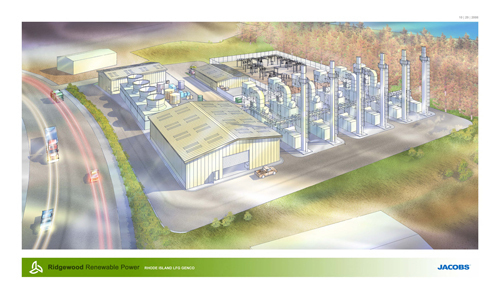
An international energy company plans to spend about $80 million building the second-largest landfill-gas-to-electric power plant in the country at the state’s Central Landfill in Johnston.
The agreement announced last week between state officials and Ridgewood Renewable Power LLC, which has operated smaller gas-to-electric plants at the landfill since 1996, will clear the way for the R.I. Resource Recovery Corporation (RIRRC) to expand the dump onto the sites of some of Ridgewood’s current plants, which will be decommissioned and destroyed.
No state money will be spent on the project, which the corporation’s executive director, Michael O’Connell, said will offset $5 million of his agency’s $60 million budget, and therefore reduce pressure to raise municipal tipping fees.
Most of the details of the development were sorted out nearly a year ago, but finalizing the agreement was held up by turmoil on the RIRRC board, O’Connell said.
Though it lacks the glamour of solar- or wind-energy projects, state officials and private developers across the country are increasingly embracing landfill-gas power plants as a reliable and cost-effective form of renewable energy and another way to combat climate change.
As the piles of garbage buried in a landfill decompose, they feed bacteria which give off a methane-rich natural gas. A gas-to-electric power plant siphons off the gas, purifies it, and uses it to generate electricity. In other states, the gas also is used to generate heat.
Methane is a powerful greenhouse gas that is more than 20 times as potent as carbon dioxide, and landfills are the second-biggest source of methane in the United States, according to the U.S. Environmental Protection Agency (EPA), which has encouraged the development of landfill-gas power plants.
There are more than 450 landfill-gas plants in operation nationwide, with the largest capacity in California and Illinois, according to the EPA. Rhode Island has the second-highest capacity in New England, behind Massachusetts, which has 47.5 megawatts of capacity online, EPA records show.
Ridgewood’s existing plants at the state landfill generate 20 megawatts of electricity, which is sold to National Grid and on the spot. The company’s managing director, Stephen D. Galowitz, declined to estimate the electricity’s annual value.
Ridgewood’s new plant will generate 41 megawatts of electricity, roughly enough to power 38,000 homes. Construction of the project, which will be done in three phases, is slated to begin next spring and be completed by the end of 2010.
Along with one of the company’s existing plants that will continue to operate, Ridgewood’s total generating capacity at the landfill will be 47.6 megawatts when the project is finished. The company says it expects to sell most of the electricity on the spot market.
Over the next 30 years, the company says its new facility will produce the same amount of energy as burning nearly 3 million tons of coal.
Ridgewood said Rhode Island’s Renewable Portfolio Standard, which mandates that 15 percent of the state’s electricity be bought from renewable sources by 2020, is a key reason why the company decided to expand its operations here.
That is “a very, very strong driver for a renewable power plant developer,” he said.
Sheila Dormody, the Rhode Island director of Clean Water Action, said she was relieved that the state had scrapped a plan floated last year to build a waste-gasification plant, which environmentalists said was really an incinerator, at the landfill.
“This is a very good project,” Dormody said. “Our end goal would be to reduce the need for landfills and stop generating so much trash, but in the meantime … this is a good solution to the problem.” •


