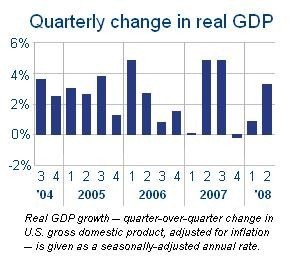
WASHINGTON – The U.S. economy grew at an annual pace of 3.3 percent in the second quarter, after rising at a 0.9-percent rate in the first quarter, the U.S. Department of Commerce’s Bureau of Economic Analysis said today in its “preliminary” report for the April-to-June period.
Second-quarter growth in the real gross domestic product – the nation’s total output of goods and services, adjusted for inflation – was nearly double the 1.9 percent of the initial report late last month, which also included the bureau’s annual revisions for 2005 through 2007. (READ MORE) The second-quarter increase in real GDP was 1.4 percentage points, or $39.7 billion, higher than in the previous “advance” estimate.
The revised increase exceeded the 2.7-percent annual pace that was the mean prediction from a Bloomberg News survey of 78 economists.
“The larger-than-average revision to second-quarter growth stemmed from upward revisions to net exports and inventory investment,” based on new Census Bureau data, the BEA said in a statement today. Upward revisions to net imports, consumer spending and spending by state and local governments, and a smaller-than-previously-estimated decline in housing construction, were partly offset by a sharper-than-anticipated decline in private inventories.
The nation registered the smallest trade gap of the past eight years, as imports fell and exports rose more sharply than previously thought. Real exports of goods and services – adjusted for inflation – rose at an annual rate of 13.2 percent, more than doubling the first quarter’s 5.1-percent annual pace, the BEA said. At the same time, imports shrank at an annual rate of 7.6 percent, after decreasing 0.8 percent in the first quarter.
The result was a 3.1-percentage-point boost to GDP growth. Excluding trade, Bloomberg noted, the economy would have grown only 0.2 percent in the second quarter after expanding 0.1 percent in the first.
“Outside of trade, the economy is considerably weaker,” Carl Riccadonna, an economist at Deutsche Bank Securities Inc. in New York, told Bloomberg News. “When you look at the spending, it looks terrible for the second half of the year.”
Private business inventories adjusted for inflation shrank by $49.4 billion in the second quarter, after narrowing by $10.2 billion in the first quarter and $8.1 billion in the 2007 fourth quarter, the BEA said.
“Current-dollar” GDP – the market value of the nation’s goods and services – increased a revised 4.6 percent, or $161.7 billion, compared with the previous quarter to $14.31 trillion (up from the 3.0 percent, or $105.7 billion, increase of the bureau’s advance estimate). That surpassed the first-quarter increase of 3.5 percent, or $119.6 billion.
The BEA’s measure of consumer spending – real personal consumption expenditures; that is, PCE adjusted for inflation – rose at a revised annual rate of 1.7 percent in the second quarter (up from the advance estimate’s 1.5-percent annual growth rate) accelerating from the first quarter’s 0.9-percent pace. The core index excluding food and energy rose at a 2.2-percent annual rate, matching both the initial estimate and the first-quarter pace.
Construction moderated in the second quarter, when housing slowed its plunge while commercial projects grew less quickly. Real residential fixed investment – mostly housing construction, adjusted for inflation – fell at a 15.7-percent pace, slowing sharply from the first quarter’s 25.5-percent annual rate of decline. Non-residential construction rose at an annual rate of 13.7 percent, slowing from the first quarter’s 8.6-percent-per-year growth.
The price index for gross domestic purchases rose at an annual rate of 4.2 percent in the second quarter (matching last month’s estimate), accelerating from the 3.5-percent pace of the first quarter, the BEA said. But prices excluding food and energy rose at a 2.2-percent annual rate that matched both the advance estimate and the first-quarter pace.
Meanwhile, corporate profits from current production fell for the fourth consecutive quarter, shrinking by $37.8 billion, or 2.4 percent, compared with the first quarter – to 7.0 percent below their year-ago level – after falling $17.6 billion in the first quarter. Domestic profits of financial corporations grew by $24.7 billion, partly offsetting non-financial corporations’ $46.9 billion quarterly decline, the BEA said.
Taxes on corporate income increased $7.4 billion in the April to June period, however, after falling $30.6 billion in the first quarter, the bureau said.
Additional information, including the full Gross Domestic Product and Corporate Profits report, is available from the U.S. Department of Commerce’s Bureau of Economic Analysis at www.bea.gov.