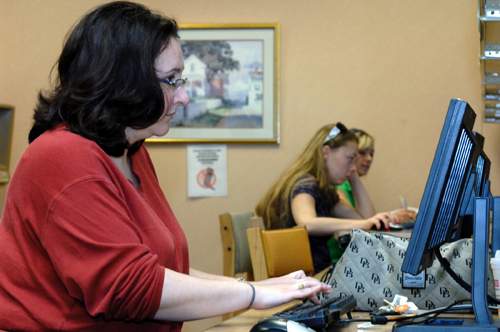
Beth Golembeske says some patrons of the Brownell Library in Little Compton come in and never check out a book, pick up a newspaper or peruse the magazines.
Instead, they make a beeline for the library’s 12 computers, at which they check e-mail, conduct research, print airline tickets or undertake a host of other seemingly limitless activities made possible by the World Wide Web. Their activities mark a sharp difference from when Golembeske, the library director, started there 32 years ago and a computer was nowhere to be found.
Computers at libraries throughout the state today serve as the visible tools of a society speeding past books on printed pages to electronic databases cataloging thousands of books, a world in which millions of connected computers form an information highway larger than any physical library in the world. As demand for access to this superhighway grows, libraries find themselves expanding computing facilities at a fast clip.
That pace will only accelerate in the coming months as federal and private dollars pay for the Ocean State Libraries consortium to purchase 730 new computers for 48 library systems across Rhode Island. In February, the U.S. Department of Commerce awarded OSL and the Ocean State Higher Education Economic Development and Administrative Network $1.2 million in federal stimulus dollars. The Champlin Foundations kicked in another $400,000 to round out the project that will replace 327 existing computers and add 403 new workstations. The computers will arrive in two batches, with about half coming this summer and the rest in the winter. OSL estimates more than 36,000 library patrons will use the new computers each week.
OSHEAN President and CEO George Loftus said the two organizations submitted the proposal after OSL noted strong demand for library computers.
“You go into almost any public library, they hand you a card that says you can use the computer for 30 minutes and 30 minutes later you have someone breathing down your neck,” Loftus said.
Demand has only increased in a tight economy. OSL Executive Director Joan Gillespie said some struggling families eliminated Internet access at home in an effort to save money. They now head to the library to type a homework assignment or work on a resume. And government agencies increasingly steer people without computers to public libraries if they need to fill out online government forms.
“It’s kind of an equalizer in a way, to be able to make that available across the population,” Gillespie said.
A study being undertaken by a University of Rhode Island graduate student also shows people increasingly flock to libraries for computer access, said Gale Eaton, director of the university’s Graduate School of Library and Information Studies. The study is not finalized, but Eaton said librarians are reporting with unanimity that they need more physical space for computers wired to the Internet.
“We’re seeing an economy where people who had [Internet access] lost it, and the expectation that you would have it has become so pervasive that the handicap of not having it is greater than ever,” Eaton said. “Public libraries really are a survival method for people right now.”
The federal and private money comes at a particularly difficult time for many libraries, as they face tight budgets and decreasing financial support from local communities, Gillespie said.
“This is a one-time shot in the arm,” Gillespie said. “It’s a tremendous boost for the libraries.”
Besides installing computers at library branches, OSL will create 10 mobile-computing labs, each outfitted with 10 laptops. Two of the labs will travel the state and assist libraries facing a sudden demand for computers. Loftus said they would have been perfect in the days after the March flooding when some libraries found their computers overrun.
And it’s not just flooding. Demand in Little Compton forces the library to pitch a tent, literally. Because of its cramped quarters, the library sets up a tent on the lawn during the busy July and August months, Golembeske said. The tent does not house books but WiFi from the library permeating the tent makes it a popular spot for summer tourists renting homes without Internet access.
The grant will also pay for OSL to purchase videotaping and projection equipment so libraries can record presentations on subjects like resume writing or interview techniques.
OSL will also deliver new computer-networking equipment. Gillespie said the routers and switches would replace equipment more than a decade old in some places.
OSHEAN and OSL initially applied for the computers and millions of dollars more to kick- start a competing broadband provider for libraries. Loftus said OSHEAN, through the grant, would pay for 75 percent of the costs of stringing new fiber optic cable, while a private partner he declined to name would pick up the remaining tab. More competition would drive down prices and allow libraries to afford faster Internet connections, or so the theory went.
“They can’t afford the amount of capacity they need in the current marketplace,” Loftus said.
But since the federal government only funded the computer part of their first funding application, OSHEAN and OSL have submitted a $22 million request to help build the broadband infrastructure, hoping to win the money under a second round of funding.
Even if the federal government awards the grant, libraries will still keep their books. Eaton suspects computers will never fully replace libraries, especially as the latter expand their offerings beyond providing novels and newspapers.
“It’s exciting that libraries are recognized as community centers,” Eaton said. •