PROVIDENCE – If a new Pawtucket Red Sox ballpark was seen by the public as an economic development project for the state, and not only a benefit for the city of Pawtucket, would it still be languishing without state approval?
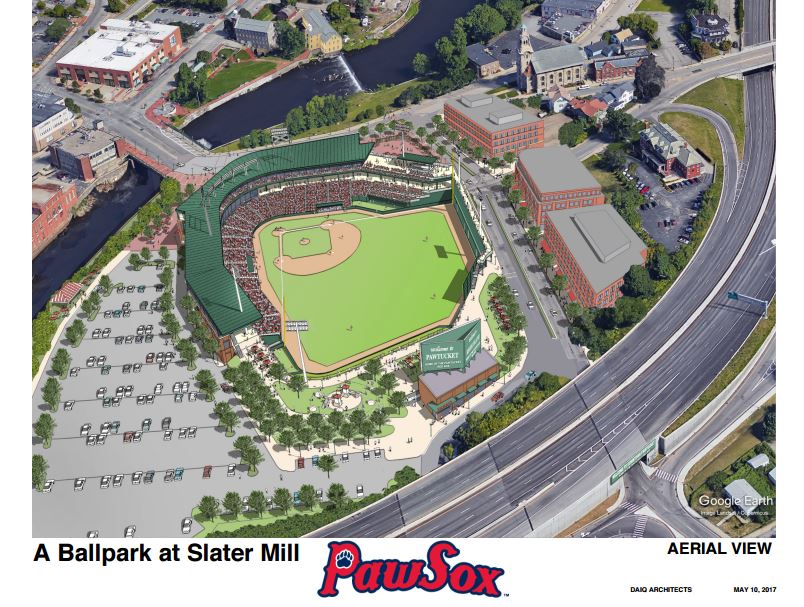
A session at the GrowSmart RI 2018 Power of Place Summit looked at the recent history of the development proposal. Over the course of 90 minutes, panelists and audience members discussed how the project could have been presented differently, to generate consensus that it’s a public-private partnership that makes sense.
The session, “The Ballpark at Slater Mill: Looking Back, Looking Ahead,” included perspectives from the team, the city, a historical nonprofit located in downtown Pawtucket and from a planning consultant who recently worked with the city of Hartford, Conn. on its minor league ballpark.
Jan Brodie, executive director of the Pawtucket Foundation, moderated the session. As background, she explained that the PawSox proposal for a new ballpark in downtown Pawtucket would be financed through a 54 percent private share, and 46 percent public, with the city and state each playing a role in repaying the public bonds.
The same kind of public-private-partnerships are taking place and being supported with state resources across Providence, through incentive packages for companies moving into Rhode Island such as Johnson & Johnson, General Electric Digital and the Wexford Science & Technology innovation center, now under construction on the Interstate 195 land.
“They all had incentive packages,” Brodie said. “So you have to ask, what makes this so different? What puts this under so much scrutiny?”
The proposal for the PawSox ballpark, which has been approved by the state Senate, was negotiated by the R.I. Commerce Corp. It has not received a hearing before the state House.
Gov. Gina M. Raimondo, who opened the Smart Growth RI sessions Thursday morning with an introductory speech, supports the project and has said the House should act on it.
“The House needs to do its job” and “at least consider” the deal approved by the Senate, she said recently, in a meeting with reporters.
When asked why the proposal hasn’t had more public acceptance, Panelist Kim Miner, who is senior vice president for the Pawtucket Red Sox and a club attorney, pointed out that the financing arrangement is complex, and difficult to explain simply. Through the public hearing process held by the Senate, she said, once residents heard specific explanations of how the bonds would be repaid, they were more supportive.
Panelist Dylan Zelazo, deputy director of administration for Pawtucket, noted that the review process has been slow, in part because government is designed for a slow consideration of issues. But one other issue that has presented itself is the ability of people against the deal to vocalize their disagreement loudly, compared to people who may support the plan.
“It’s very easy to be a loud voice of ‘No’,” Zelazo said. “It is very difficult to get a loud voice of ‘Yes’ on this. It’s very hard to kind of galvanize that support.”
Panelist Thom Deller, a consultant who is working with the city of Central Falls on development of a commuter rail station and once the director of planning for Providence, noted that Rhode Islanders need to consider Pawtucket in the way the Fenway neighborhood of Boston is perceived by Massachusetts.
But instead, the project often has been described as one that will benefit a city, not a state, he said.
“We have a tendency in Rhode Island to be very parochial,” he said. “We’re a series of communities living together as a metropolitan region. What happens in one has bearing on another.”
“We have to stop this parochialism, because it hurts us all.”
Mary MacDonald is a staff writer for the PBN. Contact her at macdonald@pbn.com.