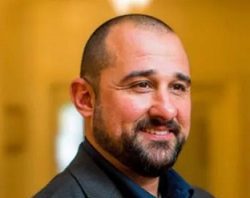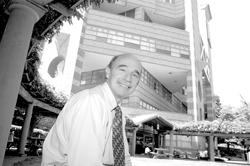
Dr. Aaron Friedman
Position: Pediatrician-in-chief of Hasbro Children’s Hospital,
and chair of the department of pediatrics at Brown Medical School
Background: Was the chair of the department of pediatrics at the University
of Wisconsin-Madison and the medical director for the University of Wisconsin
Children’s Hospital.
Education: Bachelor of science degree from Cornell University; medical
degree from SUNY Upstate Medical University in Syracuse, N.Y. He completed his
internship and residency in pediatrics at the University of Wisconsin-Madison,
along with a fellowship in nephrology.
Residence: Providence
Age: 55
Alicia Korney
Hasbro Children’s Hospital selected Friedman following a national search
for a replacement for Dr. William Oh, who served as the hospital’s pediatrician-in-chief
from the time the hospital was built in 1994 until June 2003. Dr. Oh stepped
down from his position at Hasbro and is currently a full-time attending neonatologist
at Women & Infants’ Hospital. The Corporation of Brown University also approved
the appointment of Friedman, who has spent the bulk of his career in the Midwest.
Friedman sat down for an interview in early July to discuss his dual role at Hasbro Children’s Hospital and Brown Medical School, where he will play a key role in shaping pediatric teaching, research and clinical care. He will oversee 183 campus and clinical faculty and the academic pediatric program at Hasbro as well as the programs at the Memorial and Women & Infants’ hospitals.
PBN: In terms of cultural and medical differences, how is Hasbro’s structure different for you?
FRIEDMAN: This is a private institution and I had worked at a state institution, so I’m sure there’s some cultural differences there. At the very least, some bureaucratic differences. My guess is that there are way more similarities than there are differences. Certainly the delivery of medicine in the United States is probably fairly uniform. And children get somewhat the same care all over the place. I think if there are differences, it has to do more with the standard of care a community is willing to provide. A community like this, with a children’s hospital like this, is a statement by the community that it is interested in having top-notch care for its children. And that’s who you serve in children’s hospitals, you serve your community first and then others.
Q. Have you had a chance to think about capital improvement plans for the future?
A. I haven’t been here for a very long time so that’s hard to say and I’m sure there will be things. A lot of it is forced by technological improvements and other changes in medicine. I will say one thing though, that I think is important to keep in mind. Every hospital gets older before people are willing to start doing something about it. The idea that you would anticipate making changes, both cosmetic as well as structural changes, in your hospital before it becomes dilapidated – and I’m not at all suggesting Hasbro is dilapidated – you would begin to anticipate those changes and build them into some sort of capital campaign or some capital improvement campaign so you stay somewhat ahead of the curve. It is harder to pull that off, but it would be wise if we could do that here. …
Q. A national search was performed for finding the next pediatrics head. What do you think you brought to the table that led to Hasbro picking you?
A. I don’t really know the answer to that question. My guess is having had some experience in running a department was probably useful. I also think that I’ve had the opportunity to work over the years with some terrific people who’ve worked as my mentors. So if I bring something on a personal level to the table, it’s that infusion of the help of people I’ve worked with over the years. I’m not sure if you can really draw a straight line from that to the reason that the folks here asked me to do this, but I think that may have come across in a number of the discussions we had.
Q. Research has been a big part of your career, your CV has pages and pages of articles and studies that you’ve authored. Do you see that having an impact on the hospital’s affiliation with Brown?
A. I hope so. I think our responsibilities, as a children’s hospital, is to provide the best care we can and the most up-to-date care we can. But that doesn’t get you anywhere in the future. The responsibility of this hospital, its faculty, its connection to Brown and so forth, is in part responsibility that we have to children in this community, to children beyond this community, to advance our knowledge so that it will be even better five years from now. That is something that I think somebody coming here as a successful candidate had to understand.
Q. Is there a lot of research going on at Hasbro now?
A. Absolutely. I think it’s actually a bit of a well-kept secret, unfortunately. It would probably be wise for all of us to get the word out, not only on the importance of that to the care of children, but also how integral it is to the care and how much we actually do. It shouldn’t be that hard to get the message out. But the idea that we have a responsibility to add to the body of knowledge is one that I think has not had the same play that some of the other messages have.
Q. What is the biggest issue facing pediatrics as a larger field? Does New England differ that much from the rest of the country?
A. The big issue is just as bad in New England as it is everywhere, and that is – I think if you ask people involved in the care of children, they’ll agree with me – is that we have the percent of uninsured children that we have. The idea that we would have this limited an access for children, and not just to top-notch care, and not just to high-level care, but to simple things like immunization, to nutrition and so forth. That we would still be struggling as a country to successfully provide what other countries do provide for their children is, in my perspective, the biggest single issue we’re facing in pediatrics.
Q. Here at Hasbro, is there anything that can be done to combat the problem?
A. I think that we can do a couple of things. First of all, one of the advantages of being in a state like Rhode Island, and I mean this sincerely, as opposed to someplace like California, is that we do have an opportunity to have a dialogue with the people who are in charge and we don’t have to travel 500 miles to do that. So I think a drumbeat of, ‘We owe this to our children,’ is an important step. So, yes, I think there is an opportunity to influence what goes on locally. The other responsibility I think we have is to be part of the larger chorus that spends its time in Washington and also making the same case across the country. It won’t benefit Rhode Island alone to have Rhode Island be better than its neighbors. Because under those circumstances, we will see something that is probably unfair to Rhode Islanders, which is the influx of individuals looking for what all of us would look for for our children, which is the best care we can provide. We should do that, but we should really do it for the country as a whole.
Q. Doctors are voicing dissent about the high cost of malpractice premiums. How are those premiums affecting your field?
A. Pediatrics, across the board, is different from other fields. But there are pockets within pediatrics where the malpractice issue and in particular, the premiums, are very high. … Somebody who does neonatology, for example, somebody who takes care of very young children primarily has somewhat greater risk over that period of time than most of the rest of us. So pediatrics has been partially spared, but not entirely. And it’s really only a matter of time before this becomes a real issue.
Q. You haven’t been here long, but are there any changes you’re thinking about implementing?
A. There’s a lot that I have to learn still. I think the first change is going to be cultural for me and for the faculty that’s just getting used to my getting used to this institution. … Having taken over for somebody who had been at the helm for sometime, clearly beloved and rightly so, is a bit of a challenge. Each of us getting used to each other is the first thing I have to tackle.
Q. Looking into the future, what would you like to say that Hasbro has accomplished during your time here?
A. To be honest, I’d like to see us, at the very least, maintain the
kind of community connection that we have now. I’d like it to be at least this
strong, if not stronger. I’d like to see the research endeavor of all children’s
services increased and I think the interest Brown has right now in developing
its biological sciences will be a benefit to us as developmentalists, if you
will, as people looking at growth and development. And finally, I think there’s
real opportunities on an advocacy position that faculty within the department
of pediatrics working at Hasbro do serve, and could serve, as important influences
on how the state handles care for children.