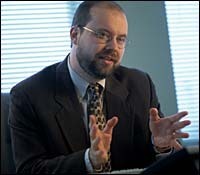
Name: Robert Petrocelli
Position: Founder, President and CEO of Heartlab Inc.
Background: President and CEO of Heartlab since the company’s founding in 1994. Imaging research coordinator at Miriam Hospital from 1991 to 1994. Imaging research specialist for Computer Sciences Corp. between 1989 and 1991. New England finalist for the Ernst & Young Entrepreneur of the Year award in 2000.
Education: University of Rhode Island, bachelor’s in physics and master’s in computer science. Brown University, Ph.D. studies in computer science (all work but dissertation).
Age: 35
Family: Married, two children
Residence: South Kingstown
Based in Westerly, Heartlab Inc. specializes in the development of cardiac imaging software and the integration of cardiac imaging network systems. The company has installed more than 800 imaging workstations worldwide. Heartlab’s cardiac archiving network system manages a volume of more than 600,000 patient cases at cardiac institutions around the globe.
PBN: Explain Heartlab’s flagship product, the Encompass suite of applications.
PETROCELLI: Encompass is a set of applications developed from a single source-code base, which is owned and developed by Heartlab. The system completely automates the flow of patient information in acute coronary-care centers. Everything from pre-interventional, history and physical to the enormous image-data sets that are created by ultrasound and X-ray equipment, to referral notes, all are completely handled within that environment. A cardiologist has one point of access to all the information he needs to make critical-care decisions. He can directly interface with what are called ‘modalities’: the cardiac catheterization labs, vascular labs, eco-cardiographic scanners or ultrasound machines, CT and MR systems, EKG systems that allow the physician to have a holistic view of the information. There’s no other system available that has such breadth of capability and that is fully integrated.
How does the flow of information in cardiac-care settings traditionally happen?
One thing that’s amazing is that for all the technology that has been brought to bear on patient care, a lot of the functions are still very much in the 19th Century. For example, history and physical (data) typically are recorded on paper. Cath lab images, which are large, high-resolution motion pictures, are still recorded on 35-millimeter film. Eco-cardiographic images, which are very sophisticated ultrasound images of the heart, are routinely recorded on videotape. And all of the findings are dealt with through manual dictation. There’s a lot of gross inefficiency in the system. Encompass completely automates that flow, so every angiogram, every ultrasound, all the findings that were ever done are available within a few seconds. Our customers will routinely consult with their surgeons in real-time and make a decision about whether to move that patient to the (operating room), saving not only hours but maybe even a day in that patient’s treatment.
Is it hard to get providers to invest in this kind of technology?
If we look at the cath lab, which is our core market, the average cost of film processing for a cardiac procedure nationally is about $58. When customers purchase our systems, they immediately reduce their costs to about $30 per case. Almost every piece of business that comes through our door is custom generated. They understand that, not only to have efficient operating expenses, but to be competitive, they need this type of technology. The reason we have so many large centers as our customers is that the real flagship centers – the Mayo Clinic, Temple University, locally Rhode Island Hospital, Miriam Hospital, New England Medical Center – have waited until the technology has become more mature to acquire it.
Tell me how Heartlab started.
We’ve grown very organically. Back around 1991, I went to work for Dr. (co-founder Jonathan) Elion under the auspices of Miriam Hospital and Brown University to do some research for the automated classification of coronary artery disease. And I became very interested in the problem, then being described as the Holy Grail, which was to eliminate the use of film in the cardiac catheterization lab and to replace that with some sort of digital format. Dr. Elion developed that standard for the public domain. I decided to take some risk and start a company to develop software for the market that was being created for the new standard.
Where did you find funding?
Initially we were self-funded. We went out as independent consultants and did some work with GE Medical Systems and Hewlett-Packard Medical Systems and plowed our consulting fees back into building the business. We at one point took a strategic investment from OEC Medical to develop some custom products for their mobile cardiac systems. That company was subsequently purchased by GE Medical Systems. In our most recent round we raised $23 million, and part of those proceeds were used to re-buy our position from GE.
How many employees?
Around 75. We’ll probably have about 100 employees by mid-fiscal-year next year. They’re mostly very high-paid engineering staff.
How many customers does Heartlab have?
We have over 100 large tertiary-care centers as our customers and that number is expected to double over the next 12 months. We’re approaching half a million cardiac procedures in the U.S. that are performed using our networks, which is significant, considering there are only 3.8 million procedures that are performed and only 1.3 million of those are performed digitally. So we have the largest single share of any company, including the very large companies like GE or Siemens or Phillips (International Inc.).
What is the value of that market?
In the United States, the cardiology market just for X-ray is about a $225 million a year market when it reaches full maturation, which should be in about three to four years. We think that the rest of it will represent another $200 million. Over the last 12 months, I’d say probably $70 million has been spent in the United States on these sorts of networks, with Heartlab getting something approaching a 30 percent share of the dollars.
What’s the percentage of cardiac-care centers that use digital systems?
There are 2,300 centers that are candidates for this technology. Probably 50 percent of those have yet to adopt.
Who are your competitors?
For what we do, we are more or less the only game in town. That doesn’t mean we don’t have competition. The GE Medicals of the world will have an X-Ray division, an ultrasound division, a CT and MR division, all of them with products that fit those niches. But they don’t have an overarching product that integrates them.
Is Heartlab profitable?
Oh yes. We’ve been cash-flow positive since inception and we tend to run EBITDA (earnings before interest, taxes and depreciation) at roughly a 22 to 25 percent rate, and net a 12 percent-of-sales rate. One of the reasons is we develop all the software here, so our margins are very good. Other competitors in our space are more like integrators or value-added resellers.
Any interest in going public?
We’re evaluating that and I think if the climate is right, that may happen. It’s very difficult to see six months or nine months into the future to understand whether the public markets are the right place to be. They’re more than just a vehicle for raising funds. They’re also an obligation that you have to meet on a quarterly basis. You want to be careful to balance when you take that yoke on. But that is something that we’re considering pretty seriously.
It seems like Heartlab makes a pretty good takeover candidate. Has there been any interest?
About two years ago one of those large companies tried to purchase us. A large company can always try to make you an offer you can’t refuse. But one of the reasons they would even consider doing that is because they have not been successful with their own internal efforts. And we’ve built a team here that is not only these 75 employees but their families. So it’s very important that we do the right thing for the business. If we’re able to be a center of excellence and keep our vision and preserve the jobs we’ve created here, then it starts to be attractive.
What’s Heartlab’s strategy going forward?
One of the things we’re looking at is taking our core technology and expanding it into some adjacent markets, and creating a second leg for the business outside of cardiology. I can’t say much more than that, but as the year unfolds it will be obvious. We think that we can develop a second pillar of the business that’s at least as large as the current pillar.