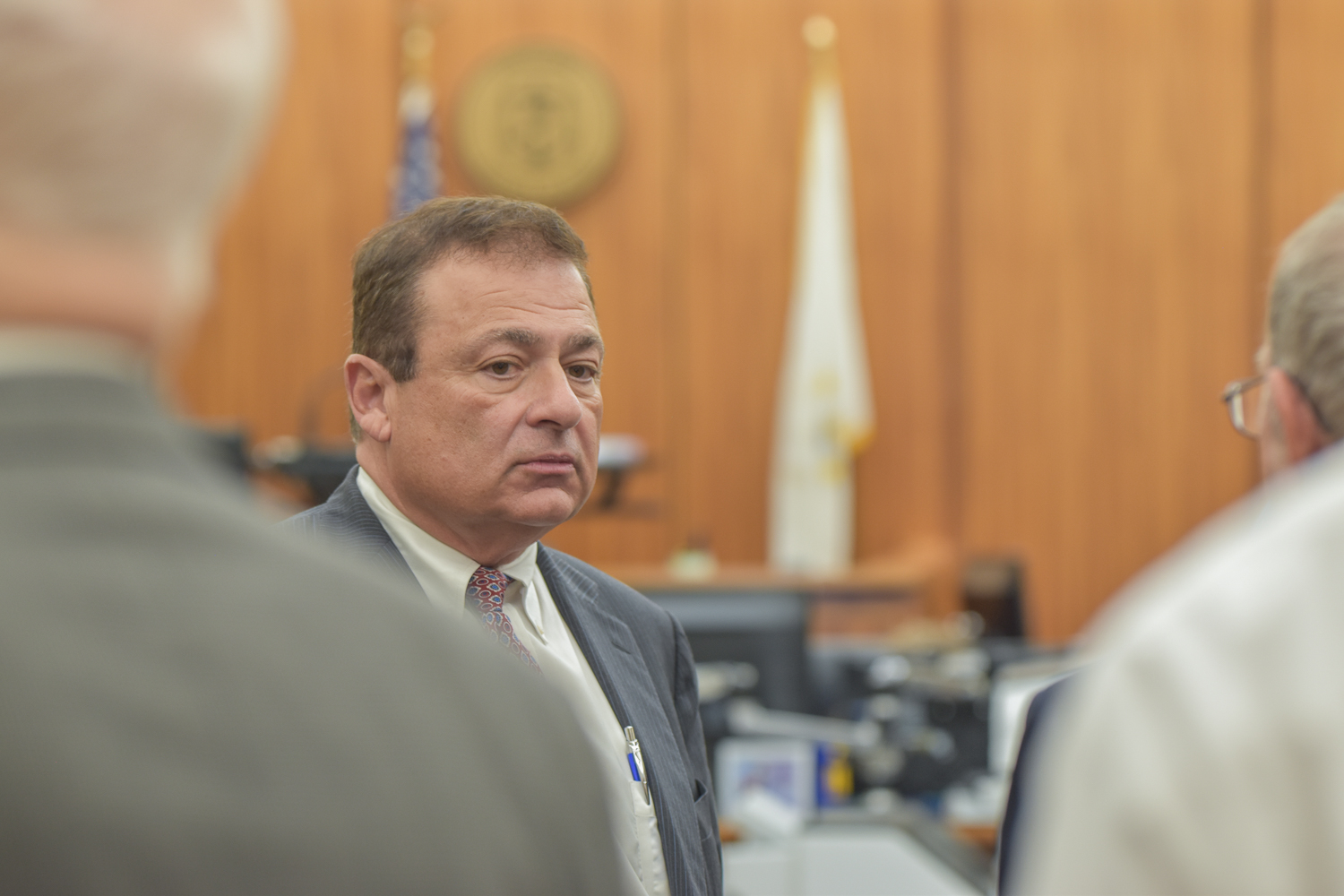
WARWICK – The fate of the state Ethics Commission’s investigation into whether former House Speaker K. Joseph Shekarchi can join the R.I. Supreme Court will be determined within a week, a Kent County Superior Court judge said Monday.
Judge Richard Licht heard arguments in Shekarchi’s lawsuit seeking to halt the Ethics Commission’s investigation into whether his bid for a seat on the state’s highest court violates Rhode Island’s “revolving door” law, which restricts lawmakers from accepting certain state positions.
Licht, who sought and received an Ethics Commission advisory opinion before joining the Superior Court in 2014, said he plans to issue his decision no later than the end of day Monday, July 27 – the day before the state’s Judicial Nominating Commission is set to interview Shekarchi and four other finalists seeking to fill the vacancy created by the March retirement of Justice Maureen McKenna Goldberg.
“They have a right to know at least what this court thinks, whatever that may be,” Licht said.
Shekarchi, a Warwick Democrat, stepped down as House speaker on May 7, three days after applying to the bench. That same day, Roger Williams University School of Law Professor Michael Yelnosky filed his complaint arguing that the leap from one branch of government directly to another would violate the revolving door rule written into state law in 1992.
The law prohibits sitting legislators from seeking or accepting employment with any state government agency for at least one year after leaving elected office. But it exempts lawmakers who seek or accept election to a constitutional office.
The commission voted to authorize a full investigation June 2, concluding that the complaint states facts that, if true, are sufficient to constitute an ethics code violation. After the Ethics Commission twice refused to end its investigation, Shekarchi’s attorney Thomas M. Dickinson filed a Superior Court lawsuit seeking to halt the probe and have a judge declare that Shekarchi did not violate the state ethics code.
Shekarchi has repeatedly insisted his application is eligible under the law. Jason Gramitt, the Ethics Commission’s executive director and chief prosecutor, argues the exemption does not apply to appointed positions such as the Supreme Court.
“They are not positions that are elected by the general electorate,” Gramitt told Licht.
Dickinson again made the case the Supreme Court is indeed a constitutional office exempt from revolving door rule. He also pointed out that the General Assembly didn’t take any action to modify the law after then-Sen. Erin Lynch Prata was appointed to the high court in 2020.
“You can infer legislative assent from silence in certain circumstances,” he said.
Licht too questioned the inaction taken by the commission.
“There could have been another vote for another advisory opinion, or to amend the initial one,” he said. “Nothing happened.”
Gramitt responded that the Lynch Prata case was different from Shekarchi’s since she sought an initial advisory opinion from the Ethics Commission. The commission did not issue a formal opinion, so the case did not create precedent.
“To say that one case of non-prosecution means that the door is wide open for everyone else after that, that’s not how the law works,” he said.
As Licht weighs his decision, he’s already predicted the outcome: “It’s probably going to the Supreme Court.”
“Fifty percent will like it, fifty percent won’t, whatever I decide,” he said. “That’s the job and I don’t mind.”