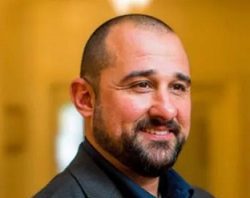
Top priority for Rhode Island’s new Supreme Court chief justice is raising the bench’s stature to a level where it really is perceived as a third arm of government. That means infrastructure changes — including a new Kent County Courthouse, expedited judicial proceeding, alternative mediation and arbitration methods, and better communication with the press.
It’s an agenda that is ambitious. But you get a sense when you meet this man that it is an agenda that will be done — maybe not all today, but it will be done.
He seems to possess the same intensity, sense of purpose as, say, Abraham Lincoln, the man that Williams has studied for much of his lifetime. Maybe he was known more as a Lincoln scholar than a jurist, but now he will make his mark in the most important judicial position in our state.
Williams was appointed to succeed Chief Justice Joseph R. Weisberger, a distinguished judge who was well respected throughout his career on the bench not only in Rhode Island, but across the country. Weisberger retired this spring. His greatest misfortune is that he was in the position of chief justice too briefly. For years he served in the Superior Court, moving to the Supreme Court where he was acting chief justice before being appointed to the permanent position, taking over an embattled court.
While he made some attempts to improve the infrastructure, his most important contribution was restoring credibility to a court that had been damaged considerably by the misdeeds of and allegations against high ranking court officials, including a former chief justice. There were few individuals who would have been capable of restoring credence so quickly to the court, Weisberger chief among them.
Williams asserts that it is time to elevate the court structurally to the position he believes it should hold as an equal and third arm of government. He seeks physical and procedural changes, a better understanding of the court itself, and greater access to judges throughout the entire court system to the media, so its members can have a clearer understanding of the procedures they cover.
Chief Justice Williams is impressive. On a recent visit to our offices on a sunny spring afternoon — a day in which lesser men might have finagled their way to the golf course — he spoke with candor about his vision for the court system. He was seeking to create a dialogue, to share that vision, to talk about his disappointments and his hopes — and only once did he mention Lincoln.
Weisberger is a tough act to follow, but Williams will not try to duplicate what Weisberger has done. Instead, he will establish his own imprint on the state’s court system. For openers he appears to be taking the right path, one that will only improve the system, for everyone who may be summoned for a traffic violation to those who are involved in far more complicated cases.
URI update
A few weeks ago we wrote how the University of Rhode Island’s journalism
program was in jeopardy of being downgraded from an independent department to
a section within communication studies. We’re happy to report that since our column,
URI officials have agreed that the journalism department has much to contribute
and therefore deserves to remain an independent and viable department. Congratulations
to those officials at URI who were part of the decision, and to those in the journalism
department who fought with such passion — and have for so many years — to maintain
the integrity of the department, and therefore the profession itself.