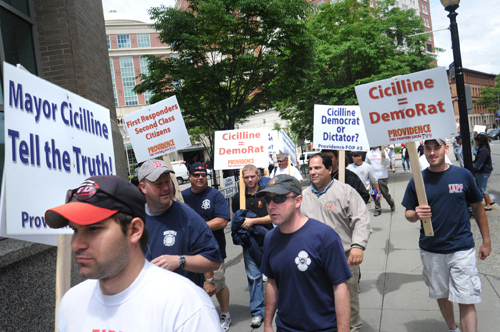
The ongoing contract dispute between Providence and its firefighters union looks a lot like one of those awful divorces that descends from difficult to bitter to all teeth and claws and recriminations.
The stalemate is driven partly by emotion: The city’s lawyer says the union is pursuing “a vendetta” against the mayor, and the head of the firefighters union says the mayor is trying to “villanize” the union.
But observers say the standoff also may be strategic, because prolonging the struggle brings advantages to both sides. According to this view, the firefighters are living better under the terms of the contract that expired in June 2005 than they would under any new contract. In these economic hard times, a new contract is sure to include concessions by the union, such as a requirement that firefighters pay a share of health care costs for the first time ever.
And some observers say Mayor David N. Cicilline is buying himself a heap of goodwill from taxpayers and voters by trying to rein in a union contract that is generous by any standard. Playing to taxpayer resentment, Cicilline often notes that only 55 of 499 firefighters live in Providence. (Many bought homes outside the city when the residency requirement for firefighters was not active.)
The contract is now in the hands of an arbitration panel.
“Both sides have lost their advocacy role and are pushing the adversarial role because it energizes their respective bases,” said City Councilman John Igliozzi.
A major sticking point is the firefighters’ share of the cost of health care; it is the only Providence labor union that does not pay for health coverage. The city is asking for 15 percent and 20 percent copays from current and new firefighters, respectively. The union’s counteroffer is 15 percent for everyone. By comparison, a 2008 survey by the Kaiser Family Health Foundation states that, nationally, workers in state and local governments pay 21 percent of employer-provided health care costs and workers in all industries pay 27 percent.
In addition, the city wants to raise the number of required years of service for a pension to 25 from the present 20; the union’s counteroffer is 25 years only for new hires. The city wants to drop the maximum disability allowance to 50 percent from the present 67 percent of pay; the union says this would violate state law.
The city wants to eliminate some firefighter positions and take greater control over some manning decisions; the union says this would leave some trucks undermanned.
Another sticking point is over the union’s cost of living allowance (COLA). It is now 3 percent, compounded annually. The city wants to eliminate compounding for all employees hired after July 1, 2004.
When figuring the simple interest, the city would use the amount of the first year of the pension as the principle on which all future increases would be based. (In contrast, compound interest is based on the amount of the latest year of the pension, which includes the initial amount plus all subsequent increases.) As an example, Kerbel said, if you start with a pension of $40,000 and figure the COLA for 20 years into the future, the difference between simple interest and compound interest of 3 percent a year is $8,000 a year after 20 years. “The effect of compounding is huge,” he added.
According to the mayor’s office, an average Providence firefighter earns $51,000 in wages; $21,680 in overtime pay; $2,554 for holidays; and $640 for clothing. He or she gets four to five weeks of vacation and 13 paid holidays.
A tone of frustration drips from the voice of Paul Doughty, head of the Providence firefighters union, when he describes the progress of the contract negotiations.
Doughty says the union has won 12 consecutive judgments from courts or arbitrators, and this should be a signal to the city that its offers are unreasonable. The city’s director of administration, Richard Kerbel, responded, “Arbitration is a process. It is not baseball; there is no clear-cut win or loss.”
Doughty says the firefighters are willing to make concessions, but that Cicilline refuses to make any compromises, refuses to negotiate and continues to “villanize” the union in public.
“That is just so wrong,” fumed Kerbel.
Fire Chief George Farrell, who has worked on both sides of the issue, says the city has brought many fresh offers to the bargaining table. Farrell retired from the fire department in 2006, after 26 years of service, including eight years, from 1994 to 2002, as an officer of the firefighters union. He went to work as the state fire marshal, and returned to Providence in 2007 as fire chief, a nonunion position.
Farrell said the conflict “probably dates to 2002,” when the previous mayoral administration brought a collective bargaining agreement to the union membership, which voted it down. “The city has presented some reasonable proposals and got no counterproposals,” Farrell said. He noted that some issues under dispute, like COLAs and staffing levels, have been under contention since at least 2002.
Doughty’s view that the city will not compromise was echoed by Kenneth Cohen, president of Providence Lodge No. 3 of the Fraternal Order of Police, whose contract with the city expired in June 2007 (with negotiation ongoing). Cohen cited the instance when the city tried last fall to switch its health care administration from Blue Cross & Blue Shield of Rhode Island to UnitedHealthcare of New England, even though the police union wished to stay with Blue Cross and offered to pay the difference in the cost of coverage. He said that the city unilaterally attempted to award the contract to UnitedHealthcare without discussions with the union.
Kerbel responded that coverage for employees would have been unaffected by the change, and the city had the responsibility to taxpayers to seek the best deal it could get. The union sought and got a court injunction stopping implementation of the contract, and the matter is now tied up in the courts.
Doughty commented, “The mayor has done a fantastic job of changing the subject and recasting himself as Robin Hood.”
Press coverage of the firefighter contract stalemate is ongoing, but the matter got an extra dose of attention in June, when the union’s promise to picket the National Conference of Mayors caused many officials of the Obama administration to cancel their participation.
Citizens were flat-out embarrassed that mayors from around the country were blocked from important meetings with the feds because of a cat fight in Providence’s front parlor. Both the mayor and the firefighters union defended their participation in the standoff, saying they were standing up for important principles; that is, fiscal responsibility by the mayor and labor rights by the union.
Igliozzi objected to the cost of outside legal work that the city has had to pay because of the prolonged dispute. According to Kerbel, the city’s cost for legal representation for firefighter contract negotiations and related arbitration has been $118,790.
Igliozzi also objected to damage to relationships and morale caused by the long and bitter stalemate. “If management and labor are in conflict for years and years, it takes a toll on services, on harmony, and on goodwill,” he said. •