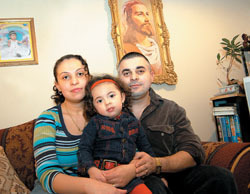
The Ochoa family of Central Falls strives to manage rising health care costs. Guillermo Ochoa, an uninsured diabetic, is seen here with his wife Johanna Flores and daughter Kelly.
Employers’ plans prove too costly, so some drop coverage
Guillermo Ochoa works 65 to 70 hours a week, at his regular job with a cleaning company, and nights and weekends by himself, trying to build up his own cleaning service. His wife, Johanna Flores, also works full time, at a pharmaceutical lab.
Flores, who brings home about $400 every two weeks, pays about $75 to get health insurance through her employer. But to cover her husband and daughter, Flores would have to give up about $300 per paycheck. “She’d be working for the insurance,” Ochoa says.
So they enrolled 2-year-old Kelly in RIte Care, the state’s Medicaid program. Her father, a diabetic, goes without insurance. At about $80 per week, his own employer’s coverage is beyond reach, he said, so he pays out of pocket, $75 every two weeks, for his insulin, and goes to a clinic in South Providence for checkups and blood tests.
Earlier this year, Ochoa’s blood pressure got so high that the clinic doctor took him out of work for two weeks. Recovering in his Central Falls apartment, he wondered how he would make ends meet without his wages. He was trying to get disability pay, but wasn’t sure he’d get it.
More and more, employer health insurance is eluding Hispanic immigrants like Ochoa. A recent report by the Center for Studying Health System Change found that, between 1997 and 2003, the share of non-elderly Latinos covered by employer plans dropped from 47.1 to 40.4 percent, while blacks saw a slight improvement, from 53.5 to 53.9 percent, and whites dropped slightly, from 73.9 to 73.5 percent.
Nationally, as Latinos fell off the private insurance rolls, they showed up in Medicaid programs: 22.5 percent had public health insurance by 2003, up from 13.7 percent. But in Rhode Island, where RIte Care eligibility had been expanded early, allowing more than 100,000 children and families to get coverage by 2000, there was little room for further growth, said John Young, the Department of Human Services associate director who oversees RIte Care.
So rather than swell the RIte Care ranks, the Latinos who have lost their employer coverage are just going without health care. State-level data are too limited to show year-by-year changes, but while between 1998 and 2000, the state Department of Health found 9.9 percent of Rhode Island Latinos ages 18 to 64 were uninsured, similar to whites’ 8.5 percent, a new analysis with 2000-2003 figures shows a whopping 19.8 percent of Latinos are uninsured.
The data reflect Ochoa’s own experience: At two previous jobs, at a warehouse and at a textile mill, he had gotten fully paid health coverage. But in Rhode Island and nationwide, benefits have shrunk and, to the extent they’re offered, become costly for many workers. Ochoa is not alone in opting out as a result; a recent Urban Institute study found that almost two-thirds of a “sharp drop” in employer health coverage from 1999 to 2002 (2.2 percentage points, to 66.9 percent of people ages 18 to 64) was due to workers no longer taking benefits.
In South Providence, another group of Latinos has also fallen off the insurance rolls: business owners. Up and down Broad Street, many of the neighborhood’s most successful people go without health care because they can’t afford insurance, said José Brito, head of the South Side Merchants Association. He is uninsured; his two youngest children are on RIte Care, along with their mother.
Mario Encarnación, owner of Correcaminos Shipping, which helps Dominicans send their cars and belongings back home, used to pay for his own coverage, but when the premiums jumped from about $350 to more than $500 per month, he said, it was too much.
So Encarnación, a father of five, never goes to the doctor. If he gets sick, he takes home remedies and hopes he’ll get better. In a dire emergency, he’d go to the hospital, but he knows how much that costs: “4,000 or $5,000 to spend two hours in the ER.”
Encarnación’s children do have private insurance, through their mother’s job. Her employer charges her $200 a month, which Encarnación pays. “The temperatures change too much here,” he said, “and the kids get sick easily. The kids can’t be uninsured.”
The vast majority of children here, however, aren’t in private plans, but in RIte Care, which covers more than two-thirds of Providence children, and three-quarters in Central Falls.
The state’s eligibility guidelines are generous: up to 250 percent of the federal poverty line, or about $3,265 per month for a family of three; this is how RIte Care has managed to minimize the children’s uninsured rate. But parents only qualify if they earn less than 185 percent, or about $2,416 – roughly what two full-time workers would earn at $7 per hour.
Increasingly, Brito and Encarnación said, that gap is leaving local Latinos with no access to insurance at all. Taking some overtime shifts can push up pay just enough to disqualify a person from RIte Care, they noted, and employer insurance isn’t just expensive for many workers, but entirely unavailable.
“In the last four years, they’ve covered every kind of employment, even state jobs,” said newly elected state Rep. Grace Díaz, D-Providence, who sat in on part of the interview. “That was one of the biggest complaints I heard as I was walking during my campaign.”
“I’d say as many as 60 percent of Latinos around here are now working for employment agencies, and they offer zero benefits,” said Encarnación. “It’s a reality of our community. We’ve lost a lot of companies and places to work, and sadly, the future doesn’t look very pretty.”
Asked how the problem could be reversed, or at least alleviated, all three said loosening RIte Care eligibility guidelines would help many families. Allowing businesses to buy into RIte Care at an affordable price would also be “fabulous,” Encarnación said.
And a private-market solution could work for the Broad Street merchants, Brito said: If all 300 were willing to join the Greater Providence Chamber of Commerce as a group, they would be eligible for discounted health insurance, but the cost of even that deterred many.
At DHS, Young said the state can’t afford to have RIte Care’s ranks grow more; as of December, it covered about 126,000 people, more than four times its original enrollment. A 2000 study said as many as 150,000 Rhode Islanders might qualify.
DHS has tried to halt growth by adding premium co-pays for the least needy and promoting RIte Share, which pays low-income workers’ share of premiums for employer-based coverage. About 6,500 people now use RIte Share, Young said.