
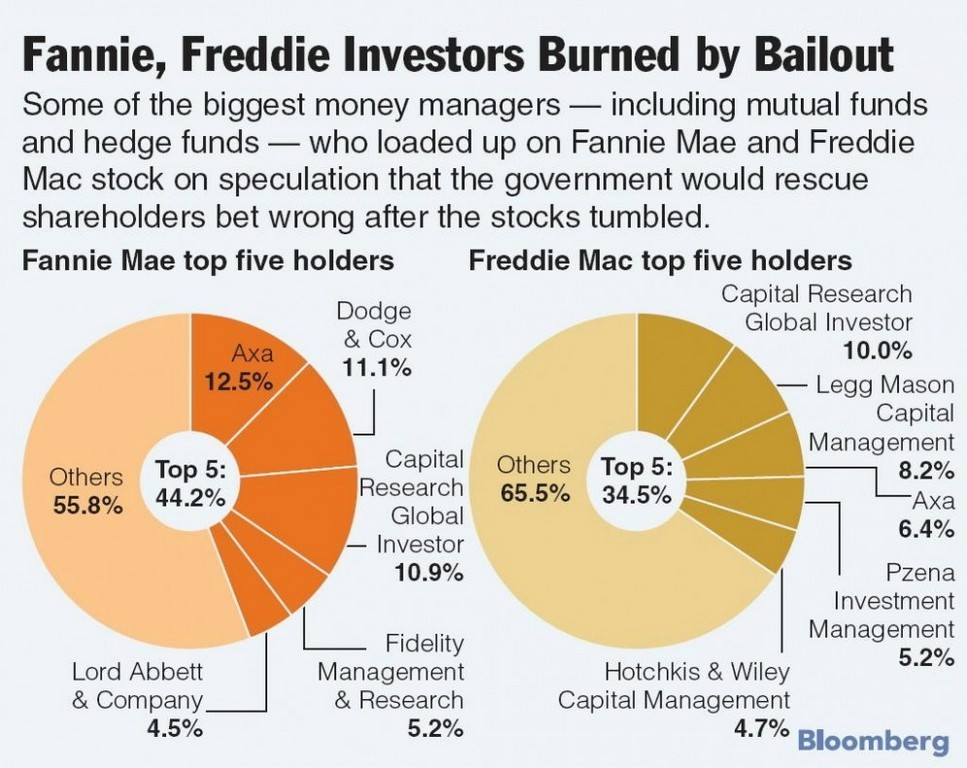
NEW YORK – Stock markets rallied today on hopes that the U.S. government takeover of mortgage giants Fannie Mae and Freddie Mac will stabilize the financial services industry.
Gainers outnumbered losers by nearly three to one today on the New York Stock Exchange, as a U.S. rally followed earlier gains in Europe and Asia. The Standard & Poor’s 500 rose 25.48 points, or 2.1 percent, to 1,267.79; the Dow Jones Industrial Average rose 289.78 points, or 2.6 percent, to 11,510.74; and the Nasdaq Composite Index edged up 13.88 points, or 0.6 percent, to 2,269.76.
But shares in Fannie Mae (NYSE: FNM) slipped 83 percent to 88 cents in New York trading, while Freddie Mac (NYSE: FRE) fell 90 percent to 73 cents. Today’s rally also bypassed companies, such as Fidelity Investments, that had large holdings in Fannie and Freddie; analysts cited the takeover’s elimination of dividend payments by the two companies.
The plan announced this weekend by U.S. Treasury Secretary Henry M. Paulson Jr.- who had met Friday evening with executives of both companies – also calls for the Federal Housing Finance Agency (FHFA) to put Fannie and Freddie under conservatorship; replace their chief executives; cap their expansion through the end of 2009 at $144 billion above their total combined assets as of July 31; and require the companies to pare their total assets by 10 percent per year thereafter.
The U.S. Treasury is to receive $1 billion of senior preferred stock, with warrants representing a 79.9-percent ownership stake in each company, and has pledged to buy mortgage-backed securities issued by the GSEs, to boost liquidity at U.S. mortgage banks.
“This is significantly positive for the market,” Walter “Bucky” Hellwig, who helps oversee $30 billion at Morgan Asset Management in Birmingham, Ala., told Bloomberg News. “Investors were looking for some kind of resolution to the problem and this eliminates a lot of uncertainty.”
But other economists remained skeptical. “If the housing market doesn’t turn around, then Fannie and Freddie become bad assets,” Vincent Reinhart, former director of the Federal Reserve Board’s Monetary Affairs Division, said in a separate Bloomberg interview.
Fannie and Freddie were established as government-sponsored enterprises (GSEs), to expand homeowner access to credit by buying and repackaging mortgage debt.
Over the years, they grew until Fannie Mae was the nation’s largest mortgage-financing provider, and together they owned nearly half the nation’s $12 trillion in outstanding residential mortgage debt. That growth had slowed early this year, after the nationwide housing slump spurred Fannie and Freddie to tighten their loan standards and both companies began requiring higher down payments in regions where housing prices were falling fastest. But that change was reversed this spring, after the National Association of Home Builders, National Association of Realtors and a number of housing advocates accused Fannie and Freddie of deepening the housing slump. (READ MORE)
Then in July, Congress stepped in, approving the Federal Housing and Economic Recovery Act of 2008. That rescue package established an independent agency to regulate Fannie Mae and Freddie Mac and, in a provision sought by Paulson, allowed the Treasury to buy shares in the companies. (READ MORE)
“Paulson sold this to Congress as, ‘Give me a blank check and I won’t have to write it,’” Reinhart said “The question now is: How big is that check going to have to be?”
Washington, D.C.-based Fannie Mae (NYSE: FNM) and McLean, Va.-based Freddie Mac (NYSE: FRE)buy U.S. mortgage debt and repackage it as guaranteed mortgage-related securities. Their customers include mortgage and investment banks, savings and loans, savings banks, commercial banks, credit unions, insurance companies and state and local housing finance agencies. Additional information is available at www.FannieMae.com and www.FreddieMac.com.