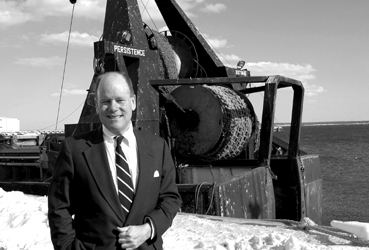
Michael McMahon, the state's lead economic development director seen here at Quonset Point, discusses the re-branding of Rhode Island.
Michael McMahon
Position: Executive director, Rhode Island Economic Development Corporation, and executive counselor to the governor on economic growth and community development
Background: A 32-year veteran of investment banking, McMahon was tapped to lead Gov. Donald L. Carcieri’s economic development transition team in 2002, then stayed on as the state’s chief economic development officer. He is a founder and partner of RockPort Capital Partners, a $100-million venture capital firm focused on the energy, power, environmental, and engineered material sectors. Previously, he was a managing director and head of global energy investment banking at Lehman Brothers and Salomon Brothers.
Education: Bachelor’s degree, American civilization, Brown University; member of the Program for Management Development at Harvard Business School
Residence: Saunderstown
Age: 57
Two years into his tenure as Rhode Island’s economic development leader, Michael McMahon has produced a “mid-term report card” outlining the progress made in Carcieri’s first two years. His view: Rhode Island has made strides in re-branding itself as a place for “innovation at scale,” developed a strong small-business program, and built on its strengths in “clusters” such as biotech, defense and consumer products. But the successes are tempered by a continued decline in manufacturing, site constraints and political problems. McMahon sat down with PBN to further review Rhode Island’s economic outlook.
PBN: What did you find when you took over in 2002?
McMahon: My initial reaction was, we had a number of the building blocks in place – the EDC, Quonset, the Economic Policy Council, Slater, the universities, the Chambers – but they weren’t working as well as they needed to. … (There was a growing understanding) of what our competitive strength really is: a combination of quality of life in the state and the quality of the work force.
PBN: How is Rhode Island’s work force? It’s not strong in terms of educational attainment.
McMahon: But remember, you need a full spectrum of workers. We’re a microcosm of the country. We have a group of people who came here from other places because they want a piece of the American dream. Historically, Rhode Island was a great gateway because you could have low-skill, factory-level jobs. Well, those jobs aren’t going to exist anymore, so you have to replace them with other opportunities, like call centers. You could say call centers aren’t the greatest jobs, but if you compare a call center versus a punch press, I’ll take the call center. The compensation’s about the same, and the working conditions are a heck of a lot better.
PBN: Doesn’t even a call center, though, require mastery of the English language?
McMahon: You’re right, but my point is we have to invest to get those workers to a level where they are 21st-century work force ready. … And if you look at the businesses that are expanding, for example the boat business, the Portuguese heritage of boat building on the East Bay is incredibly strong. The work ethic is incredibly high. A big company from Maine (Hinckley Yachts) is moving its headquarters here. Why? Much better work force. … It literally is as simple as work ethic. We hear it time and again.
PBN: You’ve tried to get Rhode Island away from the “big project” focus.
McMahon: People would put all their resources into these big projects, to the detraction of getting anything else done. And if you look at our economy, the first thing you do is build on strength. What’s our strength? There’s small business … so you’ve got to make it easier for people to start and grow their own businesses. And some of the things in our legislative agenda this year are focused very aggressively on that. … Then we said, we’re going to focus on businesses that are already in this state – whether that’s Fleet/Bank of America, Citizens, Sovereign, the defense guys, health care, education, tourism, marine trades, we call value-add manufacturing or precision manufacturing and consumer products.
PBN: So looking more at who’s already here rather than who you can bring in?
McMahon: Yes, that was the first part. … (The EDC also changed its pitch.) Before, it was quality of life, good workers, good transportation, tax incentives. Now it’s, ‘You need to be in Rhode Island,’ because it’s is a place where you can get things done, this innovation at scale concept.
PBN: What do you mean by “innovation at scale”?
McMahon: The business environment is changing so rapidly, you need a culture where you can continually reinvent your product, experiment with change but not put your core business at risk, and be cost-effective. … Rhode Island has always been good as a consumer products testing market because it’s basically a one-media buy and a very diverse population. We’re really taking that another step now.
For example, everyone talks about Wi-Fi … we’re working to make the whole state Wi-Fi enabled, which means companies that want to try new ways to do business can do that here.
PBN: How do you get the whole state Wi-Fi enabled?
McMahon: We don’t know yet. We’re just starting. We put a team together – it’s IBM, ICOA, Cisco, PowerStream. … But whether it’s the governor, the General Assembly, the federal delegation, the business community, the educators, you can get everyone together and say, ‘Here’s an idea; can we make it happen?’ That’s what innovation at scale is.
PBN: That sounds like taking what Rhode Islanders have traditionally seen as a weakness into a strength. There’s always been a sense that we’re so small, we’re unimportant.
McMahon: That’s absolutely right. It’s turning our size into a competitive advantage.
PBN: You talk about re-branding Rhode Island. What’s been our reputation?
McMahon: Corrupt government, mafia, labor union chokehold … I had a number of conversations with key decision-makers where they would raise those issues. But the mafia is not a factor, (and) the labor unions, with the exception of public employees, are very cooperative; they really do a good job. … The governor, from day one, has (promoted) good government, and that means balance in the legislative vs. the executive branch, doing things in an open, positive way rather than behind closed doors and insider dealing.
PBN: What else does the re-branding of Rhode Island entail?
McMahon: It’s a long-term process. We’re talking years, multiple administrations. But I think it’s a couple of things … first of all, thinking big, and second, really linking into the intellectual capital of the state. … If you look at centers of truly outstanding commercial success, the link to universities is obvious, whether it’s Silicon Valley, the Research Triangle, or Route 128.
PBN: Is our bigger development going to continue to be in rural or outlying suburban areas?
McMahon: We’re talking about adaptive reuse or creative reuse. You come back to quality of life, and the last thing you want to do is rip up the forests and the potato fields and the farms. … We do have a very good tool, the historic tax credits. What we’re trying to do is adaptive reuse in pockets of urban land.
PBN: But can an Amgen adaptively reuse a building?
McMahon: No, it can’t. That’s why in the case of West Warwick, if you look at the area that was targeted for the casino, there was industrial activity already in that area, so it was maybe adapting something like that. Another of the larger opportunities in the state is the Warwick train station development area. … And if you look at East Providence, we’ve got hundreds of acres right on the waterfront waiting to be developed. … These things take time, so I don’t want to give you the impression that in the next two years, you’re going to see all of this, but I think you’re going to see a lot of activity and a lot of momentum which is going to carry through.