
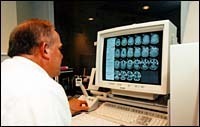
Center in Cranston. (Tom Croke)
The film sheets used by radiologists and doctors to diagnose X-rays, CT scans and other medical images eventually could be a thing of the past.
AMICAS Inc., a Newton, Mass., company says it has a better way: Why not store these images electronically and deliver them directly to the desktop PCs of radiologists and doctors? The company markets technology that allows hospital radiology departments and imaging centers to do just that.
Traditionally, medical images such as MRIs, X-rays, ultrasounds and CT scans are recorded on broad film sheets and stored in vast libraries, separate from a patient’s medical record. Physicians must retrieve the images at the radiology department or wait for the film to be developed and delivered to their offices.
The problems inherent in this system are a lack of accessibility and sloppy tracking, according to AMICAS President and Chief Executive Officer Hamid Tabatabaie.
“A lot of times the film is required to be in more than one place at one time,” Tabatabaie said.
For example, if a patient comes in with a gunshot wound and a head injury, the scanned images of both injuries are likely to be stored together. Meanwhile, an internal-medicine doctor and a neurologist both need access to the images.
Another problem: Film images can be misplaced. Tabatabaie said scanned images are lost as often as 10 percent of the time.
AMICAS’ latest product, amicas.net, is a suite of Web-based image-management services that capture digital medical images, store them and send them electronically to virtually any desktop computer with a modem hookup.
“Aside from the efficiency and cost savings, the technology offers the best available patient care,” Tabatabaie said. “Anyone in the world can see the image, so if a patient wants a second opinion from a specialist, that’s instantly available.”
For example, Massachusetts General Hospital has 20,000 desktop computers that use AMICAS to review medical images, Tabatabaie said. A patient in Rhode Island with a knee injury could have his or her MRI taken at a local clinic and instantly diagnosed by an orthopedic surgeon at Mass. General.
The AMICAS technology, approved by the U.S. Food and Drug Administration in 1997, is being used at MRI Centers of New England facility in Cranston, which processes 300 MRI procedures a month.
“A referring physician wants to evaluate an MRI sooner rather than later,” said Jay Flanagan, vice president of marketing for MCI Centers of New England. “With the (AMICAS) technology, the image is posted on the Web server and they have instant access.”
AMICAS charges $2 for each patient procedure. Other costs include servers to run the system and a set-up fee, which combined can cost anywhere from $20,000 for a small imaging center to $150,000 for a large hospital.
The overall per-procedure cost — including hardware, the hookup fee, training, maintenance and the procedure fee — is $5, AMICAS estimates. The cost of the traditional, film-based system, according to the company: $15 to $25 per procedure, based on the volume of procedures done at a given facility.
“It’s really the first affordable medical-imaging product to address the needs of doctors,” Tabatabaie said. AMICAS claims to be the only company now offering Web-based, medical imaging services that are charged on a per-procedure basis.
Digital imaging in the medical field is not a new technology. For the past two decades, some radiology departments have used “picture archive and communication systems,” or PACS, which capture images in digital to be viewed on radiology workstations.
“PACS systems did a wonderful job addressing the inefficiencies within radiology departments, Tabatabaie said. “The problem is they’re difficult to cost justify.”
Tabatabaie said PACS cost anywhere between $2 million and $12 million, depending on the system’s size. And, he said, the images are available only at the radiology workstations, which cost as much as $40,000 apiece.
More than 70 medical centers, hospitals and imaging centers use AMICAS services, including Boston Medical Center, Boston Children’s Hospital and New York-Presbyterian: the University Hospitals of Columbia and Cornell.