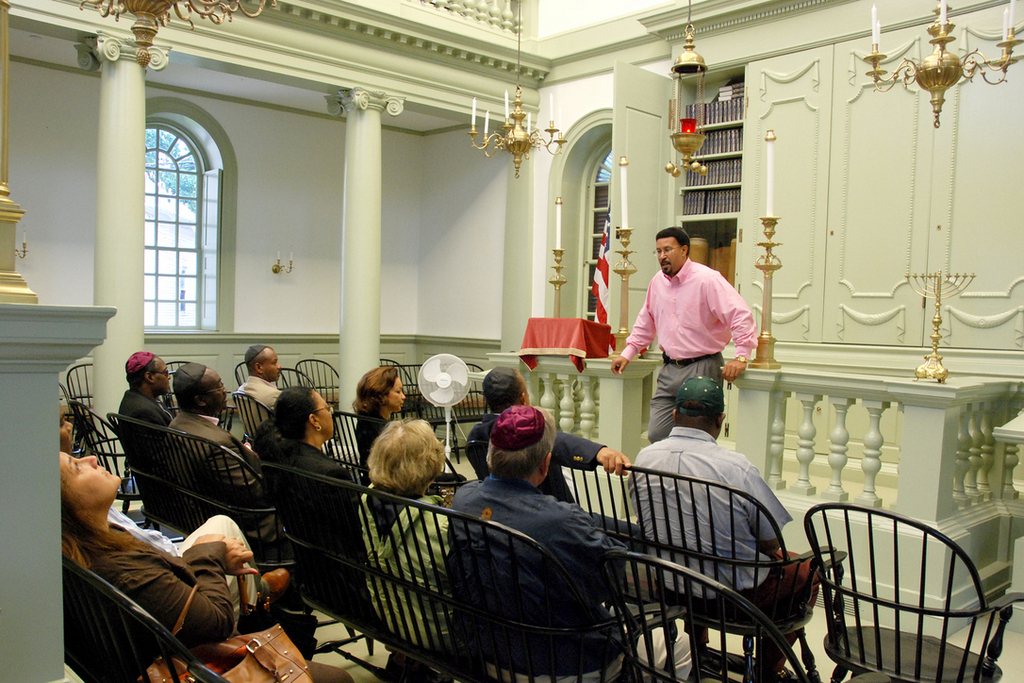
A 15-person Bahamian group visited Rhode Island from Aug. 7 to Aug. 12 as part of the U.S. National Guard State Partnership Program.
As Keith Tinker observed the layout of the historic town center in Newport, he realized it was the same as Nassau’s in the Bahamas.
The Newport Colony House is located where Parliament Square is in Nassau. And the Brick Market Place in Newport, a venue used for selling slaves in the 1600s and 1700s, is located where a similar venue, now the Pompey Museum of Slavery & Emancipation, is in Nassau.
The layouts are similar because both cities were planned by British colonists who settled in Newport in 1639 and in the Bahamas in 1647.
The layout was designed to bring people from port to commerce to government, said Keith Stokes, executive director of the Newport County Chamber of Commerce, who led a tour of historic Newport with a delegation from the Bahamas.
“What we need to do is learn from the experience of Newport,” said Tinker, director of the Bahamian Antiquities, Monuments & Museums Corporation, who was part of a 15-person group that visited Rhode Island from Aug. 7 to Aug. 12, as part of the U.S. National Guard State Partnership Program.
“The City of Nassau itself is dying because of a lack of historic preservation,” Tinker added.
Nassau has the historical assets, he said, but it hasn’t learned how to capitalize on them, so most of the city’s tourists head straight for the mammoth self-contained resorts, such as Atlantis, when they arrive.
It’s a problem because it causes much of the downtown merchants’ business to suffer. But if the Bahamas could capitalize on heritage tourism, it could draw a different kind of visitor, one more interested in the cultural aspects of the Bahamas, one who would peruse downtown and possibly shop in more stores while visiting the historical sites in the city.
The hope is that State Partnership Program might help the Bahamians come closer to meeting that economic development goal through the relationships they build with Rhode Island businesses and agencies.
This is the same program through which a nine-person delegation from Rhode Island traveled to the Bahamas in May. The State Partnership Program’s purpose is to foster an exchange of ideas between the state and partnering country across all sectors – from economic development and tourism to education to security and disaster preparedness.
One of the main differences is that members of the Rhode Island delegation, which included an architect, an engineer, a seafood exporter and vineyard owner, were looking for economic opportunities in the Bahamas, whereas the Bahamian delegation members were more focused on learning from Rhode Island’s heritage tourism success, because tourism is their No. 1 industry.
“Delegates [were] interested in learning how we have preserved and developed our cultural and historic resources to promote tourism in our state,” said Maureen Mezei, international trade director for the R.I. Economic Development Corporation and co-organizer of the delegation with Maj. Michael Manning, coordinator for the State Partnership Program for Rhode Island.
During the five-day visit, the delegation took a guided tour of Providence with Mark Brodeur, deputy director of R.I. Tourism Division of the RIEDC. They also toured Barrington, Warren and Bristol as well as historic landmarks such as the Blithewold Mansion in Bristol and The Breakers in Newport.
“You have a very unique product,” said Janet Johnson, director of product development and events strategy for the Bahamas Ministry of Tourism. “There is nothing like it anywhere else.”
But Johnson did find something missing in many of the tours, namely the history of Africans in Rhode Island. She said she had noticed that African history was “not part of the script” until she visited Newport.
Brodeur agreed. He said the delegation made him realize “we have a need to talk about our history in the Triangle Trade.” (Many a Rhode Island fortune was made in that trade; Brown University, whose own history is entangled with slavery, has recently documented that at length.)
On the other hand, Johnson was impressed by the passion in which the guides spoke about the state’s history.
“I’d like to have our guides come and see someone present with that passion,” she said.
Johnson would also like to learn more about how government has encouraged private individuals, nonprofits and foundations to preserve and maintain historic structures.
The Bahamas currently doesn’t have much help from the private sector when it comes to historic preservation, she said. The challenge is in “how you sell it … how you package it,” she added.
“We are very encouraged by what Newport has done,” she said. “We hope to tap into that expertise.”
Representatives from the Bahamas Development Bank would like to tap into some of Rhode Islanders’ knowledge as well, but their focus is more on building relationships with the state’s small business-focused agencies.
“My institution’s primary function is to provide funding for small to medium-sized enterprises,” said Dale McHardy, manager of business advisory services at the Bahamas Development Bank.
The bank formed the business advisory services department in 2004 because it recognized “it was no longer good to just lend to our clients,” McHardy said. The bank needed to provide technical training and access to expertise so that their clients’ businesses would survive, and that’s what McHardy’s department does.
The main problem for small business owners in the Bahamas is a lack of technical know-how to run their businesses, she said. Many don’t keep any records to manage cash flow.
McHardy said she would like to build relationships with agencies such as the R.I. Small Business Development Center and the Service Corps Of Retired Executives so that they could exchange ideas when problems arise.
She said the bank also might consider bringing a team of small business owners to Rhode Island to participate in seminars offered by the agencies or to be mentored by successful Rhode Island business owners in similar industries.
The possibility of Bahamian business owners finding a market for their goods and services in Rhode Island, however, would be challenging, she said, because there is not a strong manufacturing or agricultural base in the Bahamas.
Philip Simon, executive director of the Bahamas Chamber of Commerce, said overall he found the trip to Rhode Island to be an “enlightening” experience.
What he learned is that “every place has a story,” he said. “We can find the same things in our country, we just haven’t told the story in a formal manner. … We have only been independent for 35 years. It’s not too late.”