Training your employees to make them the best of the best in your industry, and being able to retain them, involves more than occasional team-building seminars or company outings.
Businesses have gotten serious about investing in their employees, and they’re encouraging them to take part in a wide range of programs and experiences to build their leadership skills and expose them to new people and new concepts.
U.S. organizations spend $109.25 billion on employee learning and development annually, with nearly three quarters ($79.75 billion) spent on the internal learning function, and the remainder ($29.5 billion) spent on external services, according to a report by The American Society for Training and Development.
Leadership programs are particularly appealing to many companies.
“Every successful organization recognizes the need to enhance their internal leadership efforts with external leadership development programs,” said Lisa Bergeron, president of Leading Women, an organization based in Charlestown that sponsors leadership development programs, executive coaching seminars and networking events for women.
“Leadership skills can be learned and superior performance sustained,” Bergeron added, “eventually driving the company’s bottom line.”
Stacey Leigh, a Rhode Island account executive for the creative and marketing talent recruitment company CM Access, attends a number of Leading Women programs each year, encouraged by her employer, which pays for her to participate.
“My incentive is the networking, learning about different companies, meeting local business women and bringing back what I’ve learned to make a difference to my company,” said Leigh.
Even better known in the state is Leadership Rhode Island, a nonprofit organization that last year celebrated a quarter-century of training emerging leaders from business, government, nonprofits and other fields through an intensive 10-month program.
“The people who come here are or want to become leaders in their sector,” said Lisa Pelosi, program director and a graduate of the 2005 class. “Our programs broaden the narrow scope of their industry.”
Leadership Rhode Island’s core program takes about 55 people each year and puts them in areas outside their comfort zones to teach new communication skills while expanding their knowledge of critical issues in the state and expanding their network of contacts.
Once a month, the group gets together for activities ranging from riding the ferry from Newport to Providence, to debating a critical issue such as health care, to spending a Saturday night in a hospital trauma center or visiting the Adult Correctional Institutions.
Elizabeth B. Eckel, senior vice president of marketing at The Washington Trust Co., participated in the program last year, and she said the experience “was invaluable both personally and professionally.”
“It provided me with an opportunity to put everything – work, family, etc. – aside for one entire day and focus on issues that affect all of us,” she said. For each month’s program, the group got reading materials ahead of time, then got to visit a place to learn more firsthand.
“We met with everyone from fishermen to inmates to elementary school students and elected officials,” Eckel said. “For health care, we visited Roger Williams Medical Center and learned about cell research; for education day we visited the Meeting Street school; for criminal justice, we did ride-alongs with the state and Providence police.”
At the end of every day, Eckel said, “we were drained,” but they were also eager to learn and discuss more, and they got together for dinner to continue their conversations.
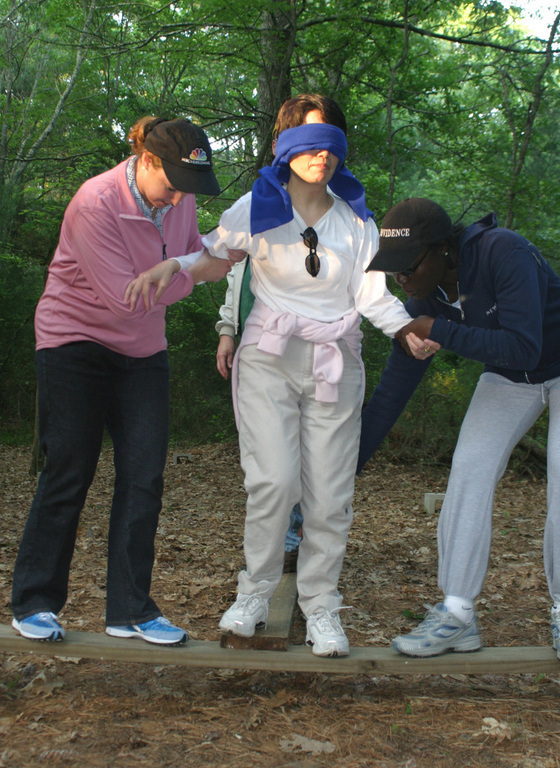
In addition, team-building exercises and other activities drove home the importance of working as a team, considering every person’s opinion and coming up with solutions “that benefit the whole,” Eckel said. For this group, all people who considered themselves leaders, one key lesson was that they weren’t all suited to take charge in every situation.
“We found that each individual has different strengths, values and skills in each unique situation,” Eckel said. When it was all over, many in the class were close friends with one another, and they were all the more involved in their communities.