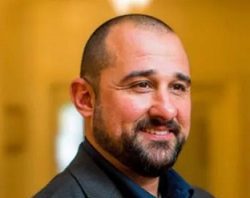
Name: Patrick McEneaney
Age: 53
Position: Regional Director, Phoenix Houses of New England. Phoenix Houses is a non-profit substance abuse services agency with 70 programs in eight states – Rhode Island, Massachusetts, Vermont, New Hampshire, New York, Texas, Florida and California. Phoenix Houses of New England – originally Marathon House – was founded in 1967.
Background: Before arriving at Phoenix Houses a year ago, McEneaney was vice president of human resources at Catholic Medical Center in Brooklyn and Queens, where he worked for 21 years.
Education: Queens College, New York (1974)
Residence: Glastonbury, Connecticut
Family: Married, four children (including five-year-old triplets)
McEneaney: ‘It’s good business to have a healthy employee.’
PBN: What is the structure of Phoenix House?
McEneaney: There is the Phoenix House Foundation, made up of different regions from California, Texas, Florida, New York — and the Rhode Island region. In this region we have facilities in Rhode Island, Massachusetts, New Hampshire and Vermont.
How many employees at Phoenix Houses of New England?
About 144 employees, 125 full time. The majority of our employees are counselors and direct caregivers
Do you get the sense business owners and leaders understand the extent of drug and alcohol problems out there? Are they getting the fact that those problems impact the bottom line?
Employers, including small business employers are recognizing in this tight job market that these problems do impact productivity. In the last five or 10 years, they have begun to recognize the cost of substance abuse. Not only the social implications, but also the economic implications, with respect to the residual impact that happens with absenteeism, workers’ compensation claims, car accidents – the things that happen behind alcohol and drug abuse.
When is it the responsibility of the employer to help a worker who has a drug or alcohol problem?
I don’t know if the word responsibility would be the driving motivation. It is just good business. Most studies have found that employers that have solid Employee Assistance Programs and health programs in place have less turnover, better employees, and in the end, a more productive workforce. Just training costs alone, to bring in somebody new, in most industries is quite an expense. The responsibility, therefore, is not really to the person who may be using drugs, but to their shareholders or their own business interests. It’s good business to have healthy employees.
You obviously deal with stigmas attached to the person with a drug or alcohol problem, perhaps that they will always have that problem – always be a problem. How many of these people are able to get back to being a productive worker?
Many of them can. But the people you mention — the ones in our mind’s eye that we feel do not meet the standard of change in their lives — are probably the same number in the universe of illness, let’s say, of diabetics who can’t control their diet or people with hypertension who cannot control smoking. Studies have shown that about the same percentage of people with other types of illnesses that are based on changing one’s behavior and lifestyle have the same amount of relapse. Studies have also shown that people who come to us and stay in a therapeutic environment for treatment – whether that is for a year or 14 months – have a high success rate. We do have an issue with stigma, because most people see the dark side of it.
Are people in positions of authority, if they have had a problem with alcohol or drugs in the past, more sympathetic towards employees going through the same kind of trouble?
We hope so. I believe there is an increased awareness of what this disease modality is like. That it strikes across economic and gender lines. As we say in the jargon of this industry, it is an equal opportunity destroyer.
It would seem with society in general, awareness is growing regarding a wide range of issues. For example, we have a staggering divorce rate. That would suggest that people are losing work hours to the legal matters that go along with a divorce. Do you get that sense?
We have changed our thinking on many, many issues Drug abuse and alcohol abuse are part of that change – in the way that we look at it from a criminal experience to an illness. A child picks up a cigarette. Twenty-five or 30 years ago, it might have been socially acceptable. Children smoking at 13, or 14 or 15 – parents tried to avoid that – but it wasn’t seen as a tremendous evil. There is a direct correlation from smoking, and then smoking marijuana, and then into using drugs on a more frequent basis. But we as a society do not deny benefits to someone who has brought about their illness or their social condition behind something like smoking. It’s only recently that we have begun to explore the connections between these addictions and one’s behavior. I think society has begun to view these addictions exactly for what they are – which are illnesses. Some of the folks that have experienced these illnesses are in the boardrooms of American companies, in high leadership positions in the state.
Are you concerned problems such as alcohol and drug abuse will be left by the wayside in terms of health insurance coverage?
The idea of fee-for-service or third party payers for what we do makes up 15 percent of our revenues. However, what we have seen is a retreat from the standard treatment of care down to just handling the medical component of it. So many insurance companies only pay the three or four days of drug detoxification. They are not paying for the long-term treatment.
I assume when a third-party-payer is paying for just three or four days of treatment – that’s scratching the surface in terms of the care that is required?
That deals with the medical problem, but it doesn’t begin to deal with the long-term problem. We have extensive outpatient programs, but the insurance companies pay a minimum. They do not like to pay
Is there any reason for optimism in terms of your relationships with insurers?
I don’t know if we are going to turn the insurance ship around. That has a dynamic of its own. But there is emerging a feeling that with drug and alcohol treatmentit makes sense to do it right the first time.
How is Phoenix House funded?
We receive 85 percent of our revenue through federal, state and local contracts.
What do you mean, specifically, when you mention state contracts?
Primarily, a state agency will sign a contract with us to provide adult care or adolescent care. We also have contracts with some of the corrections departments, probationthey will provide us with referrals.
Do you have a lot of competition out there for these contracts?
There is competition. We compete against the for-profits. But we sincerely feel that it is in our soul, to reclaim lives. It is not to return a profit to shareholders, which is admirable if that is what you want to do.
You describe alcohol or drug abuse as a disease of relapse. That must fuel frustration. What drives you, personally?
Knowing that it is a disease of relapse. And that we do have a shot at solving someone’s problems. What I tell my family and what I find most rewarding about this job is that I can look a parent or spouse in the eye and know fully that while they are with us – that child is not going to die of an overdose. Many of our parents get their first night’s sleep after a child has come in with us. I can’t promise that a child or an adult is not going to use againwe don’t have that kind of crystal ball. But while they are here, they are going to be safe. We have two cardinal rules — no drugs or alcohol, and no physical violence. If that is six, seven or eight months – that’s six, seven or eight months of an entire family getting a respite from the ravages of disease. That’s the most rewarding component of the job. There are success stories – many success stories. I’ll tell you just one. We had a woman with an eight-year-old child who came to us from a homeless shelter in Boston. The last time I spoke to her, she was in the graduate law program on taxation at New York University. She came through our program. She graduated from Northeastern Law School and is now in a graduate program. If that isn’t sufficient reward, I don’t know what is. We have a graduate’s corner every board meeting. We bring in people who have succeeded. You would marvel at them.
What is it about alcohol and drugs that is so powerful?
We believe – science believes – that there is a physiological effect that takes place once a person begins to use drugs. The longer they use drugs, the more that impact occurs.
With the science and technology that is available with CAT scans and MRIs, we see how these drugs work on the brain. Once people begin using, it affects every brain. Not all the same, but that often measures the degree of addiction.
What can the business community do to help?
We cannot win this battle; we cannot do what we do without help from the larger community. Businesses can help us, and help themselves. We’re on the front line of helping the families of Rhode Island. They make up the workforce. If we can have that husband and wife sleep better at night because their child is safe then it helps the employers of the state as well. Secondly, there is a correlation between treatment and the return on that investment. As businesspeople looking at the ROI – a dollar invested in a program similar to that at Phoenix House of New England – has a $7.50 return on that investment. That comes from federal studies, state of California studies. That’s solid business.