
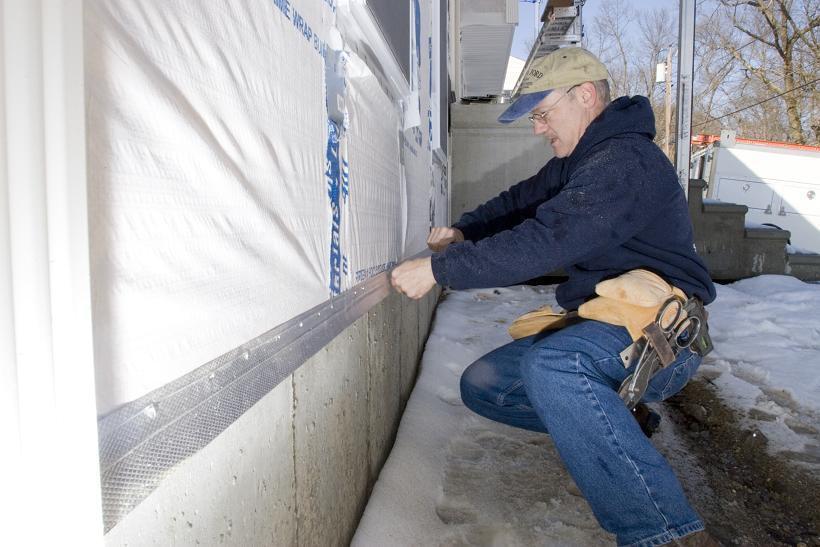
Richard Dumont was in the process of building two houses and one home addition in November 2003 when he received notification of his deployment to Iraq.
That gave him three months to find contractors who could finish the addition while he was away. He had to put the other two building projects on hold.
Dumont owns and operates R.N.D. Builders, a small construction company based in Seekonk. And he is the sole employee of the operation, which he started in 1997, though he sometimes hires contractors on a part-time basis.
Dumont joined the R.I. Army National Guard in 2000 because he wanted a change of pace. His two brothers were also in the Guard, which encouraged him.
He said the biggest obstacle to owning a small business and being an activated guardsman is time. Had Dumont had four to five months to prepare for his one-year tour in Baghdad, his business would have suffered less.
And being gone for a year suspended that income for his family, he said. “If my wife didn’t work, I probably would have lost the house.”
Dumont depended on his network of contacts in the construction industry to help replenish the business when he came back in 2005. Having two brothers who are also contractors, and friends who saved work for him kept the business from going under.
Though there are resources for those having financial difficulty due to deployment, Dumont said, he didn’t take advantage because he couldn’t see the use in getting a loan when he didn’t have the money to pay it back.
But there are loans for reservists that don’t require large monthly payments.
That’s why the Rhode Island office of the U.S. Small Business Administration is trying to provide more outreach to veterans, reservists and guardsmen who have served in Iraq, said Norm Deragon, local spokesman and veterans business development officer for the agency. “Often if the person gets deployed, the business gets deployed,” Deragon said. “The issue becomes … when they get back … in most cases they have to start from scratch.”
The SBA’s loan program that can assist them is called the Military Reservist Economic Injury Disaster Loan. It is a 4-percent interest loan for up to $1.5 million that comes directly from the SBA, not from a lender, like typical SBA loans. And it can be paid back over as much as 30 years, which lowers the monthly payments, Deragon said.
“The SBA determines what the economic injury is,” he said. “It is designed so they don’t go out of business.”
One of the greatest challenges when business owners come back is marketing, Deragon said. That’s why he encourages veterans, reservists and guardsmen to seek business counseling from the SBA.
Writing letters is sometimes the most effective way to keep customers informed of what’s happening, he said. And it can ensure customer loyalty for when the servicemen and servicewomen come back.
Writing letters is what helped save Equiptech LLC from losing its customers, said Shelley Branconnier, who runs the small construction equipment maintenance company with her husband, Brad, in Charlestown.
The couple started the company a year before Brad Branconnier, who is also in the Air National Guard, was deployed to Uzbekistan from late 2004 to the end of 2005.
Shelley Branconnier said she sent letters out to all the customers letting them know he was being deployed. She sent letters out again when she knew he was coming back.
“We found when he came back my phone started ringing within two days of mailing the letters,” she said. “We have a lot of loyal, very patriotic customers. … Only a few people didn’t come back to us.”
But that doesn’t mean they couldn’t lose more customers if he is sent on a second tour, which is still a possibility. And that would be a significant hardship.
For the year Brad was gone, Shelley Branconnier had to get a job as a house cleaner so that she could pay the bills. The business had to stop because he is the one who would travel to construction sites to fix equipment for customers when it broke down.
Branconnier said she knows there are some resources at the military base at Quonset Point, but she figured her family would have to be in dire straits, about to lose their house, in order to qualify.
That’s not necessarily true.
There is a program called the Reserve Income Replacement Program that offers financial relief to reservists and guardsmen who are involuntarily serving on active duty, said Donna Callahan, executive director of the Employer Support of the Guard and Reserve in Rhode Island. It distributes monthly payments of up to $3,000 to those whose monthly military compensation is less then their average earned income before going on active duty.
And Rhode Island has two funds – the Rhode Island Soldiers and Sailors Relief Fund and the Rhode Island Military Relief Fund – that offer grants (a maximum of $2,500) to those who have experienced unexpected emergencies and financial crisis due to the war.
Surprisingly, the war hasn’t stopped some reservists from going into business, despite the inherent risk of being called to duty.
“We’re seeing more now with the Iraq war, they’re coming in, some are looking to start businesses,” Deragon said. “One thing I’ve found is when you take a 21- to 22-year-old and send them to war for one year, it’s a maturing experience. Many don’t want to work for someone else when they come back.”
Though they are no longer in their 20s, Kathy and John Sullivan and Reed Foster – all of whom serve with the Air National Guard – also felt the need to go into business, but for a different reason than the maturing effects of war.
John Sullivan and Foster had been airline pilots when the Sept. 11, 2001, terror attacks occurred, and – knowing how those events could affect their lives as pilots – afterward they started looking for business opportunities.
They decided to buy an existing self-storage company in Westerly last year, knowing at least two of them would be deployed within a few months. It actually ended up that Kathy Sullivan and Foster were deployed less than a week after the closing date.
They would not have been able to purchase the company, which they renamed AV8 Self Storage, had it not been for the past owner offering to run the business while they were gone, Foster said.
“He knew what we did,” he said. “He totally supported us in buying the business … he bent over backwards.”
So did staff at Westerly Credit Union, which helped finance the purchase, Foster said. “Support from the community has been paramount to our success.”